Flow Meters › Brewery Flow Meter
Brewery Flow Meter
A flow meter for brewing measures the liquid and gas streams a brewery runs on. That means brewing water into the mash, hot wort to the fermenter, finished beer between tanks, CIP fluid, and the CO2 and steam behind it all. This page maps each stream to a metering technology and puts numbers on the choices. It covers commercial brewhouses; homebrew fill counters are a different product class.
Two neighboring topics have their own pages. Metering beer itself, from brewhouse transfer down to taproom dispense, is covered in the beer flow meter guide. The wider food-and-beverage selection logic, including 3-A construction and CIP temperature ratings, lives on the sanitary flow meter page.
What this page adds is the brewery math the catalogs skip. It covers the water-to-beer ratio, the volume a hot wort meter over-reports, and the flow a CIP return line must reach. It also covers what a meter must do before its total can feed an excise record.
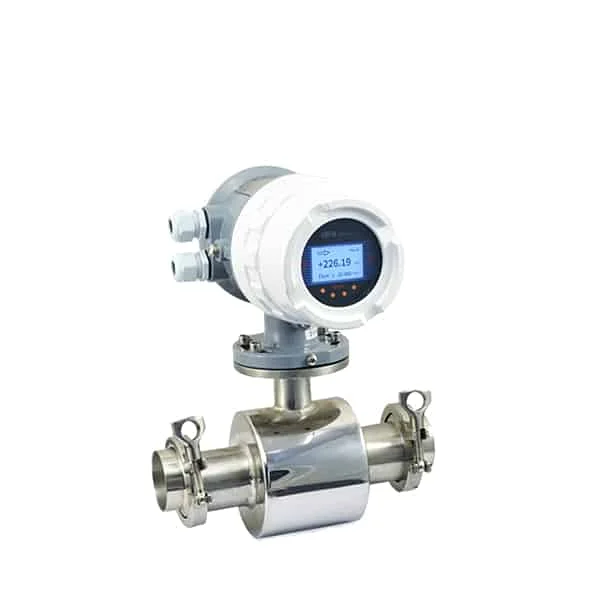 Sanitary Magnetic Flow Meter
Tri-clamp PFA-lined meter for water, wort, and beer; no moving parts and no obstruction, so CIP passes straight through.
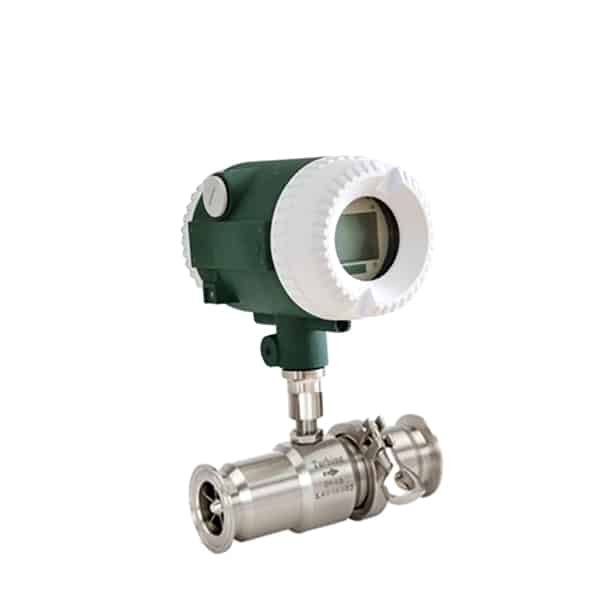 Sanitary Turbine Flow Meter
316L tri-clamp turbine for clean liquids at 0.2 percent of full scale; pulse output for batch totals.
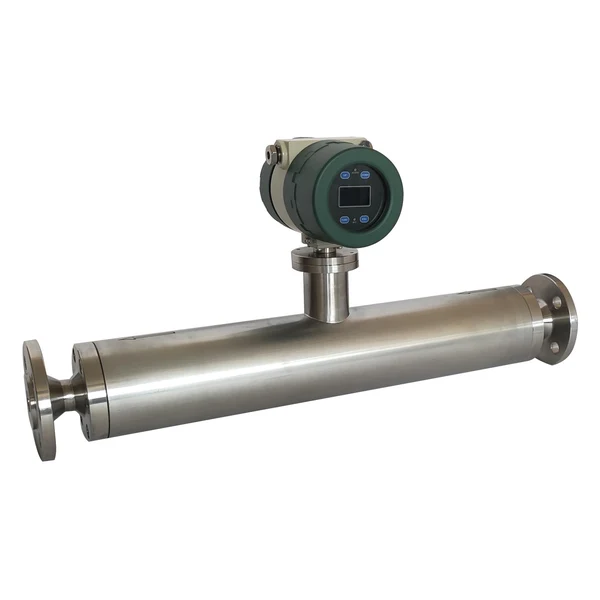 Straight Tube Coriolis Meter
Self-draining single tube reads mass and density together, which is how gravity and blend ratios get metered.
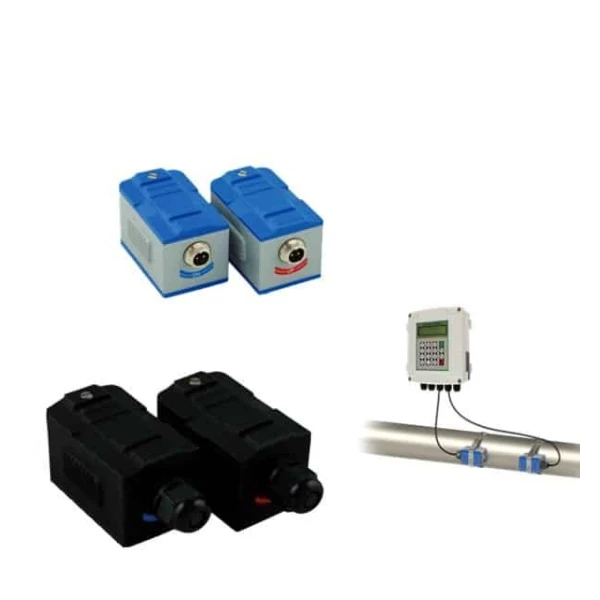 Clamp-On Ultrasonic Meter
Strap-on transducers audit a water or glycol line from outside the pipe, with nothing entering the product zone.
Metering by stream
A brewery is not one metering problem but five. Each stream has its own temperature, its own hygiene rules, and its own reason for being measured, so the right brewery flow meter changes from line to line. The table is the short version; the sections below carry the numbers.
| Stream | Conditions | First choice | Watch for |
|---|---|---|---|
| Brewing water | Cold and hot liquor, to about 80 C | Magnetic or turbine | RO-treated liquor can drop below a magnetic meter’s conductivity floor |
| Hot wort | Near 100 C at knockout, sugars and trub | Magnetic, high-temperature build | Hot volume reads about 4 percent above cold volume |
| Beer transfers | 2 to 20 C, often carbonated | Magnetic or Coriolis | CO2 breakout registers as beer unless the line stays under counter-pressure |
| CIP supply and return | Caustic, acid, and rinse to 85 C | Magnetic, chemical-resistant liner | Return flow must prove the cleaning velocity, not just that liquid moved |
| Gas and utilities | CO2, O2, steam, glycol, compressed air | Thermal mass, vortex, ultrasonic | Gas totals need mass or standard volume, not raw actual volume |
For a batch total the meter usually feeds a pulse counter or PLC input rather than being read by eye; the totalizer guide covers that pairing. A sanitary rotameter fills the gaps where a local sight reading is all a line needs.
Brewing water
Water is the stream most breweries meter last and should meter first. Industry surveys put the average consumption near seven barrels of water for every barrel of beer packaged. Efficient plants run well under that average, and small brewpubs commonly sit above ten.
Survey data on the drain side shows a mean around 2.6 barrels of wastewater per barrel of beer. Wastewater is often billed at a multiple of the supply rate.
That ratio only becomes manageable when it is measured. Four meter positions cover it: city water in, hot and cold liquor to the brewhouse, CIP makeup, and effluent out. The incoming and effluent meters are plain water instruments; the liquor meters should be sanitary builds because their lines get cleaned in place.
One trap sits in the water treatment room. Municipal supply typically conducts a few hundred microsiemens per centimeter and any magnetic meter reads it. RO permeate, though, can fall below 20 µS/cm, near or below the floor of many sensors. Meter the treated liquor with a turbine or ultrasonic instrument, or meter upstream of the RO membranes, rather than discovering the problem as a stalled reading on brew day.
Hot wort metering
The knockout line from whirlpool to fermenter is the most consequential metering point in the brewhouse, because the wort total is what brewhouse yield is judged on. It is also the point where temperature rewrites the number: liquid metered near boiling occupies about 4 percent more volume than the same liquid at 20 C. Water shrinks from 958 to 998 kg/m³ between 100 and 20 C, and a 12 Plato wort behaves closely enough for planning.
Meter 30 barrels ahead of the heat exchanger and about 28.8 barrels arrive in the fermenter, before any trub loss. That 1.2-barrel gap is eight times the error of a 0.5 percent meter. Decide once, in writing, whether brewhouse volumes are stated hot or cold, and correct between them with the 4 percent figure. Metering after the heat exchanger, on cooled wort, removes the correction entirely and is the cleaner arrangement when the piping allows it.
On the technology side, a magnetic meter is indifferent to wort density and sugar content, which is why it dominates this line. A turbine calibrated on water will shift on wort, which is denser and more viscous. If a turbine must sit there, have it calibrated on a sugar solution that matches the gravity. Between whirlpool and cooler the wort also carries trub, another argument for a bore with nothing in the flow path.
Beer transfer and blending
Cold-side transfers are modest flows: moving 10 barrels from fermenter to brite tank in 40 minutes is about 29 L/min, or 1.8 m³/h. Size the meter for that number, not for the pipe. Keep the line velocity near 1 m/s or better so the meter works in the strong part of its range.
Carbonated beer must stay under counter-pressure through the meter. Once CO2 breaks out of solution, the bubbles are metered as beer, and the mechanics of that error are covered in the foamy liquids guide.
Blending is the clearest case for a second meter. A brewery cutting an 18 Plato high-gravity brew to a 12 Plato package strength adds roughly half a barrel of deaerated liquor per barrel of strong beer. The two streams have to hold that ratio while both flows move. Two meters feeding a ratio controller do this repeatably; the tighter the ABV tolerance on the label, the tighter the repeatability the pair must hold.
A straight tube Coriolis meter is the strongest fit for blending, because it reports density alongside flow. The blend can be controlled to the measured gravity itself rather than to a calculated ratio. The same density reading flags a water-beer interface during pigging or changeover, which is beer that would otherwise go to drain.
Meters and tax records
In the United States, federal excise on beer is determined from the brewery’s own records of barrels removed, kept under 27 CFR Part 25. Many breweries base those records on a meter at racking or packaging.
A meter in that role is no longer a convenience instrument. Its total stands behind a tax figure, so it needs a documented calibration and a proving routine, not just a nameplate accuracy. Other markets run the same way under their own excise rules, with the measurement obligation falling on the brewer.
Proving does not require a lab. Run a known quantity into a calibrated vessel or across a weigh scale, three runs, and compare the meter total.
Log the as-found error each time and correct the meter when the record shows drift. The routine is in the flow meter calibration guide. The habit costs an hour a month and keeps the record ready when an audit asks for it.
CIP verification
Cleaning in place works by chemistry, temperature, time, and velocity together, and flow is the one of the four that a pump curve does not prove. The working rule for the return line is a velocity of at least 1.5 m/s, about 5 ft/s, so that the solution scrubs the full circumference of the tube. A flow meter on the CIP circuit turns that rule into a checkable number for each circuit size:
| Tube size | Bore | Flow at 1.5 m/s | In GPM |
|---|---|---|---|
| 1.5 in | 34.8 mm | 5.1 m³/h | 23 |
| 2 in | 47.5 mm | 9.6 m³/h | 42 |
| 2.5 in | 60.2 mm | 15.4 m³/h | 68 |
| 3 in | 72.9 mm | 22.5 m³/h | 99 |
If the return meter shows a 2-inch circuit cleaning at 30 GPM, that circuit is being rinsed, not cleaned, whatever the chemical strength. The CIP meter needs a liner and electrodes rated for hot caustic and acid. It pairs naturally with a conductivity sensor that tells the controller which phase, caustic, acid, or rinse, is in the line.
Application example
Food-plant CIP line, Vietnam. A DN50 magnetic flow meter was supplied for a CIP cleaning circuit, built with a PTFE liner and tantalum electrodes to stand up to the cleaning chemistry. It was delivered together with a conductivity instrument for phase detection. The combination went into service and led to repeat orders from the same plant.
Gas and utility lines
The gas side of a brewery is metered in mass or standard volume, never in raw actual volume, because pressure and temperature move the numbers. CO2 for carbonation and purging is the costly one. A thermal mass flow meter reads it directly in kg/h and shows within a week which tanks and fillers consume the CO2 budget. Wort aeration runs the other direction, small flows of air or oxygen ahead of the fermenter, and sits with the metering covered on the industrial oxygen flow meter page.
Steam to the kettle is the brewhouse energy bill; the steam flow meter page covers metering it with temperature and pressure compensation. Glycol to fermenter jackets can be balanced with a clamp-on ultrasonic meter without cutting the loop, and the glycol correction math lives in the chilled water BTU guide. Compressed air for packaging lines is its own subject, covered on the compressed air flow meter page.
FAQ
What type of flow meter should I use?
In a brewery, match the meter to the stream. Conductive liquids in hygienic lines, meaning water, wort, beer, and CIP solution, are best served by a sanitary magnetic flow meter. Clean cold liquids at a fixed rate suit a lower-cost sanitary turbine. When density or blend ratio matters, or the total feeds excise records, a Coriolis meter reads mass and gravity together; for checking a line without opening it, use a clamp-on ultrasonic meter.
What are the two most common types of flowmeters?
Across brewing, the two default technologies are the sanitary magnetic flow meter and the sanitary turbine flow meter. The magnetic meter has an open bore with no moving parts, ignores density and viscosity changes, and cleans in place, so it handles wort and beer as easily as water. The turbine costs less and totals clean liquids well. Its rotor sits in the flow and its calibration shifts with the liquid, so it stays on water and utility lines in most plants.
How much water do breweries use?
Industry surveys put the average near seven barrels of water per barrel of beer packaged, with efficient plants well under that average and small brewpubs often above ten. Around 2.6 barrels per barrel typically leaves as wastewater. The ratio is only controllable once incoming water, brewhouse liquor, CIP makeup, and effluent are each metered. That is why water meters are usually the first instruments a sustainability program installs.
What is the flow rate of beer?
On the process side it is set by tank size and transfer time. Moving 10 barrels from fermenter to brite tank in 40 minutes is about 29 L/min, or roughly 8 GPM, and larger cellars scale from there. Meters are sized to that working flow rather than to the pipe diameter. Dispense-side rates at the tap are a different, much smaller number, covered in the beer flow meter guide.
Request a quote
Tell us the stream, the line size, the temperature at the meter, and whether the total serves process control, blending, or an excise record. We size the meter, specify the sanitary connections and liner, and configure the outputs for your controller.