Home › Level Instruments › Magnetostrictive Level Transmitter SI-100
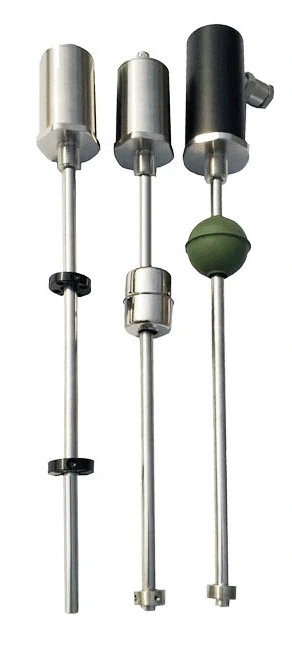
Magnetostrictive Level Transmitter SI-100
A rigid-probe level transmitter that measures by timing a torsional pulse on a waveguide, so it reads to a fraction of a millimetre and never drifts with coating, foam, or a changing dielectric. Built for tanks where you need real precision, not an estimate.
- Range: 0.2 to 6 m rigid (to 23 m flexible)
- Accuracy: ±0.1 mm or 0.05% FS
- Output: 4–20 mA + HART, Modbus RTU, or 0–10 V
- Process temp: -40 to +125 °C (+200 °C extended)
- Protection: IP67
- Connection: PN16/PN40 flange or 1 in NPT
Most level technologies trade accuracy for robustness. A float is rugged but coarse; ultrasonic and radar are non-contact but lose the echo on foam or a low dielectric. The SI-100 takes a different route. It times a mechanical pulse travelling on a wire, so the reading is set by the speed of that pulse, which does not change with temperature, dielectric, or a coated surface. That is how one magnetostrictive level transmitter delivers a sub-millimetre reading on the same tank where other methods only estimate.
Overview
The SI-100 is a rigid-probe magnetostrictive level transmitter. A stainless stem carries the waveguide; a donut float rides the stem and marks the surface. It reads from 0.2 to 6 m on the rigid stem, or up to 23 m with the flexible-cable variant, and holds an accuracy of 0.1 mm or 0.05% of full scale, whichever is greater. The output is 4–20 mA with HART, RS-485 Modbus RTU, or 0–10 V, so it drops into an analog loop or a digital bus. It runs from -40 to +125 °C as standard, or to +200 °C with a temperature extension, and carries IP67. A hazardous-area version with an Ex ia intrinsically-safe rating is available, with the exact marking set per nameplate.
Working principle
The transmitter head fires a low-current interrogation pulse down a tensioned waveguide wire inside the stem. The donut float carries a permanent magnet; where the electrical pulse meets the float’s magnetic field, the wire twists slightly, and that twist is a torsional pulse. The torsional pulse travels back up the waveguide at about 2,830 m/s, and the head clocks the round-trip time. The level is simply half the travel time times the wave speed, and a 1 GHz timer resolves that to 0.01 mm. Because the pulse is mechanical and the trigger is magnetic, there is no capacitance plate to coat, no ultrasonic beam to scatter on foam, and no microwave dielectric to fight: dirty liquids, vapors, and dielectric changes do not move the reading.
Technical specifications
Representative specifications; confirm the exact build per datasheet.
| Parameter | Specification |
|---|---|
| Measuring range | 0.2 to 6 m rigid stem; up to 23 m flexible cable |
| Accuracy | ±0.1 mm or 0.05% FS, whichever is greater |
| Resolution | 0.01 mm (1 GHz timer) |
| Output | 4–20 mA + HART; RS-485 Modbus RTU; or 0–10 V |
| Process temperature | -40 to +125 °C standard; +200 °C with extension |
| Process connection | PN16/PN40 flange or 1 in NPT |
| Wetted material | Stainless steel probe and float |
| Protection | IP67 |
| Hazardous area | Ex ia intrinsically-safe option (marking per nameplate) |
Rigid vs flexible probe
The SI-100 comes as a rigid stem or a flexible cable, and the choice follows the tank, not just the depth. Pick by headroom and span:
| Probe | Span | Use it when |
|---|---|---|
| Rigid stem | 0.2 to 6 m | Most tanks; the stem holds the float straight for the best accuracy |
| Flexible cable | Up to 23 m | Deep tanks, or where headroom will not take a long rigid stem |
For tanks under 6 m the rigid stem is the default; it keeps the float on axis and gives the full sub-millimetre accuracy. If you only need a continuous reading without contact, compare the ultrasonic level transmitter; for pressurised tanks measured from the bottom, see the hydrostatic level transmitter.
Applications
The SI-100 suits tanks where accuracy and immunity to fouling both matter:
- Custody and inventory tanks needing fine, repeatable level
- Fuel, oil, and solvent storage with coating or vapor
- Pressurised and sealed vessels (with the flange build)
- Foaming or agitated tanks that defeat ultrasonic and radar
Magnetostrictive resolution also suits the short level span of a transformer conservator; see the transformer oil level indicator guide for that application.
FAQ
What is a magnetostrictive level transmitter?
It is a continuous level transmitter that measures by timing a torsional pulse on a waveguide. The SI-100 fires an interrogation pulse down a tensioned wire inside a rigid stem; a donut float carrying a magnet rides the stem at the surface, and where the pulse meets the float the wire twists and sends a pulse back. The travel time gives the level to a fraction of a millimetre.
How do magnetostrictive sensors work?
An electrical pulse on the waveguide interacts with the float magnet to create a torsional (mechanical) pulse that travels back at about 2,830 m/s. The head times the round trip, and a 1 GHz timer resolves it to 0.01 mm. Because the pulse is mechanical and the trigger is magnetic, coating, foam, vapor, and dielectric changes do not move the reading, which is why the SI-100 holds ±0.1 mm.
How does a magnetic level transmitter work?
In the magnetostrictive type, a float with a permanent magnet sits at the liquid surface and the transmitter locates that magnet by the torsional pulse it triggers on the waveguide, then converts its position to a 4–20 mA level signal. (A bypass-chamber magnetic level gauge is a different device; the SI-100 is the magnetostrictive transmitter.)
What is magnetostrictive?
Magnetostriction is the property by which a ferromagnetic material changes shape, twisting or stretching slightly, in a magnetic field. The SI-100 uses it to generate a precise return pulse on its waveguide, and timing that pulse is what gives the 0.1 mm accuracy.
Related products
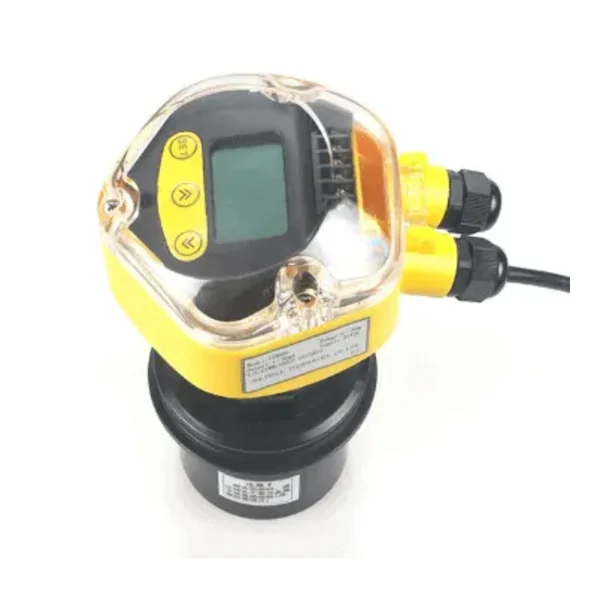 Ultrasonic Level Transmitter
Non-contact level by time-of-flight, for open or vented tanks.
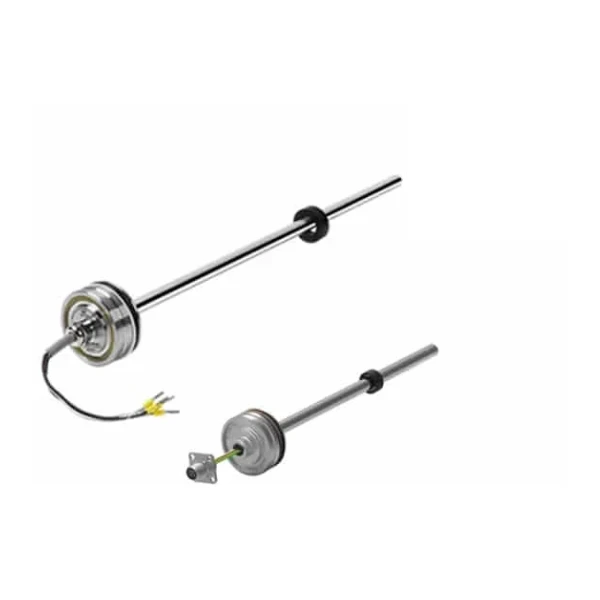 Hydraulic Cylinder Position Sensor
Magnetostrictive in-cylinder linear position sensor: absolute piston stroke, 350/700 bar, analog / SSI / CANopen.
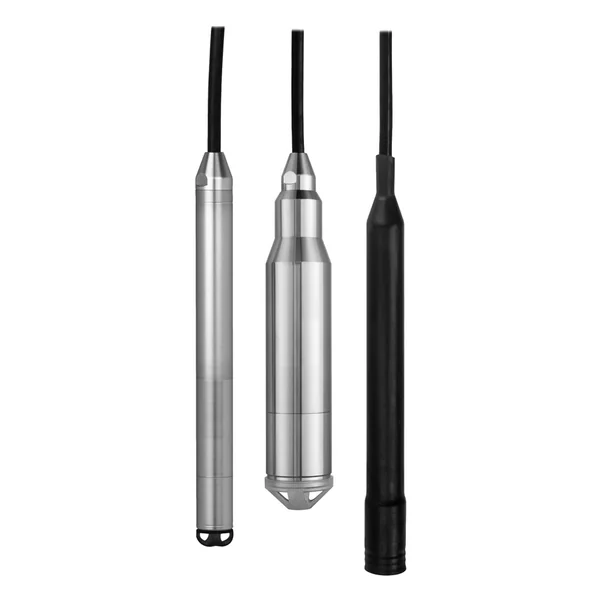 Hydrostatic Level Transmitter
Level from pressure at the bottom, for deep or pressurised tanks.
All Level InstrumentsCompare radar, ultrasonic, hydrostatic, and float methods.
Browse all level instruments →
Request a quote
Tell us five things and we configure the probe for your tank:
- Span and whether a rigid stem or flexible cable fits the headroom
- Medium, its temperature, and any vapor or coating
- Output (4–20 mA / HART, Modbus, or 0–10 V)
- Connection (flange size and rating, or NPT)
- Area (standard or intrinsically-safe)
Ordering example: SI-100, rigid stem 2.5 m, 4–20 mA + HART, PN16 flange, -40 to +125 °C, standard area.
Tell us the application and we configure one unit, not a shelf part. Have a tank we have not covered? Reach our application engineers.