Flow Meters › Thermal Mass Flow Meters › Thermal Mass Flow Meter
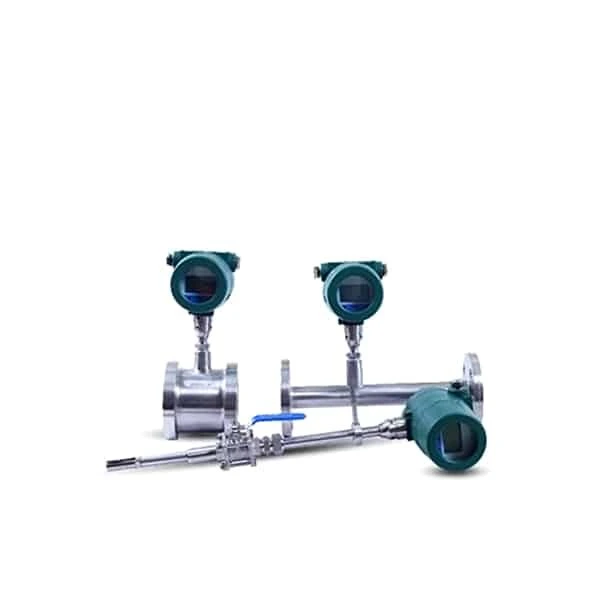
Thermal Mass Flow Meter
A thermal mass flow meter measures the mass flow of gas directly, from the heat a warmed sensor loses to the passing gas. Because it reads mass, not volume, it needs no separate temperature or pressure compensation, which makes it the simple, low-cost choice for compressed air, natural gas, and other gases.
- Principle: Thermal dispersion, direct gas mass flow
- No compensation: Reads mass; no T or P correction needed
- Form: Inline DN10 to DN80, insertion DN80 to DN4000
- Velocity: 0.1 to 100 Nm/s, wide turndown
- Accuracy: +/-1.5% to 2.5%
- Output: 4-20 mA, pulse, RS485, HART
Overview
A thermal mass flow meter, also called a calorimetric flow meter, measures gas flow from the way heat moves into the gas stream. A small sensor in the flow is warmed above the gas temperature; as gas passes, it carries heat away, and the faster the mass of gas moving past, the more heat it removes. The meter reads that heat loss and converts it directly to gas mass flow.
The key point is that it measures mass, not volume. A turbine, vortex, or orifice meter reads volume at line conditions and then needs temperature and pressure to work out the mass or the standard volume; a thermal mass meter skips that step and reports mass flow or standard volume on its own. It has no moving parts, a very wide turndown that reaches down to creeping flow, and it comes as an inline body for small pipe or an insertion probe for ducts up to DN4000. That combination makes it the standard meter for compressed air, natural gas, biogas, flare gas, and combustion or flue gas.
Features
Everything here follows from one idea: read gas mass directly from heat loss, instead of reading volume and correcting it.
Direct mass, no compensation
It reads gas mass flow directly, so there is no separate temperature and pressure compensation to buy, wire, or maintain.
Very wide turndown
It reads from about 0.1 Nm/s up to 100 Nm/s, so it catches creeping flow and even gas leaks that other meters miss.
No moving parts
Nothing spins or wears, the pressure loss is negligible, and the insertion probe installs through a single tap.
Inline or insertion
An inline body suits DN10 to DN80; an insertion probe reaches DN80 to DN4000, for ducts and large gas mains.
Standard outputs and alarms
4-20 mA, pulse, RS485 Modbus, and HART, plus one or two alarm relays for high or low flow.
Wide gas range
Air, natural gas, coal gas, LPG, flare gas, hydrogen, CO2, nitrogen, and flue gas; most gases except acetylene.
Working principle
A thermal mass flow meter uses two elements in the gas: one measures the gas temperature, and one is heated a fixed amount above it. As gas flows past the heated element, it carries heat away. The mass of gas moving past sets how much heat is lost, so the power needed to hold the temperature difference, or the size of that difference, is a direct measure of mass flow. Gas density is already built into that heat transfer, which is why the meter reads mass without a separate pressure or temperature correction.
Because the reading comes from heat transfer rather than from a spinning rotor or a pressure drop, the meter has no moving parts, almost no pressure loss, and a very wide range. It does need a clean, dry gas at the sensor, since droplets or heavy dust change the heat transfer, so a filter and a drain are fitted where the gas is wet or dirty.
Technical specifications
| Parameter | Specification |
|---|---|
| Measurement principle | Thermal dispersion (calorimetric); heat carried from a warmed sensor is proportional to gas mass flow |
| Measured medium | Most gases except acetylene: air, natural gas, coal gas, LPG, flare gas, hydrogen, CO2, nitrogen, flue gas |
| Form and size | Inline DN10 to DN80; insertion DN80 to DN4000 |
| Velocity range | 0.1 to 100 Nm/s, wide turndown |
| Accuracy | +/-1.5% of reading for the pipeline (inline) type, +/-2.5% for the insertion type |
| Process temperature | Sensor -40 C to 220 C; transmitter -20 C to 45 C |
| Working pressure | Up to 1.6 MPa (higher on request) |
| Compensation | None needed; gas mass flow is read directly |
| Output | 4-20 mA (opto-isolated, max load 500 ohm), pulse, RS485, HART; 1 to 2 alarm relays |
| Response time | About 1 second |
| Power supply | Compact: 24 VDC or 220 VAC, up to 18 W; remote: 220 VAC, up to 19 W |
| Moving parts | None; negligible pressure loss |
| Wetted material | Stainless steel sensor and probe |
Calibration is gas-specific, so the meter is set for your gas. Send the gas, the line or duct size, the flow range, and the pressure and temperature and we size it.
Flow ranges by size
The pipeline (inline) body covers DN10 to DN300; the insertion probe carries the same measurement to DN4000. Flow ranges are in standard cubic metres per hour (Nm3/h):
| DN | Flow range (Nm3/h) | DN | Flow range (Nm3/h) |
|---|---|---|---|
| DN10 | 0.3-30 | DN80 | 18-1800 |
| DN15 | 0.6-60 | DN100 | 28-2800 |
| DN20 | 1.1-110 | DN125 | 44-4400 |
| DN25 | 1.8-180 | DN150 | 64-6400 |
| DN32 | 2.9-290 | DN200 | 130-13000 |
| DN40 | 4.5-450 | DN250 | 170-17000 |
| DN50 | 7-700 | DN300 | 254-25400 |
| DN65 | 12-1200 | to DN4000 | insertion type |
Pick the size so the normal flow sits in the upper part of the range. Consult us for sizes or ranges not listed.
Inline or insertion
The same measurement comes in two bodies, chosen by pipe size. An inline meter carries the sensor in its own flanged spool for small pipe, where it is easy to mount and gives a settled flow. An insertion meter puts the sensor on a probe that reaches into the pipe through one tap, which is the economical way to meter large mains and rectangular ducts, and it can be fitted on a live line.
| Form | Best for |
|---|---|
| Inline (flanged) | DN10 to DN80; small pipe, easy mounting, a settled flow profile |
| Insertion (probe) | DN80 to DN4000; large mains and ducts, single-tap and live install |
Applications
The thermal mass meter fits clean-gas mass measurement, especially where the gas is at low pressure or in a large duct:
- Compressed air metering, sub-metering, and leak detection
- Natural gas, coal gas, LPG, and flare or torch gas
- Combustion air and aeration air in water treatment
- Flue gas and stack emissions monitoring
- Hydrogen, nitrogen, CO2, and other process gases
Challenge: An industrial customer in South Asia needed compressed air flow on a line where the velocity was too low and variable for the vortex meter first considered.
Solution: A thermal mass flow meter on a DN65 line, which reads gas mass directly across a wide range and holds accuracy at the low velocities where a vortex meter drops out.
Result: The thermal meter covered the full air range without temperature or pressure compensation, and gave a direct mass total for the plant air audit.
Related products
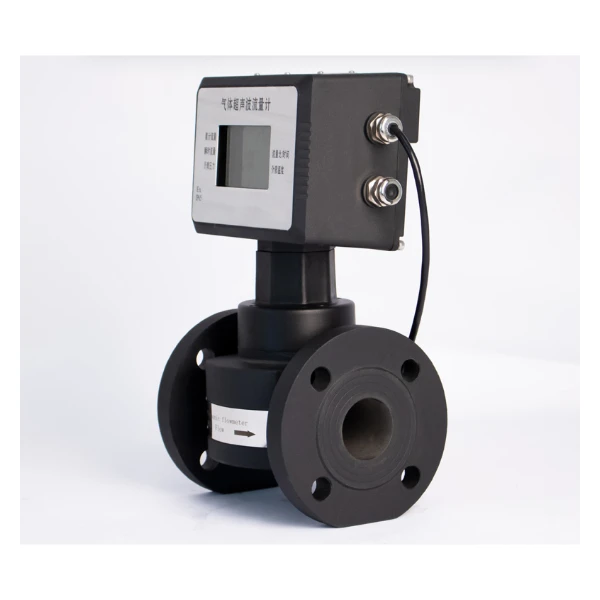 Ultrasonic Gas Flow Meter
A no-loss gas meter for larger lines and custody, with no T or P sensor in the bore.
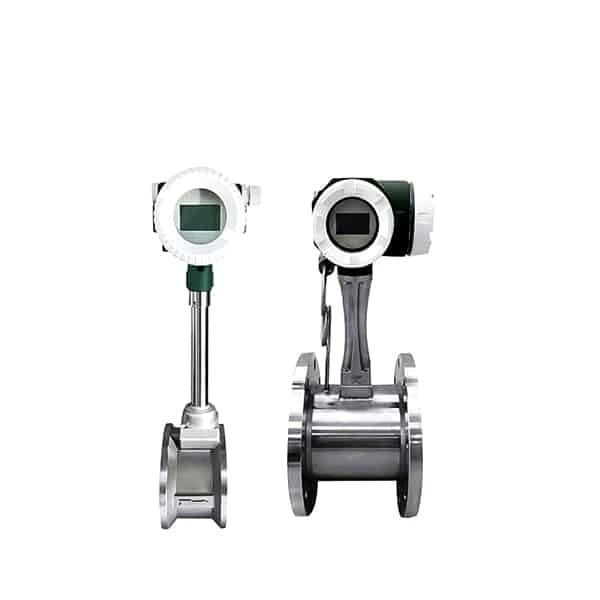 Vortex Flow Meter
A rugged meter for steam and higher-velocity gas, with temperature and pressure options.
Related applications: Natural gas.
Ammonia vapor is a common service for thermal meters, with its own rules on condensate and materials; see the ammonia flow meter guide.
For shielding-gas manifolds in particular, the argon flow meter page carries the header arithmetic and leak baseline method.
Where the gas composition changes from shift to shift, as it does on coke oven gas headers, read our guide to coke oven gas flow measurement before specifying a thermal mass meter.
On LNG terminals, thermal meters read boil-off and vapor return lines; where they fit in the wider metering scheme is mapped on the LNG flow meter page.
A worked no production baseline test using this meter is set out in our compressed air leak detection guide.
FAQ
What is a thermal mass flow meter?
A thermal mass flow meter, or calorimetric flow meter, measures the mass flow of gas from the heat a warmed sensor loses to the passing gas. Because it reads mass directly, it does not need a separate temperature and pressure measurement, and it has no moving parts.
How does a thermal mass flow meter work?
It uses two sensors in the gas: one reads gas temperature, and one is heated above it. Flowing gas carries heat away from the heated sensor, and the amount of heat removed depends on the mass of gas passing. The meter turns that heat loss into a direct mass flow reading.
Why does a thermal mass flow meter not need temperature and pressure compensation?
Heat transfer from the sensor already depends on the gas density, which is set by temperature and pressure. So the measurement reflects mass directly, and there is no need to measure pressure and temperature separately and correct a volume reading, as a turbine or vortex meter would.
What gases can a thermal mass flow meter measure?
Most clean, dry gases: air, natural gas, coal gas, LPG, flare gas, hydrogen, nitrogen, CO2, and flue gas. The meter is calibrated for the specific gas. Acetylene is the usual exception, and wet or dusty gas needs a filter and a drain ahead of the sensor.
What is the difference between a thermal mass flow meter and a vortex meter?
A vortex meter reads volume at line conditions and needs temperature and pressure to give mass or standard volume, and it needs a minimum velocity to work. A thermal mass meter reads mass directly, has a much wider low-flow range, and loses almost no pressure, but it needs clean, dry gas and is calibrated per gas.
Request a quote
Send us the gas, the line or duct size, the flow range, and the pressure and temperature, and we size the thermal mass flow meter and calibrate it for your gas.