Home › Temperature instruments › Thermowell
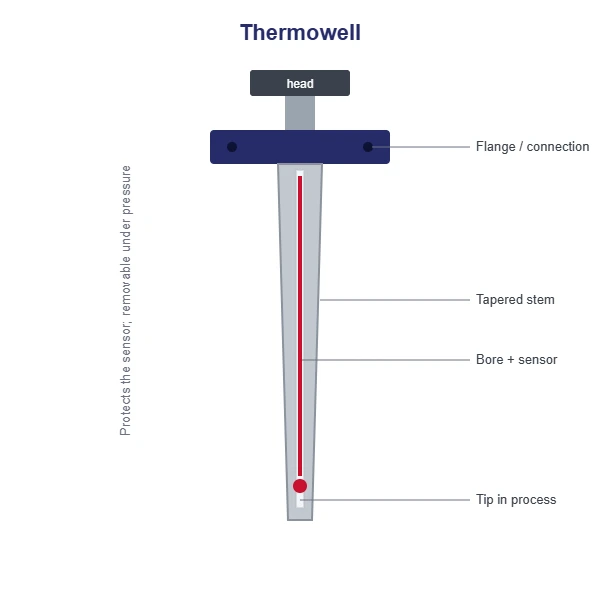
Thermowell
A pressure-tight barrier that holds a temperature sensor in the process. It lets you pull an RTD or thermocouple for calibration or replacement without draining or shutting the line, and it shields the sensor from pressure, velocity, and corrosion. On flowing lines it must be sized for wake frequency to ASME PTC 19.3.
- Connection: threaded, socket-weld, weld-in, or flanged
- Stem: straight, tapered, or stepped
- Bore: 6 or 6.5 mm for standard RTD/TC stems
- Material: 316/316L SS, Inconel, Hastelloy
- Design: wake-frequency calc per ASME PTC 19.3
- Insertion length: made to order
Overview
A thermowell is a closed-end tube that mounts into the process and receives the temperature sensor in its bore. The sensor reads through the wall, never touching the medium. That separation does three jobs: it lets you remove or replace the sensor while the line stays pressurized and running, it protects the sensor from corrosion, abrasion, and high velocity, and it contains the process if the sensor is withdrawn.
The catch is mechanical. A well sitting in a flowing fluid sheds vortices that shake it; on fast lines that shaking can fatigue and snap the well, sending the broken tip downstream. So a thermowell is not just a tube: its length, diameters, and stem style are sized for the flow with the wake-frequency calculation in ASME PTC 19.3. Tell us the fluid, velocity, temperature, and pressure and we run that calc with the build.
Features
Sensor protection
Shields the RTD or thermocouple from pressure, velocity, and corrosion.
Hot-swap the sensor
Remove or replace the element with the line still pressurized and running.
Wake-frequency rated
Sized to ASME PTC 19.3 so flow vibration cannot fatigue the well.
Any connection
Threaded, socket-weld, weld-in, or flanged to match the line.
Material to suit
316/316L stainless, Inconel, or Hastelloy for the medium and temperature.
Made to insertion depth
Stem length, lagging extension, and bore built to your point.
Connection types
The process connection sets the pressure rating and how the well is installed and removed.
| Type | Mounting | Use when |
|---|---|---|
| Threaded | Screws into a threaded boss or coupling | Low to medium pressure; quick, replaceable |
| Socket weld | Welded through a weld collar | Higher pressure; no thread leak path |
| Weld-in | Welded directly to the pipe or nozzle | Highest integrity; permanent install |
| Flanged | Bolted flange to a mating flange | High pressure, large bores, easy removal |
| Van Stone | Loose lap-joint flange over a flared collar | Saves flange material; easy bolt alignment |
Stem styles
The stem profile trades strength against response speed. ASME PTC 19.3 covers straight, tapered, and step-shank designs.
- Tapered: outside diameter narrows toward the tip. The best balance of strength and fast response, and the usual first choice on flowing lines.
- Straight: uniform diameter. Simple and economical; strong, but slower to respond than a taper.
- Stepped: a reduced tip section. The fastest response, but the step lowers vibration resistance, so use it on lower-velocity service.
Wake frequency and ASME PTC 19.3
When fluid flows past the well, it sheds vortices alternately from each side (the von Karman street). Each shed vortex gives the well a sideways kick at the shedding frequency, which rises with velocity. If that frequency approaches the well’s own natural frequency, the well resonates, and the bending stress can fatigue and break it within hours, dropping the tip into the line.
ASME PTC 19.3 TW-2016 is the calculation that prevents this. From the insertion length, root and tip diameters, bore, material, and the fluid’s velocity, density, temperature, and pressure, it checks the frequency ratio and the steady and dynamic stresses, and tells you whether the well is safe or must be shortened, thickened, or supported. A shorter or tapered well raises the natural frequency away from resonance. This is why insertion length is never guessed: send the flow data and we run the calc.
Materials
| Material | Use for |
|---|---|
| 316 / 316L stainless | General process, water, steam, mild chemical |
| Inconel 600 / 625 | High temperature and chloride or oxidizing service |
| Hastelloy C276 | Strong acids and aggressive chemicals |
| Carbon steel | Non-corrosive, economical service |
Bar stock is preferred over tube for pressure-bearing wells. Coatings (PTFE, ceramic) are available for severe corrosion.
Technical specifications
| Parameter | Specification |
|---|---|
| Design standard | ASME PTC 19.3 TW-2016 (wake-frequency) |
| Connection | Threaded, socket-weld, weld-in, flanged, or Van Stone |
| Stem style | Straight, tapered, or stepped |
| Bore | 6 mm or 6.5 mm for standard RTD/TC; others on request |
| Material | 316/316L SS, Inconel, Hastelloy, or carbon steel |
| Insertion length (U) | Made to order to reach the pipe center, with lagging extension as needed |
| Process rating | Per material and connection; suits high-pressure, high-temperature lines |
Models and ordering
A thermowell is configured to the point, then verified by the wake-frequency calc. Send these and we build and certify it.
Quote checklist, send these points: process connection (and size or flange rating); stem style and material; bore (sensor stem diameter); insertion length and any lagging extension; and the fluid, flow velocity, temperature, and pressure for the ASME PTC 19.3 check.
Ordering example: Flanged thermowell, 1-1/2 in 300# RF, tapered stem, 316L, 6 mm bore, U = 250 mm, T = 80 mm lagging, sized for 30 m/s superheated steam.
Applications
A thermowell goes on any point where the sensor must be protected or removable, especially under pressure, heat, or flow. Common uses:
- Power and steam: superheater, feedwater, and high-velocity steam lines
- Oil, gas, and petrochemical: reactors, heaters, and product lines with a removable sensor
- Chemical: corrosive media where the well takes the attack, not the sensor
- Water and HVAC: pipe-mounted RTD and bimetal points that need isolation
- Food and pharma: sanitary wells for clean-in-place vessels and lines
Application example
Power plant, superheated steam line (about 500 °C, 67 bar). A temperature point on a high-velocity steam header is exactly where a bare or under-sized well fails: the flow shakes it and fatigue cracks the root. The fix was a tapered 316 well with the insertion length set by the ASME PTC 19.3 wake-frequency calc for the line’s velocity, so the natural frequency stays clear of vortex shedding. The value is integrity: the sensor reads the steam, can be pulled online, and the well does not become debris in the turbine.
Related products
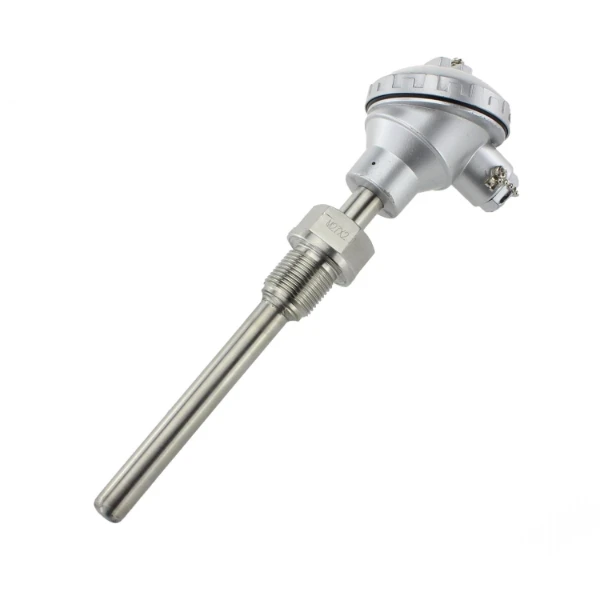 RTD Temperature Sensor (Pt100)
The accurate element that sits in the well below 600 °C.
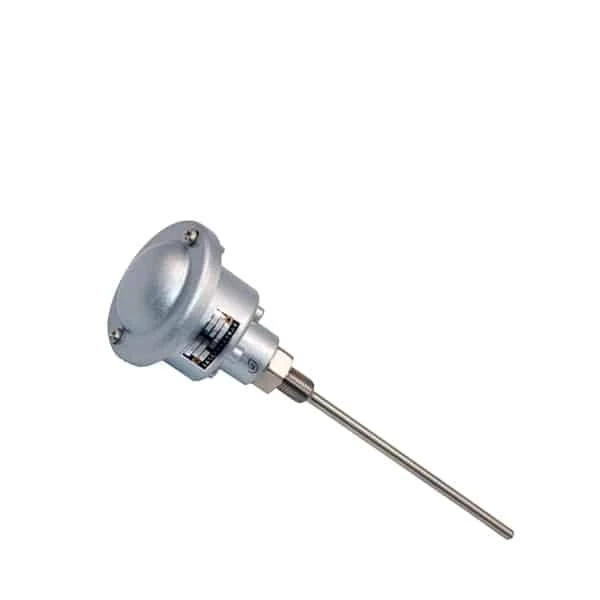 Thermocouple
The high-heat element for furnace and steam wells.
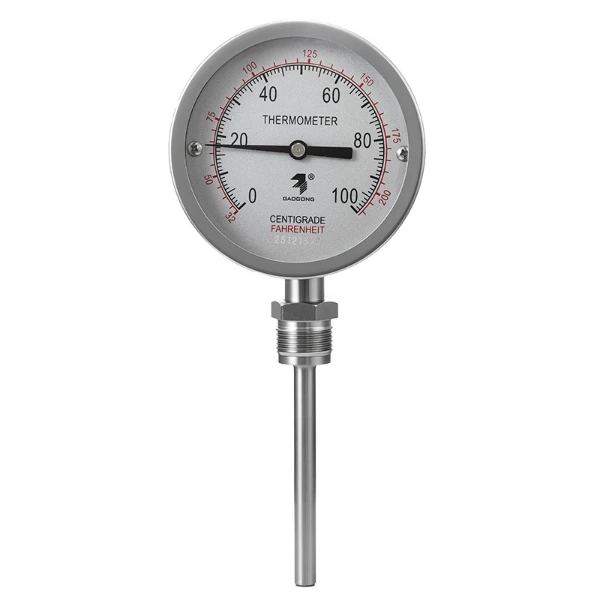 Bimetal Thermometer
The local dial gauge that mounts in the well.
Browse all temperature instruments →
Platinum thermocouples are usually protected by a ceramic tube rather than a metal well. The reasoning behind that is set out in our Type S, R and B thermocouple guide.
FAQ
What is a thermowell?
A thermowell is a closed-end tube that mounts into a pipe or vessel and holds a temperature sensor in its bore. The sensor reads through the wall without touching the medium, so it is protected and can be removed while the process stays pressurized.
What is the purpose of a thermowell?
It does three things: lets you remove or replace the sensor without shutting the line, protects the sensor from pressure, velocity, and corrosion, and keeps the process contained if the sensor is withdrawn. It also slows the response slightly, which is the trade for that protection.
What is the difference between a threaded and a flanged thermowell?
A threaded well screws into a boss and suits lower and medium pressure with quick removal; a flanged well bolts to a mating flange and suits high pressure, large bores, and aggressive service. Socket-weld and weld-in styles sit between them for higher-integrity welded joints.
What is the wake-frequency calculation?
Flow past the well sheds vortices that vibrate it. The ASME PTC 19.3 wake-frequency calculation checks the well’s length, diameters, and material against the fluid velocity so the vibration cannot resonate and break it. It is why insertion length is engineered, not guessed.
Request a quote
Send the connection, stem style, material, bore, and insertion length, plus the fluid, velocity, temperature, and pressure, and our application engineers will build the thermowell and run the ASME PTC 19.3 check, with the matching RTD or thermocouple if needed.