Flow Meters › Coriolis Flow Meters › Straight Tube Coriolis Flow Meter
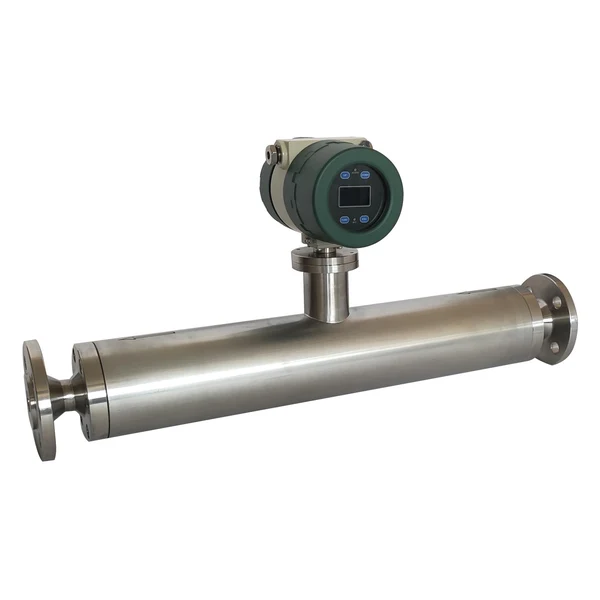
Straight Tube Coriolis Flow Meter
A straight tube Coriolis flow meter measures mass and density from the Coriolis force on a single, straight vibrating tube. The straight bore drains fully, leaves no residue, and gives a low pressure drop, so it suits clean-in-place sanitary lines and sticky, abrasive, or self-solidifying media. One instrument reads mass flow, density, and temperature, holds 0.1% to 0.5% accuracy, and needs no straight pipe run.
- Principle: Coriolis, vibrating tube; direct mass and density
- Size: DN3 to DN200
- Accuracy: 0.1% to 0.5% of rate; density ±0.002 g/cm³
- Output: 4-20 mA, pulse, RS-485 Modbus; HART option
- Rating: IP67; Ex d [ia] IIC T6 Gb
Overview
A straight tube Coriolis flow meter measures mass flow and density from the Coriolis force on a single, straight vibrating tube. Unlike a bent or U-tube meter, the straight bore drains completely, leaves no residue, and gives a low pressure drop, so it suits clean-in-place sanitary lines and sticky, abrasive, or self-solidifying media that would clog or coat a folded tube.
One instrument reads mass flow, density, and temperature directly, holds 0.1% to 0.5% accuracy, and needs no straight pipe run. Builds cover standard, high-pressure, high-temperature to 300 C, low-temperature to -200 C for liquid nitrogen and oxygen, and thermally insulated service. For the highest sensitivity at very low flows, a bent-tube Coriolis mass flow meter is the better choice.
Features
Most of what sets this meter apart comes from the shape of its tube: one straight bore, with no bend for the fluid to coat or settle in.
Drains fully, low pressure drop
The straight bore empties completely after a clean-in-place cycle and passes the flow with a low pressure drop.
0.1% to 0.5% of rate
Accuracy classes 0.1, 0.15, 0.2 and 0.5 cover a measurable flow ratio of 10:1 to 20:1.
Mass, density, temperature
Mass flow, working density to ±0.002 g/cm³ and medium temperature all come from the one straight tube.
Slurry and sticky media
Cement and lime slurry, and sticky or self-solidifying fluids, pass a bore that a folded tube would clog or coat.
No straight run needed
The meter mounts without upstream or downstream straight pipe, and nothing moves inside the line.
−200 °C to 300 °C builds
Cryogenic builds reach −200 °C for liquid nitrogen and oxygen. Jacketed builds carry asphalt and hot oil to 300 °C.
Working principle
The sensor is a single straight measuring tube. A drive coil vibrates it at its natural frequency, and a detector near each end tracks the motion. With no flow, the two detectors see the tube move in step.
Flowing fluid resists that sideways motion, and the reaction is the Coriolis force. It pushes the inlet and outlet halves in opposite directions, so their motion falls out of step. The phase, or time, difference between the detectors is proportional to mass flow, while the natural frequency of the tube shifts with fluid density.
Because the bore is straight, the tube that measures is also the tube that drains: there is no bend for solids to settle in or for a cleaning cycle to miss.
Technical specifications
| Parameter | Specification |
|---|---|
| Measurement principle | Coriolis, vibrating tube; direct mass flow, density, temperature |
| Sensor structure | Single straight measuring tube; self-draining, low residue, low pressure loss |
| Size | DN3 to DN200 |
| Accuracy (mass, liquid) | 0.1%, 0.15%, 0.2%, or 0.5% of rate |
| Turndown | 10:1 or 20:1 |
| Density measurement | 0.3 to 3.000 g/cm³, accuracy ±0.002 g/cm³ |
| Temperature measurement | -200 to 350 C, accuracy ±1 C |
| Medium temperature | -200 C to +300 C across low-temperature, standard, and high-temperature builds |
| Ambient temperature | -40 to 60 C (LED), -20 to 60 C (LCD) |
| Working pressure | 0.6 to 4.0 MPa standard; high-pressure build for tens of MPa |
| Wetted material | Measuring tube 316L; housing 304 |
| Connection | Flange, sanitary tri-clamp, or threaded (DIN, ANSI, JIS, GB, HG) |
| Outputs | 4-20 mA (load ≥750 ohm) and 0 to 10 kHz pulse; pulse 0.05%, current 0.2% |
| Communication | RS-485 Modbus; HART option |
| Display | Two-row LED or three-row LCD; mass, volume, density, temperature, totalizer |
| Power | 220 VAC or 24 VDC |
| Mounting | Integral or split (2 m signal cable) |
| Protection | IP67 |
| Explosion protection | Ex d [ia] IIC T6 Gb |
Flow ranges by size
Each size carries two figures. The standard range is the one the sensor is calibrated to at the factory and meant to run in; the upper limit is the most it carries while staying stable. Size toward the middle third of the standard range for the best accuracy and the lowest pressure loss.
| Size | Standard flow (kg/h) | Upper limit (kg/h) |
|---|---|---|
| DN3 | 96 | 144 |
| DN6 | 540 | 810 |
| DN8 | 960 | 1440 |
| DN10 | 1500 | 2250 |
| DN15 | 3000 | 4500 |
| DN20 | 6000 | 9000 |
| DN25 | 9600 | 14400 |
| DN32 | 18000 | 27000 |
| DN40 | 30000 | 45000 |
| DN50 | 48000 | 72000 |
| DN80 | 120000 | 180000 |
| DN100 | 192000 | 300000 |
| DN150 | 360000 | on request |
Versions
The straight tube sensor is built to the service:
- Standard: general liquids, slurries, and gases from -50 C to 200 C.
- High-pressure: for tens of MPa, such as oil-field drilling and cement-slurry lines.
- High-temperature: hot oil and asphalt to 300 C.
- Low-temperature: cryogenic service to -200 C for liquid nitrogen and liquid oxygen.
- Thermal insulation: a jacketed shell that keeps asphalt and other solidifying media flowing.
Applications
The straight tube design fits demanding mass-metering duties:
- High-viscosity liquids: asphalt, heavy oil, and grease
- Slurries and suspensions: cement slurry and lime slurry
- Clean-in-place sanitary lines in food, beverage, and pharmaceutical plants
- Custody transfer and batching of petroleum and chemical products
- Compressed and high-pressure gas, such as CNG and natural gas
- Cryogenic liquids: liquid nitrogen and liquid oxygen
- Concentration from density, such as lime-slurry concentration
Application example
Challenge: An asphalt terminal needed mass metering on a hot, sticky line where a bent-tube meter coated and held residue between batches.
Solution: A thermally insulated straight tube Coriolis meter was fitted; the straight bore drained fully between transfers and the jacket kept the asphalt above its pour point.
Result: Batches were metered by mass without coating or drift, and cleaning between grades dropped sharply.
Related products
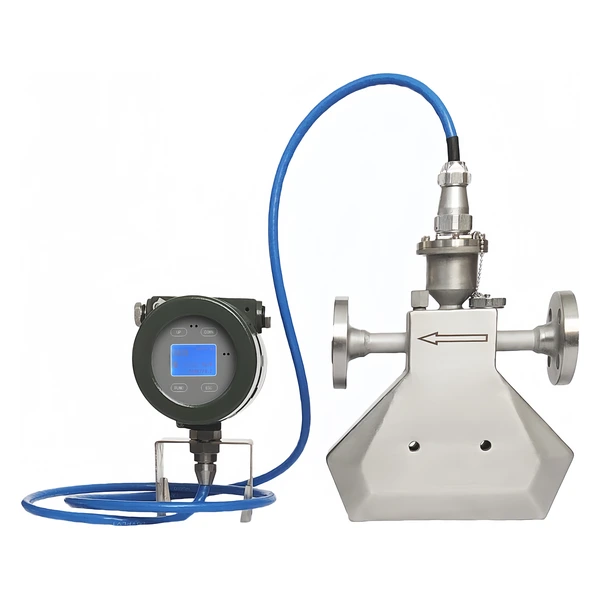 Coriolis Mass Flow Meter
Bent U-tube build for the highest sensitivity at very low flows.
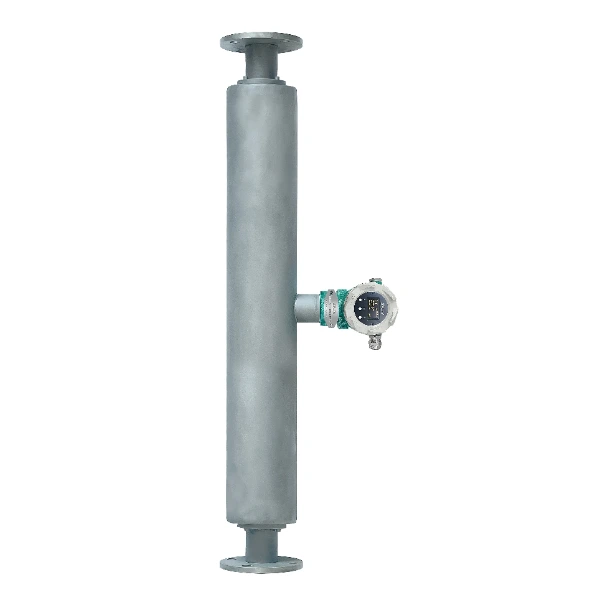 Coriolis Density Meter
The same vibrating tube, for density measurement.
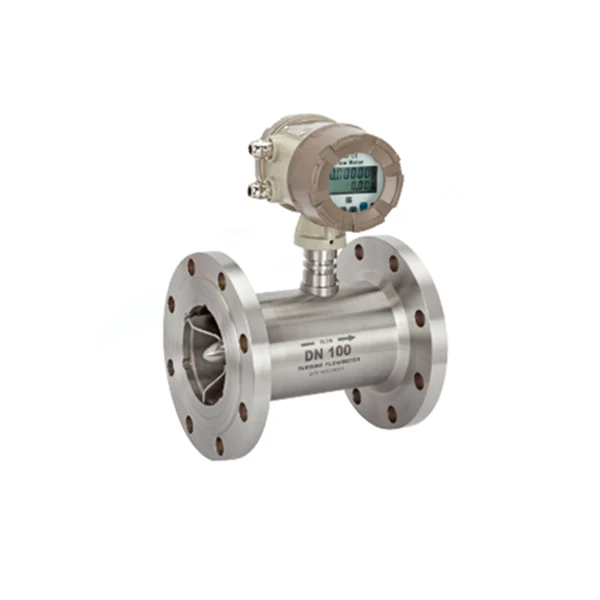 Turbine Flow Meter
Volumetric measurement for clean, low-viscosity liquids.Browse all Coriolis flow meters →
Related applications: Sanitary, Slurry.
FAQ
What is a straight tube Coriolis flow meter?
It is a Coriolis mass flow meter built around a single, straight vibrating tube instead of a bent or U-shaped tube. It measures mass flow and density directly, and the straight bore drains fully and cleans easily.
Straight tube or bent tube Coriolis?
Choose a straight tube for sanitary CIP lines, slurries, sticky or self-solidifying media, and where a low pressure drop and full drainage matter. Choose a bent (U-tube) Coriolis for the highest sensitivity at very low flows and the lowest cost on clean liquids.
How accurate is a straight tube Coriolis flow meter?
Mass accuracy is 0.1% to 0.5% of rate depending on the build, with density to about 0.002 g/cm3. A straight tube trades a little low-flow sensitivity for self-draining, low-residue operation.
Can it handle slurry, CIP, and high temperature?
Yes. The straight bore passes cement and lime slurry, drains for clean-in-place service, and high-temperature and thermally insulated builds carry hot oil and asphalt to 300 C. Cryogenic builds reach -200 C.
Request a quote
Tell us the fluid, and whether it carries solids or sets as it cools, plus the flow range, line size, temperature and pressure. We size the sensor, set the converter outputs and choose the build: standard, high-pressure, high-temperature, cryogenic or jacketed.