By Wu Peng, Senior Process Instrumentation Engineer · Last reviewed August 28, 2026
A beer flow meter is really two different products wearing one name. In the brewery it is a sanitary process instrument that batches brewing water, totals wort transfers and proves CIP flow, working in gallons per minute. In a bar it is a small digital sensor on each beer line that counts every pour in ounces, so the till and the keg can be compared. The specifications, prices and failure modes of the two have almost nothing in common.
This guide covers both. It maps the metering points from brewhouse to tap and puts real accuracy and price numbers against each technology. It also explains why beer suits a magnetic flow meter, and works through the dispensing arithmetic that keg monitoring systems are sold on. The DIY pulse sensors used on homebrew rigs share the keyword and get one paragraph where they belong.
Contents
- Two different jobs
- Brewery metering points
- Choosing the technology
- Conductivity numbers
- Draft and keg monitoring
- Foam at the meter
- FAQ
Two different jobs
The process job comes first. A brewery moves batches: strike water into the mash, sparge water, wort to the fermenter, bright beer to the packaging line, and cleaning solution through all of it. The brewery flow meter for these points is a pipeline instrument with tri-clamp fittings and a flow range from a few to a few hundred gallons per minute. Its output feeds a totalizer or batch controller.
The dispensing job is different in every dimension. A draft system pours about two ounces per second, the value at stake is counted in pints, and the meter is a compact sensor that must resolve a single short pour. Its output goes to monitoring software rather than to a control loop. Mixing up the two jobs is the fastest way to buy the wrong instrument, so the rest of this guide treats them separately.
Brewery metering points
Brewing water is the easiest point and the lowest-cost meter. Strike and sparge volumes need repeatability more than absolute accuracy, so a simple single-jet or turbine flow meter for brewing water delivers batch-to-batch consistency for well under two hundred dollars. One published vendor note is worth repeating here. A small jet meter rated near 1.5 percent can be off by 5 percent at trickle flows, so size the meter to run in its midrange.
Wort is where turbine meters get into trouble. Practitioner forums repeat the same field report: hop fragments and trub jam a turbine rotor quickly, so a strainer ahead of the meter is mandatory. A sanitary magnetic flow meter avoids the problem entirely, because it has no moving parts in the stream, and hygienic-instrument manufacturers list wort alongside beer and CIP media as standard magmeter service.
Bright beer and transfers reward a step up in instrument class. A hygienic magmeter totals the transfer. A Coriolis meter adds a live density reading, which inline instruments convert to extract in degrees Plato, so the volume and the strength of the transfer arrive from one instrument. A straight tube Coriolis drains itself and holds little residue between batches.
CIP verification is a metering point breweries inherit from the wider beverage industry: proving that cleaning solution flowed at the design rate through each circuit. The same sanitary magmeter class serves here, and the meter recovers part of its cost in water and chemical records.
Gases round out the plant. Carbonation stones are fed through a CO2 rotameter and needle valve, with the resulting carbonation level verified by measurement rather than assumed from the flow setting. Wort aeration targets 8 to 12 ppm of dissolved oxygen before pitching, and because air saturates near 8 ppm, the upper half of that range needs metered pure oxygen.
Choosing the technology
The table below puts documented numbers against each class. Prices are street prices from published US distributor listings, rounded; they give context, not a quote.
| Meter class | Typical accuracy | Best beer service | Price band |
|---|---|---|---|
| Jet / utility water meter | 1.5 to 2% in midrange; worse at low flow | Brewing water only, never beer-wetted | $65 to $200 |
| Tri-clamp turbine | 0.75 to 1.5% of reading; repeatability near 0.3% | Clean liquids: water, filtered beer; strainer before wort | $880 to $1,950 |
| Hygienic magnetic | About 0.3% of reading | Wort, beer, CIP; no moving parts, CIP-rated to 130 C class | $4,800 to $6,200 |
| Coriolis | 0.1 to 0.2% of mass, plus density | Bright beer transfers with inline Plato, high-value batching | Above the magmeter band |
| Pour sensor / batch box | A few percent cumulative; repeatability is the point | Keg line monitoring; homebrew water batching | $30 to $350 per line |
Two selection details hide behind the table. The first is temperature. A standard tri-clamp turbine is rated to about 54 °C, and hot-side service to 85 °C takes an inexpensive riser kit. Remote-mounting the display extends that to about 121 °C, while hygienic magmeters take CIP heat with no accessories at all.
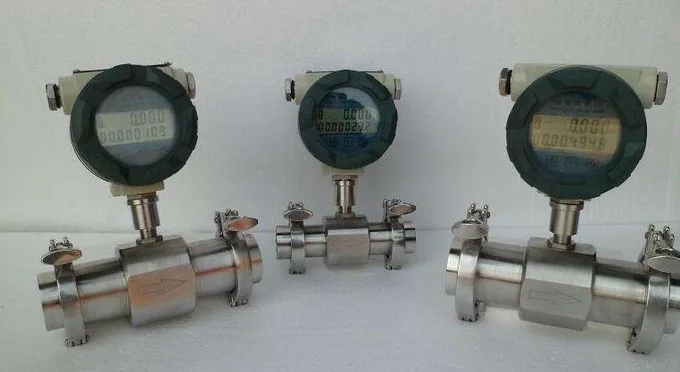
The second is the sanitary fine print. Tri-clamp fittings alone do not make an instrument food-grade: the best-selling brew turbines are industrial 316 stainless steel meters with tri-clamp ends, and at least one is labeled not food grade on its own listing. For brew water, hot-side liquor and CIP supply that is acceptable.
For bright beer and filling, specify a hygienic design with crevice-free wetted parts. That class is covered on our sanitary flow meter page, including variable-area options for simple sight-plus-signal points.
Conductivity numbers
A magnetic flow meter needs a conductive liquid, and beer meets that requirement by a wide margin. A magmeter’s working floor sits near 5 µS/cm. Published fermentation measurements put wort and beer in the low millisiemens range: one instrumented fermentation started at 5.11 mS/cm and finished near 3.42 mS/cm. That is hundreds of times above the floor, which is why the magmeter is the default process meter across breweries.
The one caveat lives on the utility side. Reverse-osmosis or deaerated brewing liquor can be far purer than beer, so on stripped-water lines check the actual conductivity against the meter’s floor before assuming the default applies. The general conductivity rules are in our magnetic flow meter page.
Draft and keg monitoring
The dispensing side runs on one number: a balanced draft system pours about 2 fluid ounces per second, the rate the Brewers Association draught quality guidance is built around. That is a gallon in 64 seconds, or roughly 0.94 gpm, or 3.55 L/min. A line that pours much slower has a restriction or an undersized applied pressure; one that pours much faster arrives as foam. A pour-rate trend from a line sensor therefore doubles as a draft-system health check.
The keg arithmetic explains the monitoring pitch. A US half barrel holds 15.5 gallons, which is 1,984 ounces, or 124 sixteen-ounce pints at theoretical yield. At six dollars a pint, one keg represents about $744 across the bar. Monitoring vendors quote draft shrinkage figures of 15 to 25 percent from untracked pours, overpours and giveaways, which on those numbers is roughly $110 to $185 per keg.
Two corrections keep that pitch in proportion. Some loss is physical and unavoidable: foam at keg changes and line cleaning mean a well-run system yields about 95 percent, not 100.
And published pricing for commercial systems runs on the order of $1,000 installed plus a monthly fee per venue. That cost has to be recovered from the gap between your actual yield and the 95 percent ceiling, not from the headline shrinkage number. Metering tells you the size of the gap; only management closes it.
The homebrew and DIY corner of this keyword uses small hall-effect pulse sensors on the water or beer line, with published cumulative errors near 1.25 percent over a batch, and consumer batch-fill boxes that close a valve at a set volume. They serve their scale and price well, and none of them is a sanitary process instrument.
Foam at the meter
Every beer meter eventually reads foam, because beer carries dissolved CO2 that breaks out wherever pressure falls. On the process side that means metering cold, under back pressure, and before pressure-dropping valves rather than after them. On the dispense side it means a pour sensor counts foam volume as beer volume. The end of a keg, a warm line or an unbalanced system all inflate the count, which is why draft installations pair the sensor with a foam-on-beer detector that shuts the line when the keg blows.
The direction of the error is worth remembering: gas in the line makes a volumetric meter read high by about the gas fraction. The mechanisms, the diagnostics and the piping fixes are the subject of our foamy liquids metering guide, which applies to beer word for word.
Application example
Beverage plant CIP metering. A beverage producer in the Philippines asked us to instrument a CIP system. We proposed a sanitary magnetic flow meter in SS316L with tri-clamp connections, and the client also asked about matching line accessories, so the cleaning circuit’s flow rate could be metered through the same hygienic connection standard as the process lines it cleans.
For the rest of the plant, from brewing water and CIP to steam and CO2, the brewery flow meter page covers selection stream by stream. Clean steam and gas lines can take a sanitary vortex flow meter with tri-clamp ends.
FAQ
What is the 3:30-300 rule for beer?
It is a freshness rule of thumb attributed to Miller Brewing: beer loses about the same amount of flavor in 3 days at 90 °F, 30 days at 72 °F, and 300 days at 38 °F. It describes storage temperature, not flow. It matters to metering only indirectly: draft systems hold beer near 38 °F, and keg monitoring systems usually log line temperature next to the pour counts for exactly this reason.
What is the ideal flow rate for draft beer?
A balanced draft system pours about 2 fluid ounces per second at the faucet, which is a gallon in about 64 seconds, roughly 0.94 gpm or 3.55 L/min. The number comes from draught-quality guidance published for the US industry. Persistently slower pours point to a restriction or too little applied pressure; faster pours turn into foam in the glass rather than more beer served.
Can you use a manometer for beer?
A manometer measures pressure, not flow, so it cannot count beer. Draft systems do use pressure instruments: a regulator gauge sets the applied CO2 pressure that keeps carbonation in equilibrium, and pressure checks help diagnose a slow pour. But volume served comes from a flow sensor in the line or from weighing the keg; no pressure reading alone can provide it.
Request a quote
Tell us the metering point, the liquid at that point, the flow range, line size and temperature, and whether the connection standard is tri-clamp or threaded. We will propose a meter matched to the real service, from brew water batching to hygienic transfer metering. Reach our application engineers or use the form below.
Written and technically reviewed by Wu Peng and the Instranova engineering team.