Home › Temperature instruments › Temperature transmitter
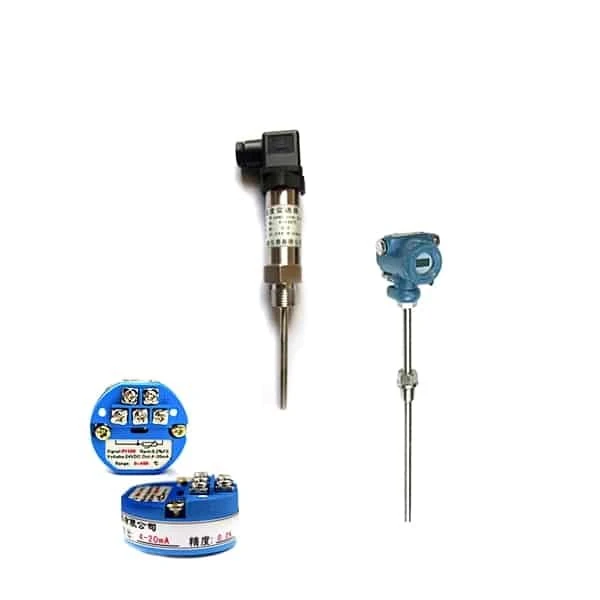
Temperature Transmitter (SI-SBW, Head and Field Mount)
A two-wire transmitter that takes an RTD or thermocouple signal, linearizes it, and sends a stable 4-20 mA output (HART optional) over long cable runs that raw sensor wires cannot survive. Available as a head-mount module inside a sensor head or a field-mount housing with a local display.
- Inputs: RTD (Pt100, Cu50, Cu100) and thermocouple (K, E, S, B, T, J, N)
- Output: 4-20 mA two-wire; HART 7 (HART 5 compatible) option
- Range: -200 to +1600 °C (sensor-dependent)
- Mounting: head (DIN B) or field housing with display
- Supply: 12-35 VDC
- Protection: IP65; explosion-proof field option
Overview
A temperature transmitter solves a wiring problem. An RTD sends a few ohms of resistance and a thermocouple sends a few millivolts, and both signals degrade and pick up noise over a long run to the control room. The transmitter sits at the sensor, converts that fragile signal into a 4-20 mA current loop (or HART), and that current travels hundreds of meters without losing accuracy. It also linearizes the sensor, compensates the cold junction for thermocouples, and drives the output to a known fault state if the sensor breaks.
The SI-SBW series accepts almost any common RTD or thermocouple, so one transmitter covers most points on a plant. Choose the head-mount module when the sensor has a connection head and the reading lives in the control system; choose the field-mount housing when an operator needs a local display at the pipe.
Features
Universal input
One model takes Pt100, Cu50, Cu100 RTDs and K, E, S, B, T, J, N thermocouples.
Stable 4-20 mA over distance
Converts ohms or millivolts to a loop current that survives long cable runs and noise.
Head or field mount
DIN B module for a sensor head, or a field housing with local display at the pipe.
Linearized output
Non-linear correction and cold-junction compensation built in for a true reading.
Sensor-break fail-safe
Drives a defined fault current on sensor break or short; reverse-polarity protected.
HART configurable
Set sensor type, range, and damping over HART 7 (HART 5 compatible) or software.
Working principle
The sensor feeds the transmitter input. An RTD changes resistance with temperature; a thermocouple produces a small voltage across its hot and cold junctions. The transmitter conditions that signal (amplify, filter, cold-junction compensate, and linearize), then converts it to a 4-20 mA current where 4 mA is the low end of your configured range and 20 mA is the high end. HART rides on top of the same two wires for configuration and diagnostics without disturbing the analog reading.
Head mount vs field mount
The electronics are the same; the package decides where the transmitter lives and whether anyone can read it at the process.
| Type | Best for | Notes |
|---|---|---|
| Head mount | Sensors with a DIN B connection head; reading used in the DCS | Compact disc module; lowest cost; no local display |
| Field mount | Points where an operator needs a value at the pipe | Rugged housing with local display; explosion-proof option |
Sensor inputs: RTD and thermocouple
Pick the sensor by temperature and accuracy, then the transmitter accepts it. RTDs win below about 600 °C for accuracy and stability; thermocouples cover the high end where RTDs cannot go.
| Input | Typical range | Use it for |
|---|---|---|
| RTD Pt100 (2/3/4-wire) | -200 to +600 °C | Accurate, stable process temperature |
| RTD Cu50 / Cu100 | -50 to +150 °C | Lower-cost narrow-range points |
| Thermocouple K / N / J / E / T | up to ~1300 °C | Furnaces, exhaust, high heat |
| Thermocouple S / B | up to ~1600 °C | Very high temperature, kilns and metals |
Ranges are typical and depend on sensor class and wire. A four-wire RTD removes lead-resistance error and is preferred for accurate points.
Thermistors are absent from this input list for a reason; the thermistor, thermocouple and RTD comparison lays out why in numbers.
Technical specifications
| Parameter | Specification |
|---|---|
| Sensor input | RTD Pt100 / Cu50 / Cu100 (2-, 3-, 4-wire); thermocouple K, E, S, B, T, J, N |
| Measuring range | -200 to +1600 °C (sensor-dependent) |
| Output | 4-20 mA, two-wire; HART 7 (HART 5 compatible) option |
| Accuracy | Per accuracy class; confirm on datasheet |
| Supply voltage | 12-35 VDC (rated 24 VDC) |
| Fault signal | Defined output on sensor break or short circuit |
| Mounting | Head mount (DIN B) or field-mount housing with display |
| Protection | IP65; explosion-proof field-mount option |
Representative specifications. Confirm the accuracy class, sensor type, and approvals for your point on the datasheet.
Output and wiring
The SI-SBW is a two-wire (loop-powered) device: the same pair carries 12-35 VDC power in and the 4-20 mA signal out, so a single twisted pair runs to each point. Set the sensor type, range, and damping over HART or the configuration software before commissioning. Calibrate against a known input: simulate or apply the low end and trim to 4 mA, apply the high end and trim to 20 mA. On thermocouple points, keep the cold junction and any compensation cable correct, since an error there shifts the whole reading.
Applications
Temperature transmitters appear on nearly every process line that has a thermowell. Common uses:
- Oil, gas, and petrochemical: vessels, exchangers, and lines, often with explosion-proof field housings
- Power and boilers: feedwater, steam, and flue gas with thermocouples
- Chemical and pharmaceutical: reactors and jackets where the value drives control
- HVAC and utilities: chilled and hot water, where head-mount modules feed the BMS
- Metals and kilns: high-temperature thermocouple points up to ~1600 °C
Application example
Offshore oil and gas platform. An operator standardized 88 temperature points on one transmitter series to simplify spares and certification across the platform. Field-mount housings with the right ingress and area approvals went on exposed points, head-mount modules on sheltered ones, all reading 4-20 mA back to the control system. One configurable transmitter covering RTD and thermocouple inputs kept the bill of materials short and the documentation consistent.
Related products
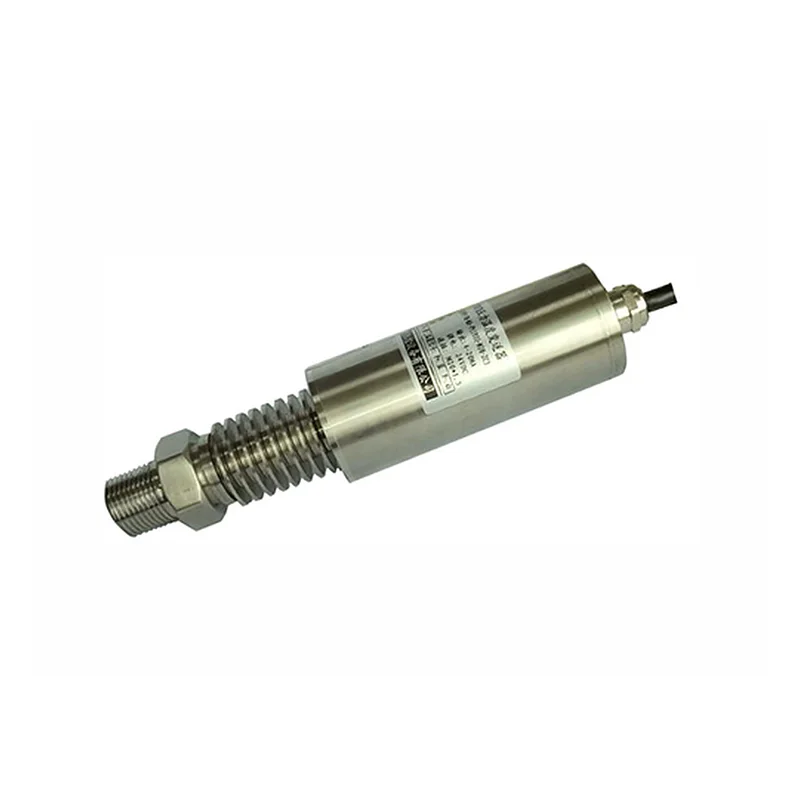 Combined Pressure and Temperature Sensor
Browse all temperature instruments →
If the panel still receives raw element wiring, our guide to 2, 3 and 4-wire RTD connections quantifies the cable error and shows when a head mounted transmitter is the better route.
FAQ
How does a temperature transmitter work?
It takes the signal from an RTD (resistance) or thermocouple (millivolts), conditions and linearizes it, compensates the cold junction for thermocouples, and converts it to a 4-20 mA loop current proportional to your configured range. The current travels long distances without the loss a raw sensor signal would suffer.
What is the difference between head mount and field mount?
The electronics are the same. A head-mount transmitter is a small disc that fits inside the sensor connection head and has no display; a field-mount transmitter is a rugged housing with a local display and explosion-proof options for points where an operator needs to read the value at the process.
RTD or thermocouple: which input should I use?
Use an RTD (Pt100) below about 600 °C for the best accuracy and stability; use a thermocouple for high temperature, up to about 1300 °C for type K or N and ~1600 °C for type S or B. The same transmitter accepts either.
How do you calibrate a temperature transmitter?
Apply or simulate a known sensor input, trim the low end to 4 mA and the high end to 20 mA, then check a midpoint. On HART units you set sensor type and range digitally first. Recheck after any sensor change.
Request a quote
Tell us the sensor (RTD or thermocouple type), the range, the mounting (head or field), and any area approvals, and our application engineers will configure one transmitter for the point. For pressure and temperature at the same location, see the combined pressure and temperature sensor.