Home › Temperature Instruments › Temperature Sensors
Industrial temperature sensors come in two families: RTDs and thermocouples. An RTD measures temperature from the change in a platinum element’s resistance; a thermocouple measures it from the voltage between two dissimilar metals. The choice comes down to temperature range, accuracy and cost. The pages below give real specifications and ordering details for each, and the table sets out which one fits your process.
RTD and thermocouple sensors
An RTD wins on accuracy and stability up to about 600 C; a thermocouple wins on high-temperature reach, speed and price. Most plants run both.
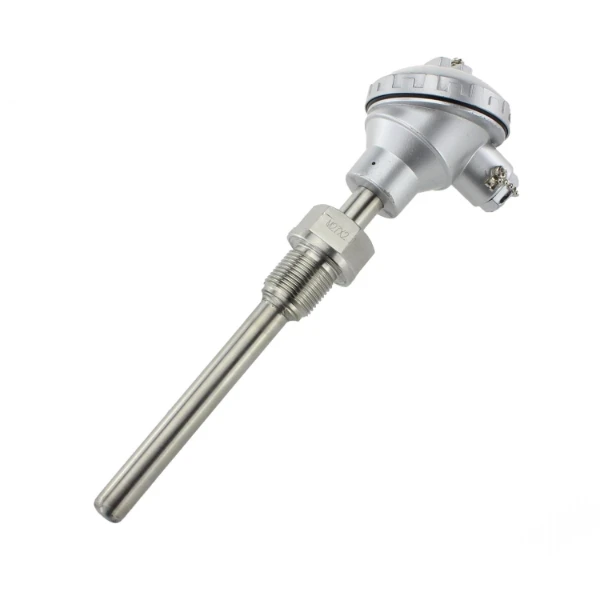 RTD Temperature Sensor (Pt100)
Platinum resistance element, best accuracy and stability to 600 C.
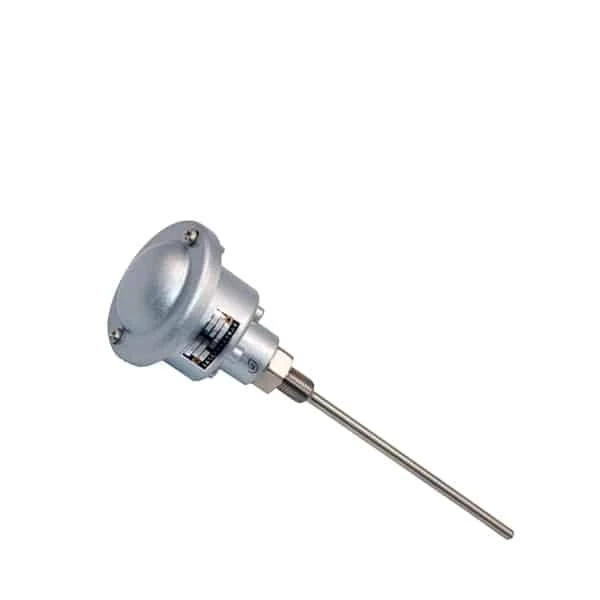 Thermocouple (K, J, E, S, R, B)
Fast, rugged and low-cost for high temperatures past 1300 C.
RTD vs thermocouple: choosing the sensor
Start with the temperature, then the accuracy you need and the budget. This table covers the usual decision.
| Your requirement | Pick | Why |
|---|---|---|
| -200 to 600 C, best accuracy and repeatability | RTD (Pt100) | Linear, stable, low drift over years |
| Furnace, kiln or exhaust, up to 1300 C and beyond | Thermocouple | Only a thermocouple survives the heat |
| Fast response to a changing temperature | Thermocouple | Small junction reacts quicker than an RTD |
| Tight tolerance below 600 C | RTD Class A | Class A holds plus or minus (0.15 + 0.002t) C |
| Lowest cost, rugged, long runs | Thermocouple | Cheaper element, tolerant of vibration |
Both feed a temperature transmitter that converts the signal to 4-20 mA / HART, and both mount inside a thermowell so the sensor can be replaced without breaking into the process.
A deeper treatment, with IEC tolerance classes worked at real temperatures, is in the RTD vs thermocouple guide.
FAQ
How does an RTD temperature sensor work?
A Pt100 RTD has a platinum element of 100 ohms at 0 C. As temperature rises, its resistance rises along the IEC 60751 curve. The transmitter passes a known current through it, measures the voltage, and converts the resistance to temperature. A three- or four-wire connection cancels the lead-wire resistance so long cable runs do not add error.
What causes RTD sensor failure?
The common causes are mechanical: vibration that fatigues the element or lead wires, thermal shock that cracks the platinum, and moisture ingress that corrodes the connections and shifts the reading. Mounting the sensor in a thermowell and matching the insulation to the temperature prevents most early failures.
Request a quote
Quote checklist, send these five points: RTD or thermocouple (and the type, such as Pt100 or Type K); the temperature range; the accuracy class; the insertion length and process connection; and whether you need a transmitter or thermowell with it. Tell us the application and we configure one unit, not a shelf part.
Written and technically reviewed by the Instranova engineering team, last reviewed 2026-06-21. Based on the Instranova temperature sensor datasheets and IEC 60751 / IEC 60584, plus field experience across process and high-temperature service. Questions? Reach our application engineers.