Home › Products › Flow Meters › Ultrasonic Flow Meters › Clamp-On Ultrasonic Flow Meter
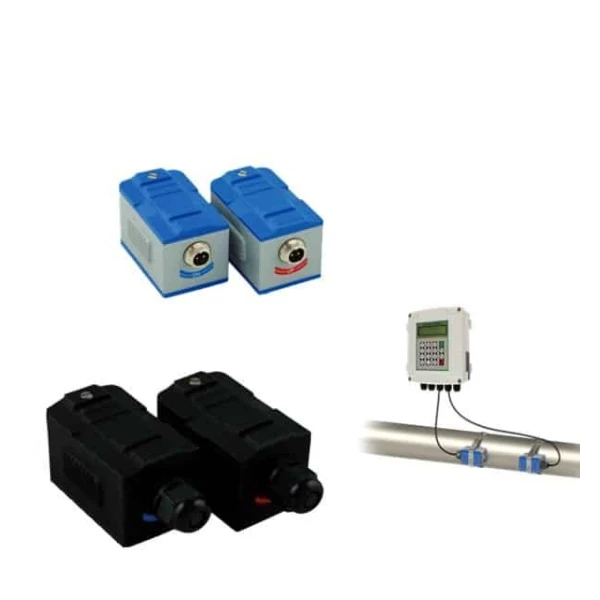
Clamp-On Ultrasonic Flow Meter
A transit-time flow meter whose transducers strap to the outside of the pipe. Nothing is cut and nothing touches the liquid, so it fits a live pipe in minutes and reads flow on a DN25 to DN1200 line to plus or minus 1% of reading.
- Type: clamp-on, fully non-invasive transit-time
- Pipe size: DN25 to DN1200
- Accuracy: plus or minus 1% of reading; repeatability 0.2%
- Output: 4-20 mA, pulse (0-10 kHz)
- Transducer: IP68, to 130 C high-temp option
Overview
A clamp-on ultrasonic flow meter measures flow from the outside of the pipe. Two transducers strap to the pipe wall and send ultrasonic pulses across the flow, once with it and once against it; the difference in travel time gives the velocity, and velocity times the pipe area gives the flow. Because nothing is cut and nothing enters the liquid, it fits a pipe that is already running, with no shutdown, no leak path and no pressure drop.
It reads a DN25 to DN1200 line to plus or minus 1% of reading, on a 0 to 7 m/s range, and gives 4-20 mA and a pulse output from a wall transmitter with a 4-line display. The encapsulated IP68 transducers come standard to 80 C and in a high-temperature version to 130 C, on a double-shielded cable up to 300 m, so the meter sits well away from the pipe if it needs to.
Features
Why a clamp-on meter suits a live pipe:
Nothing cut
Transducers strap to the outside, so no hole, no leak path and no shutdown to fit it.
DN25 to DN1200
One transmitter covers a small process line up to a large distribution main with the right transducer.
No pressure drop
The bore stays clear, so there is no obstruction, no wear and no head loss.
High-temp transducer
Standard to 80 C, with a high-temperature transducer to 130 C for hot water and effluent.
Long cable run
A double-shielded transducer cable to 300 m puts the transmitter where it is easy to read.
4-20 mA and pulse
Loop and 0-10 kHz pulse outputs to a PLC or totalizer, on a 16-key 4-line display.
Working principle
Transit-time measurement sends an ultrasonic pulse diagonally across the pipe in both directions. The pulse going with the flow arrives sooner than the one going against it, and that time difference is proportional to the average velocity of the liquid. The transmitter knows the pipe size and wall, so it turns velocity into flow. The clamp-on transducers couple the pulse through the wall, so the signal crosses the wall twice.
Because the signal must pass through the wall, the method suits a sound, full pipe of clean to lightly loaded liquid. A heavily scaled, lined or air-filled pipe, or one carrying many solids or bubbles, scatters the signal, so where the clamp-on echo is too weak an insertion meter is the better choice.
Technical specifications
| Parameter | Specification |
|---|---|
| Measurement principle | Transit-time ultrasonic, clamp-on |
| Convertor | TUF-2000B |
| Pipe range | DN15 to DN6000 (set by the transducer) |
| Velocity range | 0 to ±7 m/s, bi-directional |
| Accuracy | ±1% of reading; repeatability 0.2% |
| Medium temperature | -30 to 90 C standard; -30 to 160 C high-temperature transducer |
| Liquid | Single clean or turbid liquid, turbidity to 10000 ppm, few bubbles |
| Pipe material | Carbon steel, stainless, cast iron, copper, cement, PVC; lining allowed |
| Straight run | 10D upstream, 5D downstream, 30D from a pump |
| Outputs | 4-20 mA (0 to 1 kohm); OCT pulse; relay |
| Inputs | Three 4-20 mA, plus a Pt100 pair for heat metering |
| Communication | RS-485 Modbus RTU (M-Bus optional), over 1000 m |
| Power supply | DC 8-36 V or AC 85-264 V; 1.5 W |
| Protection | Convertor IP67; transducer IP68 |
| Display | 2 x 20 backlit LCD; SD-card logging optional |
Representative TUF-2000B specifications; confirm per datasheet for your pipe and transducer.
Clamp-on transducers
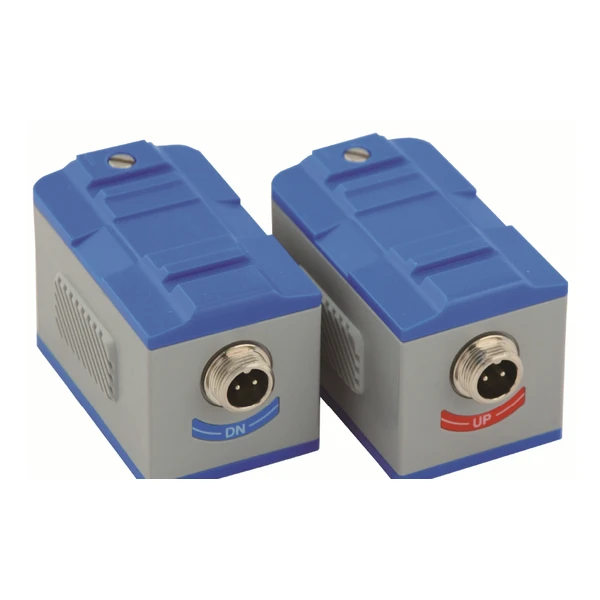
The convertor pairs with a clamp-on transducer matched to the pipe. Three sizes cover DN15 to DN6000, each in a standard (-30 to 90 C) or high-temperature (-30 to 160 C) build. The transducers fasten to a steel or iron pipe with built-in magnets, or with a steel belt, strap, or stretcher, and a sliding mounting bracket sets the spacing; potted transducers reach IP68.
| Model | Type | Pipe range | Temperature | Size |
|---|---|---|---|---|
| TS-2 | Small clamp-on | DN15 to DN100 | -30 to 90 C | 45 x 25 x 28 mm |
| TM-1 | Medium clamp-on | DN50 to DN700 | -30 to 90 C | 64 x 39 x 44 mm |
| TL-1 | Large clamp-on | DN300 to DN6000 | -30 to 90 C | 97 x 54 x 53 mm |
| TS-2-HT | Small, high-temp | DN15 to DN100 | -30 to 160 C | 45 x 25 x 28 mm |
| TM-1-HT | Medium, high-temp | DN50 to DN700 | -30 to 160 C | 64 x 39 x 44 mm |
| TL-1-HT | Large, high-temp | DN300 to DN6000 | -30 to 160 C | 97 x 54 x 53 mm |
A sliding mounting bracket (HS for DN15 to DN100, HM for DN50 to DN300, EB-1 above DN300) holds the transducer and sets the installation distance for a fixed mount.
Clamp-on or insertion
Both are transit-time meters; the transducer is what differs. Clamp-on straps to the outside and touches nothing, which is the right choice for a sound pipe of clean to lightly loaded liquid, up to DN1200, where you want a fast, fully non-invasive fit. Where the pipe is very large, thick-walled or lined, or the wall is scaled enough that the clamp-on signal will not hold, an insertion ultrasonic flow meter places the probes inside the wall and keeps a strong path. For a metered custody point a full-bore inline meter may suit better.
Installation
Pick a straight run of at least ten diameters upstream and five downstream, on a full pipe, and clean the contact area to bare metal. Enter the pipe size, wall and liquid in the transmitter so it sets the transducer spacing, apply couplant and clamp the transducers at that spacing. Check the signal strength reads strong before fixing them, route the cable, up to 300 m, and wire the 4-20 mA or pulse output.
Applications
- Water and wastewater mains, retrofitted with no shutdown
- Chilled and hot water and HVAC, with the energy option
- Temporary surveys and check metering on existing lines
- Chemical and process liquids where no wetted meter is wanted
- Hot effluent to 130 C with the high-temperature transducer
Challenge: A site needed flow on an existing wastewater main but could not shut it down or cut into the line to fit an inline meter.
Solution: A clamp-on ultrasonic flow meter with the transducers strapped to the running pipe, set to the pipe size and wall, and wired out on 4-20 mA.
Result: Flow read to plus or minus 1% with no break in service, no penetration and nothing in the bore.
Related products
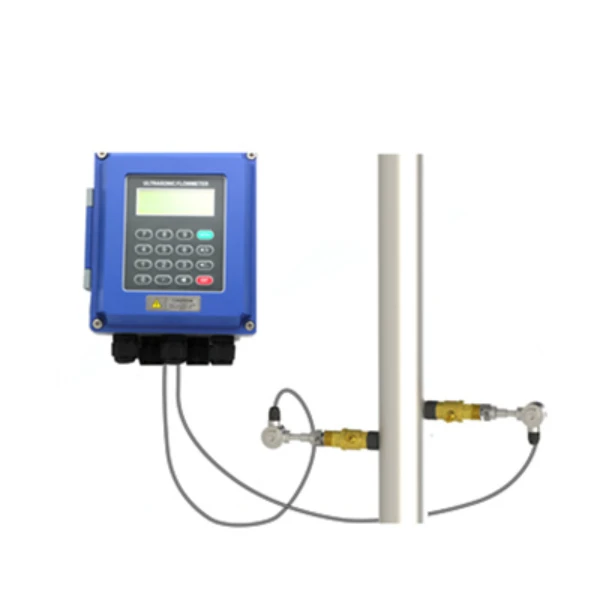 Insertion Ultrasonic Flow Meter
Transit-time TUF-2000B with insertion probes for large, thick or lined pipes to DN6000.
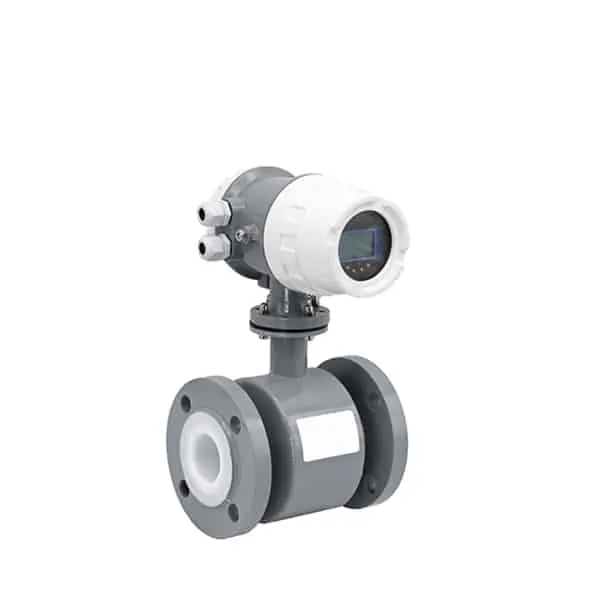 Magnetic Flow Meter
Full-bore mag meter for conductive water, slurry and chemicals, no obstruction.
Browse all ultrasonic flow meters →
Related applications: Chemical, Wastewater.
The 0 to 7 m/s span above is a velocity, not a flow. The pipe velocity calculator turns your flow rate and pipe bore into that number in one step.
Many clamp-on installations feed an energy calculator on chilled or hot water loops; see the chilled water BTU metering guide for the delta-T math and sensor pairing rules.
Bubble content is the practical ceiling for transit-time measurement; the failure modes and the piping that removes gas are covered in our guide to metering foamy liquids.
A clamp-on transducer set is also the quick way to cross-check a fire pump test line without cutting pipe; the fire pump flow meter page covers the testing rules.
One common clamp-on job is checking an aged billing meter in place; the background numbers are in our digital vs mechanical water meter guide.
FAQ
How does a clamp-on ultrasonic flow meter work?
Two transducers strap to the outside of the pipe and send an ultrasonic pulse across the flow with it and against it. The pulse going with the flow arrives sooner; the difference in the two travel times gives the velocity, and velocity times the pipe area gives the flow.
Can you measure flow without cutting the pipe?
Yes. A clamp-on meter straps the transducers to the outside of a running pipe, so nothing is cut and nothing enters the liquid. It fits with no shutdown, no leak path and no pressure drop, which is why it suits a retrofit or a temporary survey.
How accurate is a clamp-on ultrasonic flow meter?
On a sound, full pipe of clean liquid with enough straight run, it reads to plus or minus 1% of reading with 0.2% repeatability. A scaled, lined or air-filled pipe weakens the signal and reduces accuracy.
What are the disadvantages of a clamp-on flow meter?
The signal crosses the pipe wall twice, so a very thick, lined or heavily scaled wall, or many solids or bubbles, can weaken it. Choosing a sound, full section of pipe handles most cases; where the wall defeats clamp-on, an insertion meter is the better choice.
Request a quote
Tell us the pipe size, wall and lining, the liquid and its temperature, and we configure one clamp-on meter for the line, not a shelf part.