By Wu Peng, Senior Process Instrumentation Engineer · Last reviewed August 27, 2026
A flow meter for foamy liquids has to survive a condition most meters are never specified for: gas mixed into the liquid. Foam and entrained bubbles make a volumetric meter count gas as product, make a transit-time ultrasonic meter lose its signal, and make a Coriolis meter read low. The errors run in different directions for different technologies, which is why the same aerated batch can read high on one meter and low on the next.
This guide covers liquids that carry foam or bubbles in a pipe: fermentation broth, detergents, latex, resins, dairy and beverage lines, and any tank that gets top-filled. It explains where the gas comes from, how each meter type fails when measuring aerated liquids, which diagnostics reveal gas for free, and the piping that removes it. One scope note first: a laboratory soap-film calibrator, a spray-foam machine meter, and a fire-fighting foam concentrate meter all share this keyword and are different subjects; the last section separates them.
Contents
- Where the gas comes from
- Volume, mass and bubbles
- How each meter fails
- Diagnostics that reveal gas
- Piping that sheds gas
- Foam on open channels
- Same name, other products
- FAQ
Where the gas comes from
Foam is a symptom. Before choosing a meter that tolerates it, trace the gas to its source, because most of the sources can be closed off upstream for less than the price of a better meter.
The usual entry points form a short list. A tank filled from the top with a long free fall beats air into the liquid with every drop. A suction line that draws from a low tank level pulls a vortex funnel down to the pump inlet and draws air in with the liquid. Pump literature puts the failure point of most centrifugal pumps near 14 percent entrained air, with special designs reaching about 24 percent.
A worn seal or a loose fitting on the suction side leaks air inward without leaking liquid outward, which is why it goes unnoticed. A centrifugal pump then chops whatever air arrives into fine froth.
Cavitation and flashing create vapor from the liquid itself wherever pressure dips below vapor pressure. And dissolved gas comes out of solution when pressure falls, following Henry’s law: solubility scales with absolute pressure, so a pressure drop across a valve can turn a clear liquid into a bubbly one downstream.
The removal ladder matches the list. Extend the fill pipe below the liquid line so filling stops making foam. Keep suction submergence deep enough, add an anti-vortex plate over the tank outlet, and repair suction-side seals. Give the liquid residence time in a calm tank so bubbles rise out before the meter.
Hold back pressure on the metering line so dissolved gas stays dissolved. Where air arrives in slugs anyway, as in truck loading, the settled answer is mechanical: an air eliminator chamber ahead of the meter floats the gas off and vents it back to the tank. That is standard practice ahead of the positive displacement meters used for fuel and LPG loading.
Volume, mass and bubbles
One line of arithmetic explains most of the meter behavior on this page. Bubbles are large by volume and nearly weightless by mass. Take water carrying 5 percent gas by volume: the air in that mixture is about 0.006 percent of the mass, while the mixture density falls by about 5 percent, from 998 to roughly 948 kg/m³.
A volumetric meter therefore over-counts the liquid by roughly the gas fraction, since it meters the mixture and the customer receives only the liquid. A true mass meter barely registers the gas itself; its problem, covered below, is that bubbles disturb how it measures.
This is the practical version of the mass flow versus volumetric flow distinction: on aerated liquids, mass-based measurement starts with a structural advantage before any vendor feature enters the picture. Entrained air flow measurement therefore begins with one decision: whether the number you owe, on the invoice or in the batch record, is mass or volume.
How each meter fails
Each technology fails in its own direction, and knowing the direction is half the diagnosis. The table summarizes; the notes after it give the mechanisms.
| Meter type | What bubbles do | Reading direction | Practical limit |
|---|---|---|---|
| Magnetic | Counts gas as liquid; large bubbles sweeping the electrodes add noise or drop the signal | High, by about the gas fraction | Fine aeration passes; slugs and electrode-size bubbles disrupt |
| Coriolis | Bubbles decouple from the tube motion, damping the vibration | Low on mass and density; erratic in slugs | Standard modes: a few percent; published entrained-gas modes: about ±3% up to 15% gas by volume |
| Ultrasonic, transit time | Bubbles scatter the beam and attenuate the signal | Dropouts, then no reading | Bubble and solids content around 10,000 ppm, about 1% by volume |
| Ultrasonic, Doppler | Bubbles are the signal: it reads velocity from reflectors larger than about 100 microns | Reads where transit time cannot | Needs bubbles or solids; still totals mixture volume, not liquid |
| PD and turbine | Sweep or spin gas through as if it were liquid; slugs over-speed a turbine rotor | High, by the gas fraction or more | Use an air eliminator upstream, as custody practice does |
| DP elements | Mixture density enters the flow equation, and trapped gas shifts the impulse lines | Biased by density error | Vent hole in the plate passes small amounts; compensate density or avoid |
Two rows are worth expanding. The magnetic meter is the misleading one: on finely aerated liquid it keeps producing a steady, plausible number, because it measures the velocity of the mixture across the pipe area and converts to volume. Nothing warns you that the volume includes gas. On foamy hygienic lines this is the classic complaint: the meter runs, the totals run high.
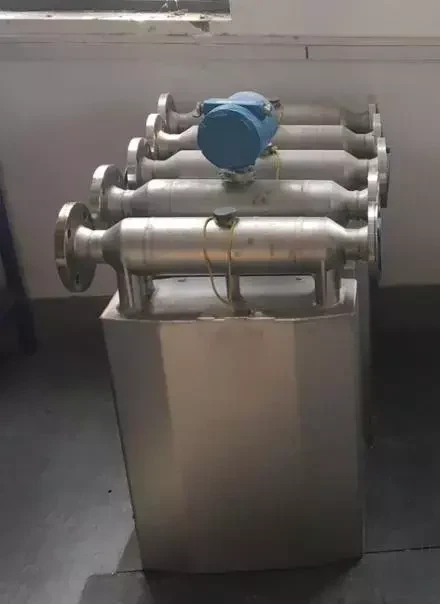
The Coriolis meter fails for a mechanical reason: a bubble is lighter than the liquid around it, so when the tube vibrates, bubble and liquid do not move together. The decoupled motion absorbs energy, damps the tube, and pulls both the mass and the density reading down.
Older meters could stall outright when gas arrived. One vendor now states its meters keep operating from 0 to 100 percent gas content, which is an operating claim, not an accuracy claim. Another specifies its entrained-gas mode at about ±3 percent up to 15 percent gas void fraction. Treat both as what they are: engineered tolerance of a condition that is still worth removing.
Diagnostics that reveal gas
A Coriolis meter on a foamy line doubles as a free gas detector, and this is worth configuring before any change of equipment. Two variables do the work.
The first is drive gain, the excitation power the transmitter spends keeping the tubes vibrating at target amplitude. On clean liquid it idles low and flat. Entrained gas damps the tubes, so drive gain climbs, and a step toward 100 percent is the signature of gas breakout; at the ceiling the measurement is degraded even though the display still updates. Trend it in the control system and alarm on the step change.
The second is density. The transmitter reads mixture density continuously, so a reading that sits below the known liquid density by 1 percent implies roughly 1 percent gas by volume.
The estimate is approximate, because the same decoupling that damps the tubes also biases the density low. As a relative indicator it is excellent: a fermenter transfer that starts at 1,010 kg/m³ and sags to 990 mid-batch marks the moment the foam arrives. A magnetic meter offers cruder versions of the same idea: electrode-signal noise and empty-pipe diagnostics both trip when bubbles grow into slugs.
Piping that sheds gas
Meter placement can remove most of the gas problem without a single accessory. The rules are short and they compound.
Mount the meter at a low point in the run, with the pipe rising after it, so the meter section stays liquid-full and bubbles migrate away from it. Prefer a vertical run with upward flow for Coriolis and magnetic meters: rising flow carries bubbles through instead of letting them collect. Never mount at a high point, because that is exactly where gas accumulates. A pocketed meter reads badly on a line that is otherwise fine.
Keep back pressure on the metering section, with a back-pressure valve or simply an elevation rise downstream. Dissolved gas then stays in solution through the meter and flashes somewhere harmless instead. And where slugs are part of the process, place an air eliminator ahead of the meter and pipe its vent back to the tank.
Straight-run practice stays the same as for clean liquid; nothing about aeration relaxes it. What changes is the order of operations at start-up: let the pump flood the line and push the start-up air through before totals count, the same discipline as an empty-full-empty batching line.
Foam on open channels
Surface foam on a flume or weir is a different problem from bubbles in a pipe. There the flow is computed from the water level, a look-down ultrasonic sensor reads the level, and foam sits on top of the water, so the sensor reads the foam crest and reports a level, and therefore a flow, that is too high.
The fixes stay upstream of the electronics: a baffle that keeps the foam blanket away from the measuring point, a stilling well so the sensor reads a foam-free column, and if chemistry allows, defoamer dosed into the well only. A radar sensor helps on some foams but is not a guaranteed pass through a thick blanket. Where the channel is a part-full pipe, a partially filled pipe magnetic flow meter reads level and velocity from inside the flow, below the foam, and does not see the blanket at all.
Same name, other products
Three unrelated instruments share this page’s keyword, and mixing them up wastes procurement time. A soap-film flow meter, sold as a bubble or foam flow meter, is a laboratory device that times a soap bubble up a graduated tube to calibrate small gas flows in the mL/min range. It measures gas, not liquid.
A spray-foam machine meter is a small gear meter on the two chemical streams of a polyurethane proportioner. The chemicals are ordinary liquids, and the foam only exists after they mix, so this is standard gear meter service.
A fire-fighting foam concentrate meter proportions concentrate into a water stream; the concentrate itself is a clean viscous liquid, metered before any foam is made. If your liquid already contains the foam, the rest of this guide applies; if the foam comes later, size a normal liquid meter for the pre-foam liquid.
Application note
Fermentation transfer lines. A typical broth transfer reads well early in the batch and drifts as CO2 comes out of solution. The working pattern pairs a Coriolis meter in a rising run with a density trend and a drive-gain alarm: density flags the gas fraction, drive gain flags severity, and line back pressure holds most of the CO2 in solution until after the meter. The meter reports mass, so the gas that does pass changes the total far less than it would on a volumetric meter.
Beer is the everyday example of an aerated liquid at the point of dispense; the beer metering guide applies these rules to draft systems and keg monitoring.
FAQ
What is the best flow meter for foamy liquids?
A Coriolis mass flow meter with an entrained-gas mode is the strongest single choice: it reads mass, so bubbles barely touch the total, and its density and drive-gain diagnostics report the gas as it happens. A magnetic flow meter is acceptable on finely aerated conductive liquid if you accept over-registration of about the gas fraction. In every case, removing the gas upstream with back pressure, calm tankage or an air eliminator beats tolerating it.
How do I calculate the flow rate using a bubble flow meter?
A bubble, or soap-film, flow meter is a laboratory gas calibrator, not a process liquid meter. You time a soap film between two marks on a graduated tube: flow equals the swept volume divided by the time, for example 50 mL traversed in 30 seconds is 100 mL/min. It calibrates gas sampling pumps and chromatograph flows, and has no role on foamy process liquids beyond sharing their name.
What is the bubbly flow regime?
Bubbly flow is the two-phase pattern in which gas travels as discrete bubbles dispersed in a continuous liquid, typically at low gas fractions. As gas fraction rises the bubbles coalesce into slugs, then churn, then an annular gas core. Flow meters tolerate bubbly flow best: fine, evenly dispersed bubbles degrade a reading gradually, while slug flow produces the erratic, jumping outputs that get meters blamed for a piping problem.
What are two types of flowmeters?
The division that matters here is volumetric versus mass. Volumetric meters, including magnetic, turbine, PD and ultrasonic types, report the volume of whatever passes, gas included. Mass meters, chiefly Coriolis and thermal types, report mass, and a bubble that is 5 percent of the volume is only about 0.006 percent of the mass. On aerated liquids that single distinction predicts most of the error you will see.
Request a quote
Tell us the liquid, where the foam or gas comes from, the flow range, line size and pressure, and whether the total you settle on is mass or volume. We will propose a metering layout, and the gas-handling upstream of it, sized for the real condition of the line. Reach our application engineers or use the form below.
Written and technically reviewed by Wu Peng and the Instranova engineering team.