By Wu Peng, Senior Process Instrumentation Engineer · Last reviewed September 11, 2026
Saturated steam sits at the boiling point that belongs to its pressure, so pressure alone fixes both its temperature and its density. Superheated steam has been heated past that point, so pressure and temperature move independently and a meter needs both. The practical difference is density. At 10 bar absolute, dry saturated steam is 5.145 kg/m³; heat it to 300 °C at the same pressure and it falls to 3.876 kg/m³.
That gap is not a curiosity. A vortex meter configured for saturated density and fed 300 °C steam reports mass flow 32.7 percent high, and nothing on the display says so, because the number still looks plausible.
This guide sets saturated vs superheated steam side by side, with the property tables for both states and the arithmetic that turns a density error into a billing error. It also covers why a differential pressure meter drifts at roughly half the rate of a vortex meter, what happens when the steam is wet, and how the state changes line sizing.
Contents
- Two states, one pipe
- Saturated steam properties
- Adding superheat
- Density and the reading
- Compensation inputs
- Wet steam
- Velocity and sizing
- Choosing the meter
- FAQ
Two states, one pipe
Boil water in a closed vessel and the vapor that forms sits at the saturation temperature for that pressure. At 7 bar absolute the saturation temperature is 164.95 °C, and no amount of extra heat raises it while liquid water is still present, because the heat goes into evaporating more water instead.
Once all the liquid has gone, further heat does raise the temperature. Steam above its saturation temperature is superheated, and the gap between the two is the degree of superheat. Below the saturation line there is a third condition that matters more to a flow meter than either of the clean cases: wet steam, which is saturated vapor carrying liquid droplets, described by its dryness fraction.
Saturated steam properties
For saturated steam, pressure alone sets everything. Fix the pressure and the temperature, specific volume and density all follow from the steam tables.
| Pressure (bar abs) | Saturation temp | Specific volume | Density | Evaporation heat |
|---|---|---|---|---|
| 2 | 120.21 °C | 0.8857 m³/kg | 1.129 kg/m³ | 2201.5 kJ/kg |
| 7 | 164.95 °C | 0.2728 m³/kg | 3.666 kg/m³ | 2065.7 kJ/kg |
| 10 | 179.88 °C | 0.1944 m³/kg | 5.145 kg/m³ | 2014.6 kJ/kg |
| 20 | 212.38 °C | 0.0996 m³/kg | 10.042 kg/m³ | 1889.8 kJ/kg |
| 70 | 285.83 °C | 0.0274 m³/kg | 36.53 kg/m³ | 1505.0 kJ/kg |
Dry saturated steam, published steam table values; density shown as the reciprocal of specific volume.
The first trap in this table is the word absolute. A boiler gauge reading 7 bar is 8.013 bar absolute, and the two rows are not close: the density at 8 bar absolute is about 4.16 kg/m³ against 3.666 kg/m³ at 7 bar absolute. Configure a meter from the wrong row and the density is 11.9 percent low against the true value, which lands straight on the mass reading. Every steam sizing form should say which one it means.
Adding superheat
Superheat breaks the one to one link between pressure and temperature. The same 10 bar line can carry steam at 179.88 °C, at 250 °C or at 300 °C, and each has a different density.
| Condition | Temperature | Density | Against saturated |
|---|---|---|---|
| 7 bar abs, saturated | 164.95 °C | 3.666 kg/m³ | reference |
| 7 bar abs, superheated | 250 °C | 2.973 kg/m³ | 18.9 percent lighter |
| 10 bar abs, saturated | 179.88 °C | 5.145 kg/m³ | reference |
| 10 bar abs, superheated | 250 °C | 4.296 kg/m³ | 16.5 percent lighter |
| 10 bar abs, superheated | 300 °C | 3.876 kg/m³ | 24.7 percent lighter |
| 70 bar abs, saturated | 285.83 °C | 36.53 kg/m³ | reference |
| 70 bar abs, superheated | 500 °C | 20.75 kg/m³ | 43.2 percent lighter |
Published superheated steam table values, density as the reciprocal of specific volume. At 70 bar absolute the saturation temperature is 285.83 °C, so 500 °C is 214.2 °C of superheat.
Density and the reading
Steam flow metering is indirect: most steam meters do not weigh anything. A vortex meter counts shed vortices and reports volume; a differential pressure element measures a pressure drop. Mass flow comes from combining that measurement with an assumed or calculated density, and the assumption is where the error lives.
Take the 10 bar line again. A vortex meter reports mass as volume multiplied by density, so if it holds 5.145 kg/m³ while the true density is 3.876 kg/m³, the mass reading is high by the ratio of the two.
Vortex error = (ρassumed / ρtrue) − 1
5.145 / 3.876 − 1 = +32.7 percent
A differential pressure element behaves differently. Its output follows the square root of density, so the same density error is softened.
DP error = √(ρassumed / ρtrue) − 1
√(5.145 / 3.876) − 1 = +15.2 percent
That relationship generalizes. For any density deviation, a vortex or other volumetric meter drifts at roughly twice the rate of an orifice, nozzle or averaging pitot element on the same steam.
This is not an argument for choosing differential pressure, since a 15 percent error is still unusable. It is an argument for getting the density right in both cases, and for treating an uncompensated vortex reading on a variable superheat line with particular suspicion. On the 70 bar power plant case the same arithmetic gives 76.0 percent for the vortex and 32.7 percent for the DP element.
Compensation inputs
Because saturation ties pressure and temperature together, a saturated steam meter needs only one of them. Measure line pressure, look up the saturation table, and the density follows. Many installations use a pressure transmitter for exactly this reason, and some use temperature instead where the pressure tapping is awkward.
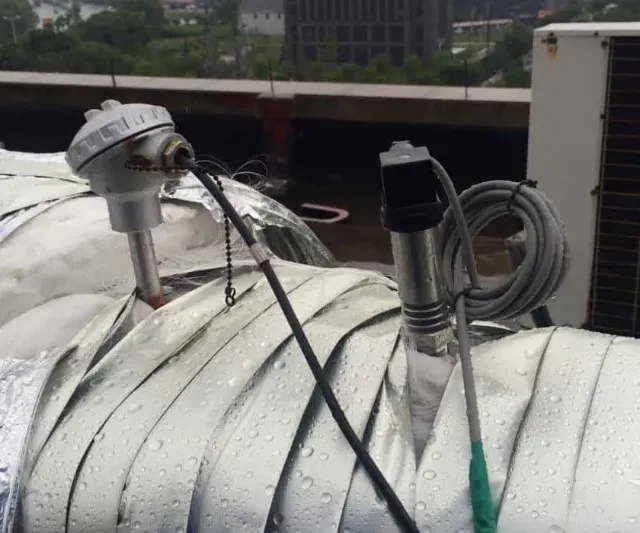
Superheated steam has two independent variables, so it needs two live inputs. A pressure transmitter and a temperature sensor feed a flow computer or a multivariable transmitter, which calculates density from both before it calculates mass. The reasoning and the error arithmetic are set out in our guide to pressure and temperature compensation, and the pressure side is covered by the steam pressure transmitter page.
One caution applies to lines that are only sometimes superheated. A header fed through a desuperheater, or a turbine extraction line at part load, can sit at saturation in the morning and at 40 °C of superheat in the afternoon. A single fixed density cannot serve both, and a saturation lookup is wrong whenever the steam is superheated, so those lines need the two input arrangement even though the nameplate says saturated service.
Wet steam
Real distribution steam is rarely perfectly dry. Heat loss through pipe walls condenses part of the flow, and the line carries a mixture of vapor and droplets described by its dryness fraction. A meter calibrated for dry steam sees the vapor phase it was told to expect, so the mass it reports is not the mass of water arriving at the user.
Published quantified error curves against dryness fraction are hard to find. What the instrument suppliers do agree on is the remedy: put a separator and a trap set upstream of the meter, dry the steam before measuring it, and treat a persistently wet line as a distribution problem rather than a metering problem. Droplets also erode a vortex shedding body and a nozzle throat over time, which is a second reason not to meter wet steam and hope.
Velocity and sizing
Steam state also drives line and meter sizing, because velocity limits differ. Published guidance puts saturated steam in the range of 25 to 40 m/s for general distribution, with 15 m/s preferred on long runs to hold down pressure drop. Figures as high as 76 m/s are quoted only for dry, short, straight, well insulated lines. Dry superheated steam carries no droplets to erode the pipe, so it is allowed to run faster, typically 50 to 70 m/s.
The sizing consequence is easy to miss. Superheating a line does not change the mass flow, but it lowers the density, so the volumetric flow and the velocity both rise. Take 2 t/h at 10 bar absolute.
Saturated: 2,000 / 5.145 = 388.7 m³/h, which is 21.5 m/s in DN80 and 32.5 m/s in DN65
At 300 °C: 2,000 / 3.876 = 516.0 m³/h, which is 28.5 m/s in DN80 and 43.2 m/s in DN65
Velocities calculated on nominal bore.
The same two tonnes an hour runs 32.7 percent faster once superheated, and the DN65 option moves from the top of the saturated band to a figure only acceptable because the steam is dry. Meter bodies inherit the same arithmetic, so a meter sized from a saturated table and then installed on a superheated line often ends up a size too small.
Line velocity can be checked with the pipe velocity calculator, and sizing tables for common bores are on the 2 in and 3 in steam meter page.
Choosing the meter
Vortex and differential pressure elements are both used for steam flow measurement, and both read correctly when the density input is right. Vortex meters are the usual first choice, because a single wafer or flanged body handles saturated and superheated service with no impulse lines to freeze or fill. Ranges and accuracy are on the steam vortex flow meter page and the general vortex flow meter page.
Differential pressure elements suit the extremes. A flow nozzle stands up to high temperature, high velocity main steam where an orifice plate would erode. An averaging pitot tube gives the lowest permanent pressure loss on a large header and fits through a single tapping.
The calculation chain behind all of them, including the square root relationship used above, is worked through in differential pressure flow calculation. A routing view by technology is on the steam flow meter page, and the difference between reporting kilograms and reporting cubic meters is covered in mass flow against volumetric flow.
Application example
Power generation, South Africa. A DN200 main steam line running 35 to 55 t/h at 500 °C and 67 bar was specified with an averaging pitot element, a differential pressure transmitter and a flow computer. At that pressure the saturation temperature is close to 286 °C, so the line carries more than 200 °C of superheat and pressure alone cannot give the density. The proposal therefore carried both a pressure and a temperature input to the flow computer rather than a saturation lookup.
FAQ
What is the difference between saturated and superheated steam?
Saturated steam is at the boiling temperature for its pressure, so pressure alone fixes its temperature and density. Superheated steam has been heated above that temperature, so pressure and temperature vary independently. For measurement that means saturated steam needs one live input and superheated steam needs two.
What is the advantage of using superheated steam?
It carries no liquid, so it does not condense in the line or damage turbine blades, and it can run at higher velocity because there are no droplets to erode pipe walls. The trade is lower density and poorer heat transfer, which is why process heating usually prefers saturated steam.
What are the disadvantages of using saturated steam?
It sits on the saturation line, so any heat loss immediately produces condensate, water hammer and wet steam at the point of use. It also limits the temperature available at a given pressure, and metering it accurately depends on the steam being dry rather than wet.
What are the three types of steam?
Wet saturated steam, which carries liquid droplets; dry saturated steam, at the saturation temperature with no liquid left; and superheated steam, heated above the saturation temperature for its pressure. Flow meters are calibrated for dry steam, which is why wet lines get a separator upstream.
Which flow meter suits superheated steam?
A vortex meter with live pressure and temperature inputs covers most distribution and process lines. On high temperature, high velocity main steam a flow nozzle or an averaging pitot element with a differential pressure transmitter and flow computer is the usual arrangement.
Request a quote
Tell us the line pressure, the steam temperature, whether the service is saturated or superheated, the bore and the flow range, and we will size the meter and specify the density inputs it needs. Reach our application engineers or use the form below.
Written and technically reviewed by Wu Peng and the Instranova engineering team.