Flow Meters › 2 Inch and 3 Inch Steam Flow Meters
2 Inch and 3 Inch Steam Flow Meters
A 2 inch steam flow meter is, in most plants, a DN50 vortex meter with temperature and pressure compensation. The 3 inch steam flow meter is the same instrument in the next common bore. What separates the two sizes is capacity. At 7 barg saturated, a DN50 bore passes about 65 to 2,273 kg/h of steam; a DN80 bore passes about 143 to 5,009 kg/h.
This page puts those numbers in a table, works one sizing example end to end, and explains why the meter is often smaller than the pipe.
A caution on shopping by size alone. The listings that dominate this search sell what is one meter under many storefronts, at anywhere from a few hundred dollars to over nine hundred. More than one carries a 2 inch title over a description block copied from the DN25 version, wrong flow range included. A steam meter is specified by capacity at your working pressure, not by pipe size, so check the flow table before the flange size.
This page assumes the technology decision is already made. If it is not, the steam flow meter overview compares vortex against the differential-pressure elements. The steam vortex flow meter page carries the full product specification for the meters below.
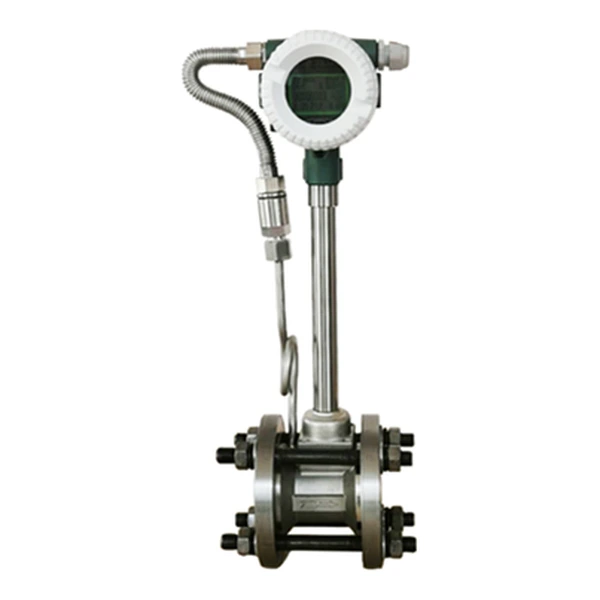 Steam Vortex Flow Meter
The default for 2 and 3 inch steam lines: built-in temperature and pressure compensation reports mass flow directly.
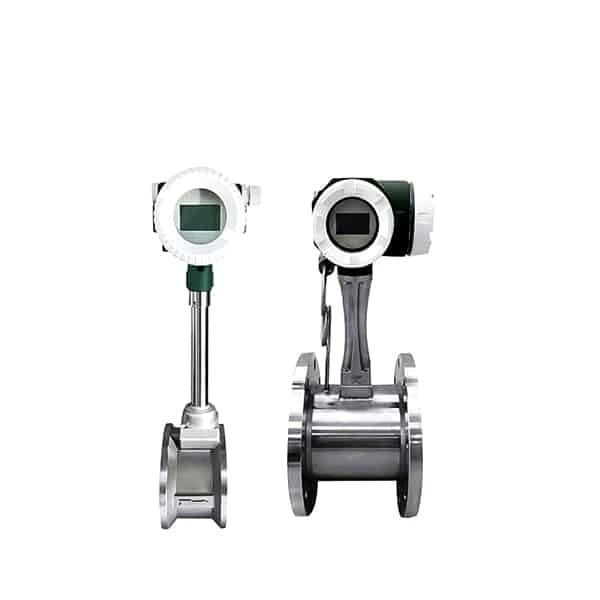 Vortex Flow Meter
The base meter in wafer or flange body, DN50 and DN80 included; it reads steam by volume, for pairing with external compensation.
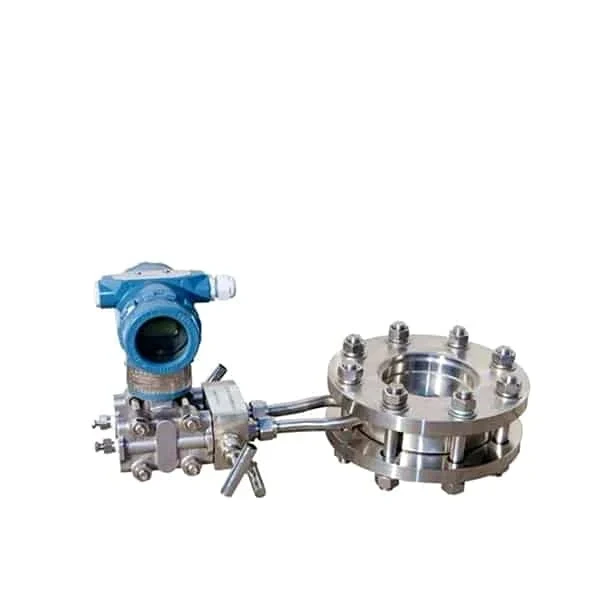 Orifice Plate Flow Meter
The differential-pressure alternative on small steam lines, paired with a DP transmitter and a flow computer.
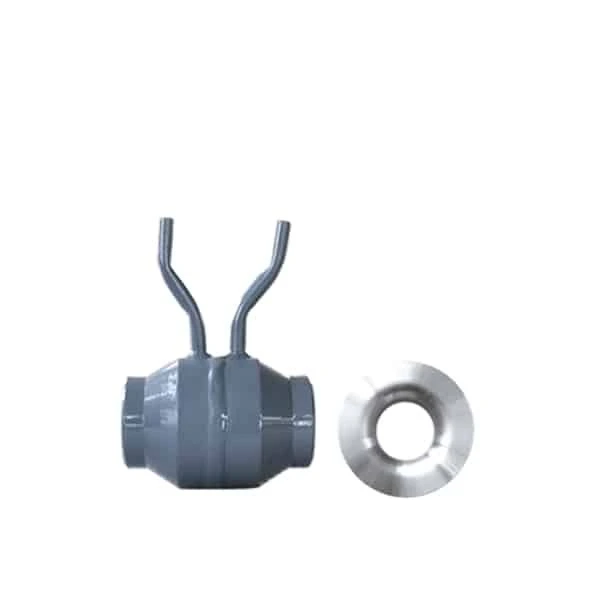 Flow Nozzle Flow Meter
For steam beyond vortex temperature and pressure limits: a wear-resistant DP element for boiler-house conditions.
Capacity by pressure
Steam flow meter sizing is velocity arithmetic. A vortex meter bore passes whatever mass of steam corresponds to its velocity band at the working density. Capacity is therefore not one number per size; it moves with pressure.
The table below multiplies the Schedule 40 bore area (inside diameter 52.50 mm for 2 inch, 77.93 mm for 3 inch) by the 2 to 70 m/s steam velocity band of our vortex meters. Density at each pressure comes from the saturated steam tables.
| Saturated steam | Density, kg/m³ | DN50 (2 in), kg/h | DN80 (3 in), kg/h |
|---|---|---|---|
| 1 barg (120 °C) | 1.14 | 18 to 620 | 39 to 1,365 |
| 3 barg (144 °C) | 2.17 | 34 to 1,184 | 74 to 2,607 |
| 5 barg (159 °C) | 3.18 | 49 to 1,732 | 109 to 3,816 |
| 7 barg (171 °C) | 4.17 | 65 to 2,273 | 143 to 5,009 |
| 10 barg (184 °C) | 5.64 | 88 to 3,078 | 194 to 6,781 |
| 16 barg (204 °C) | 8.58 | 134 to 4,679 | 295 to 10,309 |
Values are computed limits at 2 and 70 m/s, not calibration points; confirm the final range on the order. At 1 barg the 2 m/s floor is optimistic. The Reynolds number there is only about 9,000; shedding needs roughly 10,000 to stay clean, and stated accuracy holds from about 20,000, so the usable low end sits nearer 4 m/s.
Read the table vertically and the main point appears. The same DN50 meter that tops out at 620 kg/h on a 1 barg line carries 4,679 kg/h at 16 barg, seven and a half times more. A quote request that leaves out the pressure will get the wrong bore.
Sizing worked example
Take a process steam branch at 1,500 kg/h of saturated steam, 7 barg, with a 3 inch pipe already in place. At 7 barg the density is 4.17 kg/m³, so 1,500 kg/h is 360 m³/h of actual volume.
Spread over the DN80 bore that is 21.0 m/s. Over a DN50 bore it is 46.2 m/s. Both sit inside the 2 to 70 m/s band, so both meters would read.
The DN50 is still the better choice. At 21 m/s the DN80 uses less than a third of its velocity band. Every low-load condition, night setback, standby, a single consumer running, drops it toward the floor where the meter cuts off.
The DN50 at 46 m/s sits comfortably in the upper half and keeps reading down to about 65 kg/h. The general rule follows. Pick the bore that puts normal flow in the upper half of the velocity band, then verify the minimum load stays above the low-end cutoff. Our pipe velocity calculator does the velocity arithmetic for any bore and flow.
Application example
Oil and gas site, bidirectional saturated steam. An inquiry arrived with the full data set this page asks for: pipe 168.3 mm OD with 7.11 mm wall, saturated steam at 0.49 to 7.7 t/h in both directions, 1.29 MPa, a minus 46 to 330 °C rating, standard flanges. That flow range spans nearly 16:1, and the flow runs both ways, which a standard vortex meter does not read. Proposed: an orifice plate flow meter sized to the stated bidirectional range. The line was larger than DN80, but the method is the same at any size.
Meter vs line size
Steam pipes are sized for pressure loss and future load, so they usually run at lower velocity than a flow meter reads best at. The practical consequence: the correctly sized meter is often one, sometimes two, sizes smaller than the line it serves. A 3 inch header carrying 1,500 kg/h at 7 barg is a DN50 metering job. Install the meter between concentric reducers, with the straight-run requirement counted in the meter bore, not the pipe bore.
Necking down does cost some pressure drop. On a saturated steam line, though, the loss through a vortex bore one size down is small against the distribution losses. The alternative is worse: an oversized meter spends its life near the low-flow cutoff and logs zeros through every light-load shift. Fit the meter to the flow, not to the flange that happens to be there.
Turndown in practice
Catalog turndown claims for steam meters run from 30:1 to beyond 100:1. The velocity band above is 35:1 (70 over 2), and that is the working limit for the meters on this page. The higher claims lean on wider velocity bands and best-case sizing at high density.
Field results are lower. An installed vortex meter that was not sized to its actual load commonly delivers 15:1 or 20:1 before the low-flow cutoff. A poorly sized one can let a noticeable share of the plant’s light-load steam pass unmetered. That is billing and efficiency data lost, not just a display reading zero.
Two habits protect the turndown you paid for. First, size from the minimum load up, not the maximum down. The question is not whether the meter survives the peak but whether it still reads the night load.
Second, state the working pressure on the inquiry. The same kg/h figure lands at a different velocity at every pressure, as the capacity table shows.
For market context, branded 2 inch vortex steam meters trade between roughly 3,000 and 6,000 dollars in US distribution, and compensated imports run well under half of that. The extra money buys accuracy class, diagnostics, and documentation, not more turndown than the sizing allows.
Compensation and outputs
Steam is bought, balanced, and reported by mass, and a vortex meter measures velocity, which is volume. Density closes the gap. On saturated steam, pressure or temperature alone fixes the density through the steam tables. On superheated steam the two are independent and the meter needs both.
That is the reasoning behind the multivariable steam vortex meter. An RTD and a pressure cell sit on the meter body, density is computed on board, and the output is already in kg/h. The alternative is a plain vortex meter plus separate transmitters and a flow computer, covered in the pressure and temperature compensation guide.
Outputs are the standard set at both sizes: 4-20 mA for the compensated mass flow, a pulse channel for totalizing, RS-485 where the boiler house logs digitally. If the line pressure itself needs a control-room signal, that is a separate steam pressure transmitter, not a second tapping on the meter.
Installation and wet steam
Vortex meters at these sizes need a developed flow profile: allow 40 pipe diameters straight upstream and 20 downstream in the meter bore. At DN50 that is about 2.1 m and 1.05 m, short enough to find on most steam runs. Support the pipe so the meter does not carry bending loads, and insulate up to the body but leave the electronics head clear.
Wet steam is an accuracy problem no listing mentions. Saturated steam at the end of a long uninsulated run carries condensate droplets. The meter reads the vapor velocity while the water carries mass it never sees, and droplet impact erodes the bluff body over time.
Keep the metering point close to a separator or drip leg with a steam trap. If the real question is how much steam a process consumed, metering the returning condensate is sometimes the cleaner answer. The condensate flow meter guide covers when that swap makes sense.
FAQ
How to select flow meter size?
For steam, convert the mass flow to actual volume using the density at working pressure, then divide by the bore area to get velocity. Pick the size that puts normal flow in the upper half of the meter’s velocity band, 2 to 70 m/s for a vortex meter on steam. Check that the minimum load stays above the low end. The pipe size is where you start looking, not the answer: the meter is often one size smaller than the line.
What is the best flowmeter for steam measurement?
On 2 and 3 inch lines the vortex meter with temperature and pressure compensation is the standard answer. It has no moving parts, handles steam temperature, and outputs mass directly. Differential-pressure elements such as the orifice plate or flow nozzle take over at extreme pressure and temperature or where a bidirectional reading is needed.
Turbine meters that surface in size-based shopping results are not steam instruments, and a variable area tube only works on steam when its scale and compensation are built for the working pressure. The steam flow meter overview compares the technologies in full.
How to measure steam flow rate?
Measure a velocity or a differential pressure, then convert to mass. A vortex meter counts vortex shedding to get velocity and multiplies by bore area for volume flow. An orifice plate derives flow from the pressure drop across a restriction.
Either way the reading only becomes kg/h or lb/hr after density compensation from the steam temperature and pressure. That happens on the meter body in a multivariable instrument, or in a flow computer.
What are the units of measurement for steam flow?
Mass units: kg/h and t/h in metric plants, lb/hr in US practice, with 1,000 kg/h equal to about 2,205 lb/hr. Steam is accounted by mass because its volume changes with every pressure swing while the energy travels with the kilograms. A raw volumetric reading in m³/h is only a stepping stone; if a steam meter quotes capacity in m³/h without a stated pressure, the number cannot be compared to anything.
Request a quote
Send five numbers: the steam flow range in kg/h or lb/hr, the working pressure, saturated or superheated with the temperature if superheated, the line size, and the output you need. We size the bore from the flow and pressure, which is exactly the arithmetic on this page, and confirm the flange to match your line. Tell us the application and we configure one unit, not a shelf part.