Flow Meters › Vortex Flow Meters › Steam Vortex Flow Meter
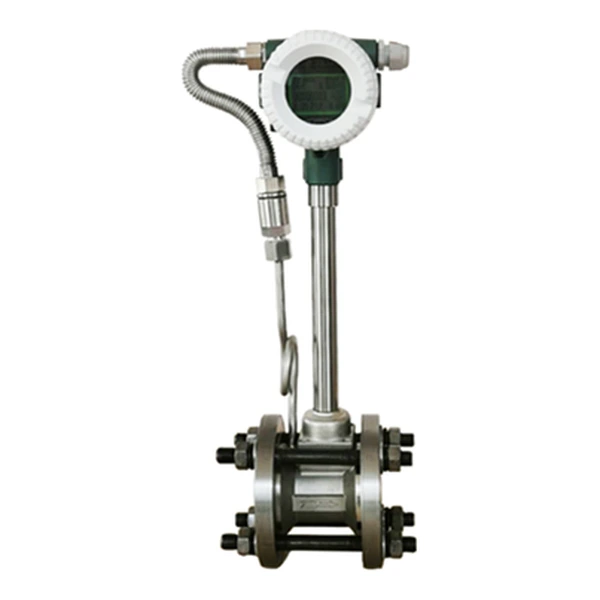
Steam Vortex Flow Meter
The vortex meter is the standard for steam. It counts the vortices a bluff bar sheds into the flow, and built-in temperature and pressure compensation turns that into a true steam mass. It has no moving parts and handles saturated and superheated steam to 400 C.
- Principle: Karman vortex shedding
- Steam: saturated and superheated, to 400 C
- Size: wafer DN15 to DN300; flange to DN1000
- Compensation: built-in temperature and pressure (steam mass)
- Output: 4-20 mA, pulse, RS-485; IP65
Overview
A steam vortex flow meter is the usual first choice for steam. A bluff bar in the bore sheds a Karman vortex street, the shedding frequency gives the velocity, and the meter scales that to volume flow. Steam, though, is sold and balanced by mass, and steam density swings with temperature and pressure, so the meter carries built-in temperature and pressure sensing and reports the steam in mass. It has no moving parts to wear in a hot wet line, and it runs to 400 C, which is why vortex is the standard steam meter.
The same body also measures gas and liquid, so this is the full-capability vortex meter set up for steam. For a general selection across all media, see the vortex flow meter; for a gas-only meter with an onboard flow computer, see the precession vortex gas flow meter. On a very large steam main, an insertion vortex flow meter fits where a full-bore body is impractical.
Features
Everything here follows from one job: metering steam by mass, in a hot line, with no moving parts.
Steam to 400 C
A temperature build to 400 C handles saturated and superheated steam, with no moving parts to wear.
Built-in T and P, steam mass
Onboard temperature and pressure sensing corrects the density and reports the steam in mass.
Saturated and superheated
One meter measures saturated and superheated steam, and the same body also reads gas and liquid.
Wafer or flange, to DN1000
A compact wafer body to DN300, or a flange body to DN1000 for large steam mains.
4-20 mA, pulse, RS-485
An LCD head drives analog, pulse, and Modbus, with a 3.6 V lithium battery option for a local total.
Low loss, integral or split
The bar adds little pressure loss, and the head mounts on the body or remote on a hot line.
Working principle
A bluff body, the shedder bar, sits across the bore. As steam passes it sheds vortices alternately from each side, the Karman vortex street, and the shedding frequency is proportional to the flow velocity. A sensor counts the frequency, and the meter scales velocity to volume flow from the known bore. Steam density, though, changes with temperature and pressure, so an integrated temperature and pressure measurement corrects the density and gives the flow in mass. Because the shedding has to be clean, the meter needs a developed profile: 40 diameters of straight pipe upstream and 20 downstream.
Technical specifications
| Parameter | Specification |
|---|---|
| Measurement principle | Karman vortex shedding; volumetric, with temperature and pressure compensation to mass |
| Medium | Saturated and superheated steam; also gas and liquid |
| Size | Wafer DN15 to DN300; flange to DN1000 |
| Medium temperature | -40 to 80, 150, 300, or 400 C (by build) |
| Ambient temperature | -20 to 70 C, 86 to 106 kPa |
| Nominal pressure | Steam and gas 1.6 to 5.0 MPa; liquid to 25 MPa |
| Accuracy | ±1.0% or ±1.5% of rate |
| Velocity range | Steam 2 to 70 m/s; gas 1.5 to 60 m/s; liquid 0.15 to 7 m/s |
| Compensation | Integrated temperature and pressure on the meter (steam mass) |
| Outputs | 4-20 mA; three-wire voltage pulse (high ≥5 V, low <1 V); RS-485 |
| Power | DC 12 V or 24 V; 3.6 V lithium battery for local display |
| Display | LCD: rate, total, vortex frequency, temperature, pressure |
| Straight run | 40D upstream, 20D downstream |
| Cable entry | M20 x 1.5 or 1/2 NPT |
| Mounting | Integral or split (10-core shielded cable) |
| Protection | IP65 |
| Explosion protection | Intrinsically safe Ex ia IIC T6 Ga |
Representative specifications; confirm per datasheet for the size, steam condition, and temperature you need.
Ordering example. Steam vortex flow meter for saturated steam on a DN100 line, 1.0 MPa, built-in temperature and pressure compensation, 4-20 mA and RS-485, flange body.
Measuring range
A vortex meter is sized by velocity, not by a fixed flow table. Keep the steam velocity inside the band so vortex shedding stays strong across the turndown; size the bore to the steam flow at the working pressure.
| Medium | Velocity range | Note |
|---|---|---|
| Steam | 2 to 70 m/s | Saturated or superheated |
| Gas | 1.5 to 60 m/s | Compressed air and plant gas |
| Liquid | 0.15 to 7 m/s | Clean, low-viscosity liquid |
Saturated or superheated
Steam is metered by mass, and steam density changes sharply with temperature and pressure, so the meter has to correct for it. How it corrects depends on the steam:
- Saturated steam. Temperature and pressure track each other on the saturation line, so density follows from pressure alone using steam tables. A pressure input is enough, and pressure compensation gives the higher accuracy.
- Superheated steam. Temperature and pressure are independent, so the meter needs both to fix the density. Temperature alone is not enough and would carry a large error.
The reason compensation matters is the size of the density swing. Saturated steam at 1.0 MPa that drops to 0.8 MPa loses close to a fifth of its density, and an uncompensated vortex meter would then over-read the mass by roughly 20%. Built-in temperature and pressure on the meter removes that error and reports a true steam mass.
Applications
Steam vortex meters suit boiler and process steam where a true mass total matters:
- Boiler-house steam output and distribution headers
- Process steam to reactors, dryers, and heat exchangers
- Sterilize-in-place and clean-steam utilities
- District heating and campus steam loops
- Steam sub-metering for energy cost allocation
Application example
Steam metering with remote readout. A utility plant in Europe metered steam with a vortex meter set up for temperature and pressure compensation, where the indicator had to sit about 25 m from the hot line. A split build put the measuring body in the steam run and the head in a cooler, accessible spot on a shielded cable, and the onboard compensation gave a steam mass total rather than a raw volume. The customer wanted tighter accuracy than the meter class, and accepted the vortex meter once the compensation and the mass output were in place.
Related products
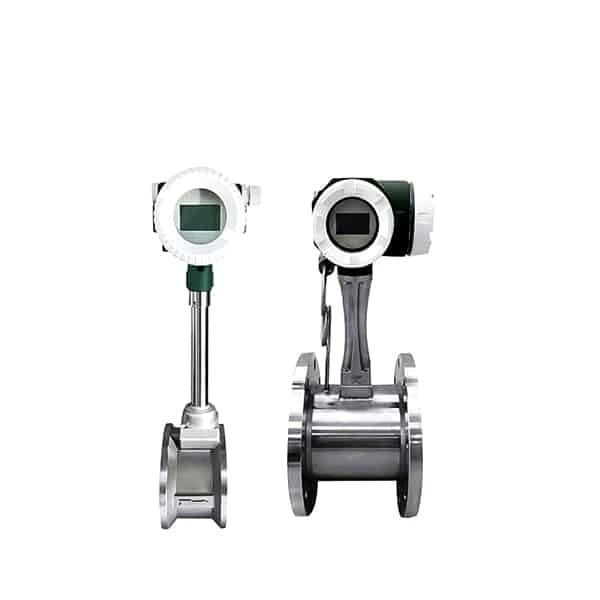 Vortex Flow Meter
General vortex selection for steam, gas, and liquid, DN15 to DN1000.
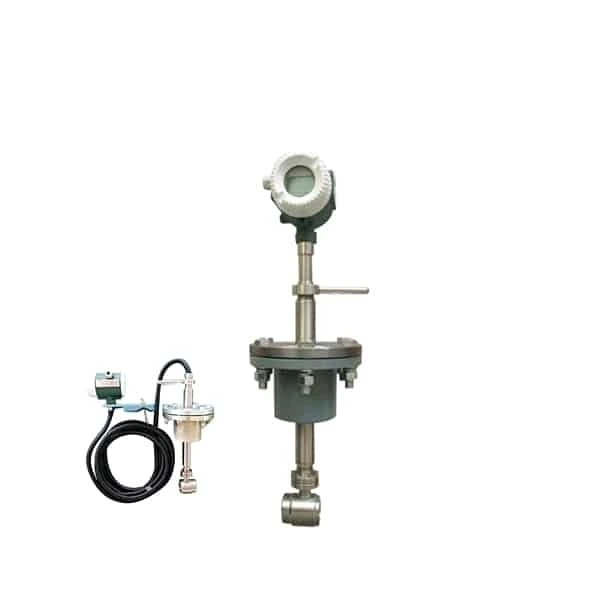 Insertion Vortex Flow Meter
For large steam mains where a full-bore body is impractical.
Browse all vortex flow meters →
Related applications: Steam.
Steam density moves with every boiler load swing, which is why this meter carries its own compensation. The math behind it is explained in our pressure and temperature compensation guide.
On the return side of the same loop the fluid is hot water near saturation, and flash steam decides what a meter can read. That case is worked through in the guide on metering steam condensate.
If the job is a DN50 or DN80 line, the 2 inch and 3 inch steam flow meter page gives the saturated steam capacity of each bore across the pressure range.
A vortex meter holding the wrong density reads high by a known amount; the arithmetic is in saturated vs superheated steam.
FAQ
How do you measure steam flow?
With a vortex flow meter and temperature and pressure compensation. A bluff bar sheds a vortex street whose frequency gives the steam velocity, and the meter scales that to volume; built-in temperature and pressure then correct the density and report the steam in mass. Vortex is the standard because it has no moving parts and runs hot.
What is the best flow meter for steam?
A vortex meter, for most steam lines. It handles saturated and superheated steam to 400 C, has no moving parts to wear in a hot wet flow, adds little pressure loss, and corrects to mass on board. For a very large main, an insertion vortex meter covers the size at a lower cost.
Does a steam flow meter need temperature and pressure compensation?
Yes. Steam density swings with temperature and pressure, so without compensation the mass reading drifts as conditions change, by tens of percent across a pressure swing. Built-in temperature and pressure removes that error. For saturated steam a pressure input is enough; for superheated steam you need both.
What is the difference between saturated and superheated steam here?
For saturated steam, temperature and pressure track the saturation line, so density follows from pressure alone. For superheated steam they are independent, so the meter needs both temperature and pressure to fix the density. The compensation set differs accordingly.
Request a quote
Send us the steam condition, the size, the flow range, and the temperature and pressure, and we set the body, the compensation, and the outputs.