Flow Meters › Magnetic Flow Meters › Magnetic Flow Meter
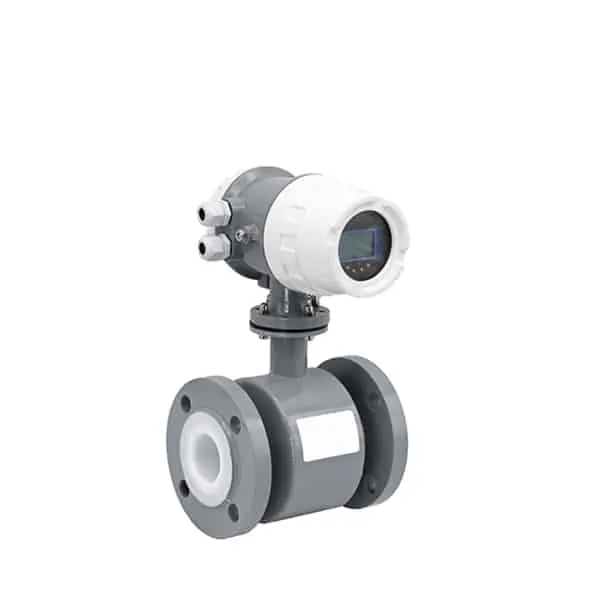
Magnetic Flow Meter
An obstruction-free electromagnetic flow meter for conductive liquids: water, wastewater, slurries, acids, and alkalis. No moving parts, no pressure loss, and accuracy held across changing density, viscosity, and temperature.
- Sizes: DN6 to DN2000
- Accuracy: ±0.5% of reading standard, ±0.2% optional
- Conductivity: ≥5 µS/cm
- Liners: rubber, polyurethane, PTFE, PFA
- Output: 4-20 mA, pulse/frequency, RS485
Overview
A magnetic flow meter measures the volume flow of any liquid that conducts electricity, down to about 5 µS/cm. Because nothing sits in the bore, it adds no pressure loss and shrugs off suspended solids, fibers, and abrasive slurry that would jam a turbine or clog a meter with moving parts. The reading does not drift with density, viscosity, or temperature, which is why water utilities, wastewater plants, mining, chemical, and food lines run them as the default for conductive service.
The meter is a sensor plus a converter. The sensor is a lined steel tube with a pair of field coils and two electrodes; the converter drives the coils, reads the millivolt signal, and outputs flow. It ships as a compact integral unit or as a remote sensor with a wall-mount converter for hot, vibrating, or hard-to-reach lines. The match that matters is liner and electrode to the process. The rest of this page walks the selection.
Features
What an electromagnetic meter gives you on conductive liquids:
No obstructionEmpty bore, no moving parts, no pressure loss; passes solids and slurry.
Stable across the processReading independent of density, viscosity, temperature, and pressure.
Wide size rangeDN6 to DN2000, one principle from dosing lines to outfalls.
Liner and electrode choiceRubber, polyurethane, PTFE, or PFA; 316L to Hastelloy, titanium, tantalum.
Smart diagnosticsEmpty-pipe detection and electrode-resistance checks flag bubbles and coating.
Integral or remoteCompact or wall-mount converter; 4-20 mA, pulse, and RS485 outputs.
Working principle
The meter runs on Faraday’s law of induction. The coils set up a magnetic field across the bore. As conductive liquid moves through that field, it generates a voltage between the two electrodes that is proportional to the average flow velocity. The converter measures that voltage and, knowing the bore area, reports volume flow. Field strength and electrode spacing are fixed by the build, so the signal tracks velocity in a straight line. This is also the limit of the technology: a liquid that does not conduct, such as oil, a pure hydrocarbon, or deionized water, produces no signal and cannot be measured.
Technical specifications
| Parameter | Specification |
|---|---|
| Principle | Electromagnetic induction (Faraday’s law) |
| Nominal size | DN6 to DN2000 |
| Accuracy | ±0.5% of reading standard; ±0.2% optional |
| Minimum conductivity | ≥5 µS/cm |
| Liner | Rubber, polyurethane, PTFE, or PFA |
| Electrode | 316L standard; Hastelloy C, titanium, tantalum options |
| Nominal pressure | 4.0 MPa (DN10-150), 1.6 MPa (DN10-1000), 1.0 MPa (DN10-1600), 0.6 MPa (DN10-2000); special ratings on request |
| Medium temperature | Set by liner: up to ~80°C (rubber/polyurethane), ~150°C (PFA), ~180°C (PTFE) |
| Output | 4-20 mA, pulse/frequency, RS485/RS232 (Modbus) |
| Power supply | 85-265 VAC or 24 VDC; two-wire and four-wire versions |
| Body / flange | Carbon steel, stainless options; flange to DIN, ANSI/ASME, or JIS |
| Mounting | Integral or remote converter; submersible sensor for buried lines (rating per nameplate) |
Representative specifications; confirm exact figures per datasheet for the chosen size and build.
Liners and electrodes
Two choices decide whether the meter survives the process: the liner, which sets the temperature ceiling and the abrasion and chemical resistance, and the electrode, which has to read a millivolt signal without corroding or coating over. Pick the liner by temperature and chemistry first, then the electrode by the media.
| Liner | Temp limit | Strength | Best for |
|---|---|---|---|
| Rubber (neoprene) | ~80°C | Abrasion, low cost | Water, raw sewage, mild slurry |
| Polyurethane | ~80°C | Excellent abrasion | High-sand produced water, mineral slurry |
| PTFE | ~180°C | Broad chemical resistance | Hot, oily, or aggressive acids and alkalis |
| PFA | ~150°C | Smooth bore, vacuum rating | Clean chemical and food service |
Electrodes follow the chemistry: 316L for water and most utility service, Hastelloy C for mixed acids, titanium for chlorides and seawater, and tantalum for the most aggressive media such as concentrated acids. Sanitary builds add tri-clamp connections and a polished PTFE bore for CIP lines.
Models and ordering
The series shares one sensor and converter platform across several mounting and power options. Pick the version by where the meter sits and how it is powered.
| Version | Use it for |
|---|---|
| Integral (compact) | Standard in-line metering on accessible pipe |
| Remote converter | Hot, vibrating, flooded, or hard-to-read locations; converter on the wall |
| Battery powered | No mains power; distribution and irrigation networks |
| Insertion | Large pipe where a full-bore meter is too costly; hot-tap install |
Quote checklist, send these five points:
- Pipe size and flange standard (DIN, ANSI/ASME, or JIS)
- Medium, and whether it is conductive (water, slurry, acid, alkali)
- Flow range, process temperature, and line pressure
- Liner and electrode preference, or let us choose from the chemistry
- Output and power: 4-20 mA, pulse, RS485; mains or battery; integral or remote
Ordering example. DN100, ANSI 150 flange, PTFE liner, 316L electrodes, 4-20 mA plus RS485, 220 VAC, integral converter, for treated water. Tell us the application and we configure one meter for it, not a shelf part.
Installation
A magnetic flow meter only reads right when the bore is full and the field is clean. Keep a straight run of 5D upstream and 3D downstream; where a valve, elbow, or reducer sits upstream, open that to 10D upstream and 5D downstream. Mount so the tube stays full, with no air pocket at the electrodes; a vertical run with upward flow is the safest fill. Ground the sensor to the liquid with grounding rings or grounding electrodes so the signal has a stable reference, and avoid mounting next to large motors or variable-frequency drives that inject electrical noise. The empty-pipe and electrode-resistance diagnostics will flag a draining line or a coating electrode before the reading goes quietly wrong.
Applications
Magnetic flow meters run wherever the liquid conducts: potable and raw water, wastewater and sludge, mineral slurry in mining, pulp stock in paper, dosing and process lines in chemical plants, and CIP and product lines in food and beverage. The two examples below are anonymized from our project records.
Application example
Steel mill, corrosive process water. A mill standardized on PTFE-lined magnetic flow meters in 14 in (DN350) lines carrying chemically aggressive process water, where an obstruction-free bore and a chemically resistant liner were the deciding requirements. The order ran to roughly fifty units across the plant on a single liner and electrode specification.
Application example
Water utility, tendered supply. A utility tender called for DN100 meters at 1.5 MPa and 0 to 60°C, PTFE liner with 316L electrodes, 4-20 mA output, on ASME Class 150 flanges. The standard build met every line of the specification, so the same configuration covered the full set of meters in the tender.
Related products
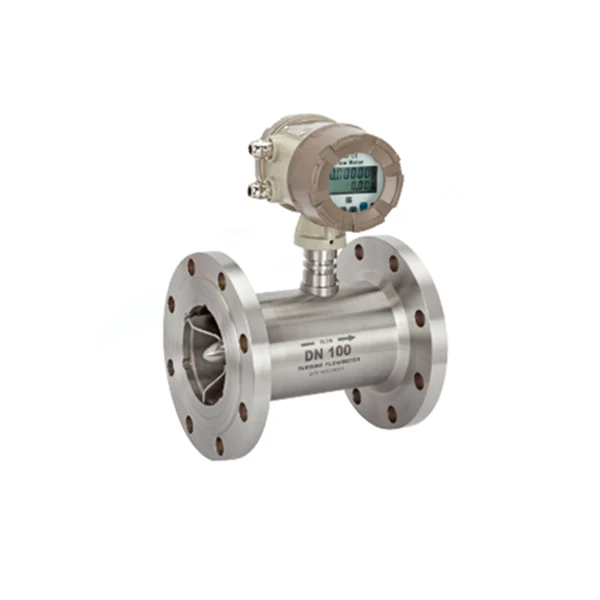 Turbine Flow Meter
Clean low-viscosity liquids, high turndown and pulse output.
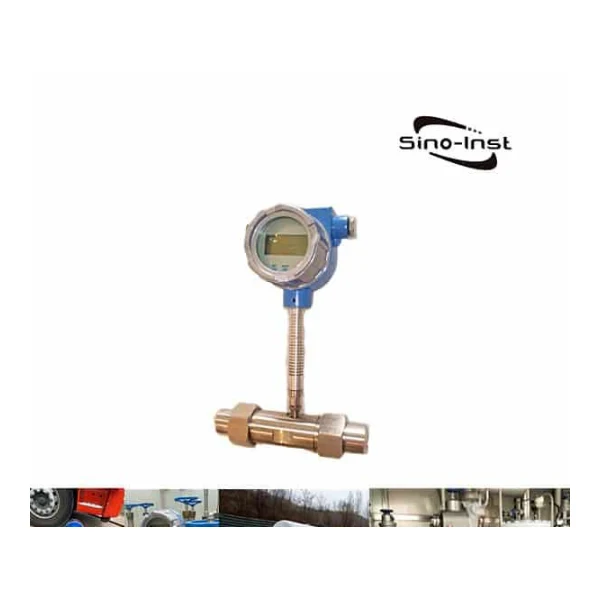 Liquid Nitrogen Flow Meter
Cryogenic turbine metering for LN2 and other liquefied gases.
Related applications: Chemical, Wastewater, Slurry.
One conductive solution worth a note is ammonia water: magnetic meters handle the aqueous form but not anhydrous NH3, as explained in our ammonia flow meter guide.
On agricultural mains the choice is often between this meter and the traditional propeller meter; our irrigation flow meter page compares them by accuracy, straight run and site power.
Planning to mount the meter on a riser? Vertical mounting with upward flow is fully supported; the orientation rules for every meter type are collected in our vertical flow meter installation guide.
Metered pump test lines that discharge to a tank or drain are one more service for full-bore magnetic meters; see the fire pump flow meter selection page.
FAQ
What is a magnetic flow meter used for?
It measures the volume flow of conductive liquids: water, wastewater, slurry, acids, and alkalis. Because the bore is empty, it suits dirty and abrasive service that would clog a mechanical meter, and it adds no pressure loss to the line.
What liquids can a magnetic flow meter measure?
Any liquid with a conductivity of about 5 µS/cm or higher. It cannot measure non-conductive fluids such as oils, pure hydrocarbons, gases, or deionized water, which produce no signal in the magnetic field.
How accurate is a magnetic flow meter?
Standard accuracy is ±0.5% of reading, with a ±0.2% option. Accuracy holds across changes in density, viscosity, and temperature as long as the pipe stays full and the liquid stays conductive.
How much straight pipe run does a magnetic flow meter need?
Plan for 5 pipe diameters upstream and 3 downstream. If a valve, elbow, or reducer sits just upstream, open that to 10 diameters upstream and 5 downstream, and keep the bore full at the electrodes.
Request a quote
Send the five points from the quote checklist and our application engineers will size the meter, choose the liner and electrode for your chemistry, and confirm the output and flange. Not sure the liquid conducts? Tell us what it is and we will confirm whether a magnetic meter fits or route you to the right technology.
Written and technically reviewed by the Instranova engineering team. Based on the SI electromagnetic flow meter series datasheet, IEC/Faraday measurement principle, and field experience with conductive water, wastewater, and slurry service.