Flow Meters › Differential Pressure Flow Meters › Orifice Plate Flow Meter
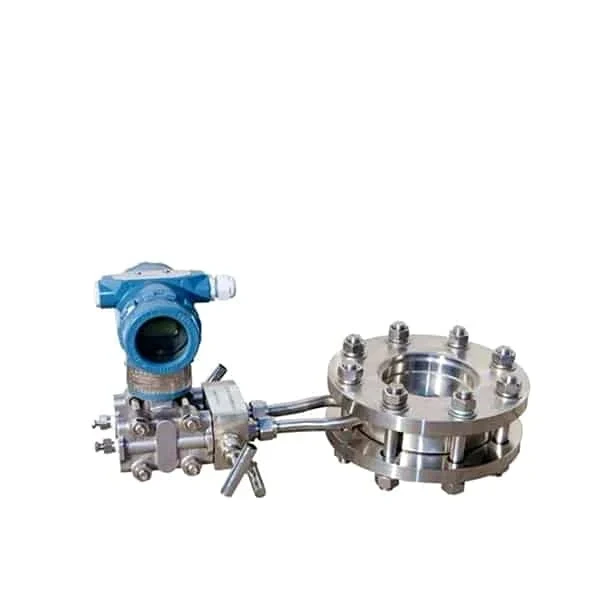
Orifice Plate Flow Meter
A differential pressure flow meter that measures with an orifice plate. The plate narrows the pipe, the flow speeds up and the pressure drops, and a transmitter reads that drop. Flow follows the square root of the pressure difference, so it measures clean liquid, gas, and steam with no moving parts.
- Principle: Differential pressure, orifice plate
- Standard: ISO 5167, beta ratio 0.2 to 0.75
- Size: DN50 to DN1000 and up; integral for small bore
- Medium: clean liquid, gas, and steam
- Output: DP transmitter, 4-20 mA and HART
Overview
An orifice plate flow meter is the most widely used differential pressure flow meter. A thin plate with a precise bore, the orifice, sits between two flanges and narrows the pipe. As the fluid passes the constriction it speeds up, and the pressure falls; pressure taps on each side of the plate feed a differential pressure transmitter that reads the drop. By Bernoulli, the flow rate follows the square root of that pressure difference, so the meter infers flow from a pressure reading, with no moving parts in the line.
It is the standard, low-cost way to meter clean liquid, gas, and steam, and the orifice plate is made and installed to ISO 5167, so the discharge coefficient is known without a flow calibration. The orifice gives a permanent pressure loss, which a vortex flow meter or a low-loss DP element avoids; for a packaged small-bore build the integral orifice carries the plate, taps, and transmitter as one unit.
Features
Everything here follows from one idea: read flow from the pressure drop across a known orifice.
Orifice plate element
A precise bored plate narrows the pipe and creates the pressure drop the meter reads.
Made to ISO 5167
Plate, taps, and beta ratio follow ISO 5167, so the coefficient is known without a calibration.
Liquid, gas, and steam
One technique reads clean water, oil, gas, and steam, from small bore to very large pipe.
No moving parts
Only the plate is in the line, so it is rugged and serviceable, with the electronics in the transmitter.
4-20 mA and HART
An integral or remote DP transmitter sends 4-20 mA with HART, and reads square-rooted flow.
Low cost, large pipe
The lowest-cost way to meter a very large pipe, where other technologies are dear.
Working principle
The orifice plate narrows the bore, so the fluid must speed up to pass through it. As the speed rises, the static pressure falls, by conservation of energy; downstream of the plate the pressure partly recovers. Pressure taps on the upstream and downstream sides feed a differential pressure transmitter, which reads the drop across the plate. Bernoulli’s relation makes the flow rate proportional to the square root of that pressure difference, with a discharge coefficient set by the plate geometry and the beta ratio, the bore divided by the pipe diameter. Because the plate is made to ISO 5167, the coefficient is known from the standard, so the meter reads without a wet calibration. The transmitter takes the square root and outputs flow.
Technical specifications
| Parameter | Specification |
|---|---|
| Measurement principle | Differential pressure across an orifice plate; flow follows the square root of the drop |
| Medium | Clean liquid, gas, and steam (water, oil, air, natural gas, saturated and superheated steam) |
| Standard | ISO 5167 (or GB/T 2624); concentric, eccentric, or segmental plate |
| Beta ratio | 0.2 to 0.75 (bore to pipe diameter) |
| Pressure taps | Flange, corner, or D and D/2 |
| Size | DN50 to DN1000 and larger; integral orifice for small bore (DN10 to DN50) |
| Accuracy | About 1% of reading, set largely by the DP transmitter; tighter with flow calibration |
| Turndown | About 3:1, wider with a smart or stacked transmitter |
| Plate material | 304 or 316 stainless; higher alloys for corrosive or high-temperature service |
| Transmitter | Integral or remote DP transmitter; 4-20 mA with HART; square-root extraction |
| Connection and pressure | Flanged to the line rating; high-pressure and high-temperature builds available |
| Straight pipe | Required upstream and downstream per ISO 5167 (depends on beta and fittings) |
Representative specifications; the plate is sized to ISO 5167 for the line, fluid, and flow you give us.
Ordering example. Orifice plate flow meter, DN150, saturated steam, 0 to 8 t/h, 316 plate, flange taps, integral DP transmitter with HART.
Orifice, venturi, or other element
The orifice plate is one of several differential pressure elements, and the choice trades cost against pressure loss and turndown:
| Element | When to choose it instead of an orifice |
|---|---|
| Venturi | Low permanent pressure loss on large pipes, where pumping energy matters |
| Flow nozzle | High-temperature, high-pressure, and high-velocity service, above all steam |
| V-Cone | Very short straight runs and a wider turndown in tight piping |
| Wedge | Viscous, dirty, and slurry fluids that would clog an orifice |
| Averaging pitot tube | The lowest pressure loss, and big pipes installed through a single tap |
See the differential pressure flow meters overview to compare them all.
Applications
Orifice plate flow meters suit clean flow across industry:
- Steam metering in plants and boilers
- Natural gas and process gas measurement
- Water, feedwater, and cooling-water lines
- Clean oil and process liquid
- Large-pipe flow where other meters are costly
Application example
Steam header. A plant metering saturated steam on a large header needed a rugged, low-cost measurement that would not foul. An orifice plate flow meter, sized to ISO 5167 with a 316 plate and an integral DP transmitter, read the steam from the pressure drop with nothing moving in the line. Setting the straight pipe run and the beta ratio for the header was the detail to confirm at sizing.
Ordering an orifice plate? The tapping type (corner, flange, or D and D/2) is part of the discharge-coefficient calculation and has to be specified with the plate.
Related products
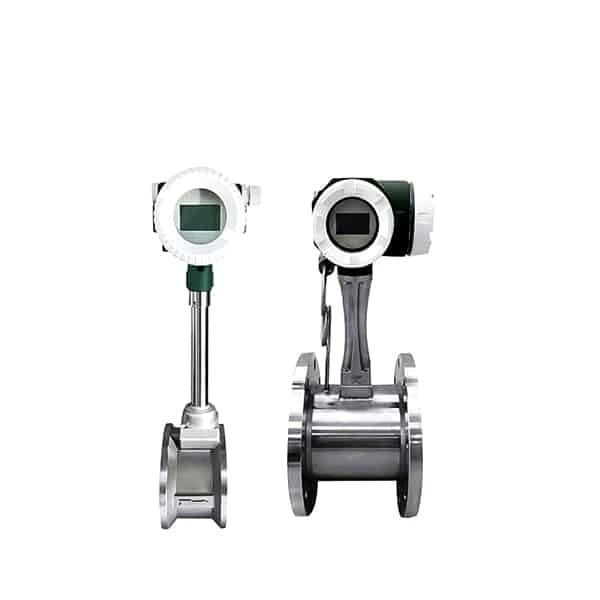 Vortex Flow Meter
A no-moving-parts meter for steam and gas with a wider turndown.
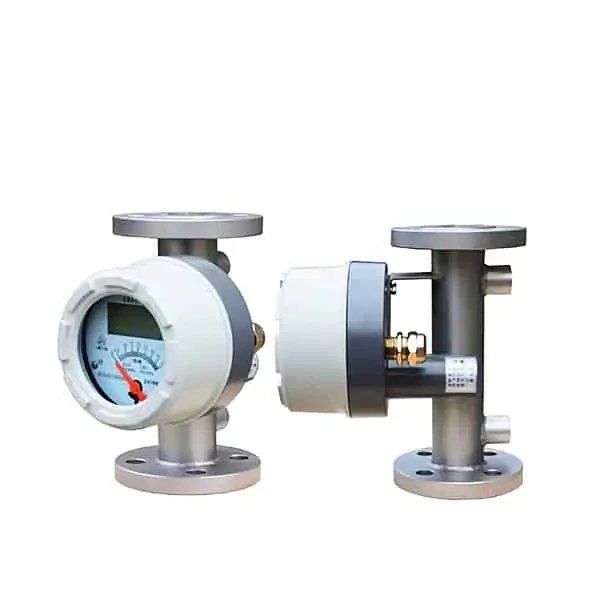 Metal Tube Rotameter
A simple local flow read for smaller lines.
Browse all differential pressure flow meters →
Related applications: Steam.
For the physics behind the square-root law, with a worked flow calculation from a 25 kPa drop, read the guide to the flow rate and pressure relationship. To estimate flow from your own DP reading, use the flow rate from pressure calculator.
FAQ
How does an orifice plate flow meter work?
An orifice plate narrows the pipe, so the fluid speeds up and the pressure drops across it. A differential pressure transmitter reads that drop, and because flow follows the square root of the pressure difference, the transmitter computes the flow. Only the plate is in the line; there are no moving parts.
How accurate is an orifice flow meter?
About 1% of reading, set largely by the differential pressure transmitter and the plate. Because the plate is made to ISO 5167, the discharge coefficient is known from the standard, and a flow calibration tightens it further.
What is the beta ratio?
The beta ratio is the orifice bore divided by the pipe inside diameter, usually 0.2 to 0.75. A smaller beta gives a larger pressure drop and a stronger signal but a higher permanent loss; the plate is sized for the line and flow.
What is the difference between an orifice plate and a venturi?
An orifice plate is the lowest cost and the most common, with a higher permanent pressure loss. A venturi or nozzle recovers most of the pressure, so the loss is low, which saves energy on large flow at a higher price. We help you choose by line size, flow, and loss budget.
Request a quote
Send us the line size, the fluid, the flow range, and the pressure and temperature, and we size the orifice plate to ISO 5167 and set the transmitter.