Home › Products › Density meters › Coriolis density meter
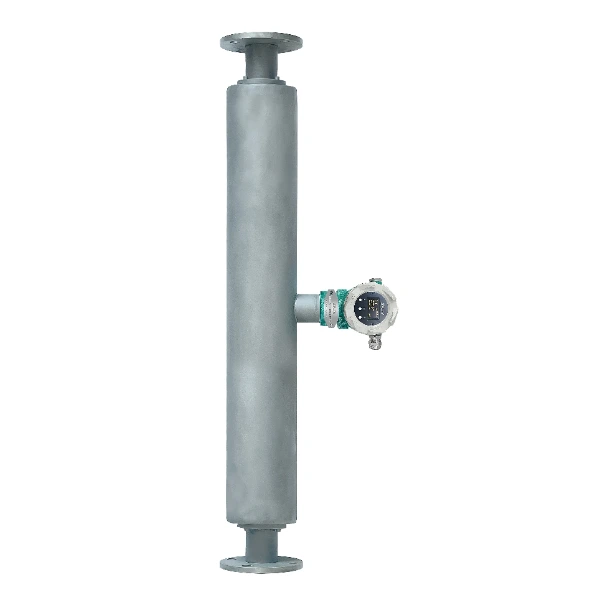
Coriolis Density Meter
A Coriolis density meter measures liquid density from the resonant frequency of a vibrating flow tube, to a high accuracy of ±0.001 g/cc. The full-bore tube carries the whole stream, so it reads density and the concentration it implies continuously, with no probe in the flow.
- Range: 0 to 3 g/cc (0 to 3000 kg/m³)
- Accuracy: ±0.001 g/cc (±1 kg/m³)
- Output: 4-20 mA, RS-485 Modbus RTU
- Wetted: 316L or titanium
- Rating: IP65, Ex d IIB T6
Overview
A Coriolis density meter is an inline instrument that reads liquid density continuously from a vibrating measuring tube. The whole process stream passes through the tube, which is driven at its resonant frequency; the denser the liquid, the lower that frequency, and the meter converts the shift to density with high precision. Because density maps to concentration for a known fluid, the same meter holds blend ratios and tracks solution strength in real time. For direct mass flow on the same vibrating-tube principle, see the Coriolis mass flow meter.
This is the higher-accuracy, full-bore option in the density line. Where a clamp-in probe is enough, the tuning fork density meter is simpler and lower cost; where the tightest density figure and a flow-through tube are wanted, the Coriolis meter is the choice. The same vibrating-tube sensor can also report mass flow when configured as a flow meter.
Features
±0.001 g/cc density from a vibrating measuring tube.
The whole stream flows through; nothing protrudes into the line.
One reading gives density and the concentration it implies.
The pressure effect on the reading is corrected and negligible.
316L or titanium wetted parts, configured to the fluid.
4-20 mA and RS-485 Modbus RTU; Ex d IIB T6 rated.
Working principle
The sensor is a measuring tube driven into vibration at its natural frequency. The mass of fluid inside the tube sets that frequency: a denser fluid raises the vibrating mass and lowers the frequency in a precise, repeatable way. The transmitter measures the frequency and converts it to density, correcting for temperature so the reading stays stable as the process changes. When the same tube is also used to measure mass flow, the Coriolis effect on the vibrating tube gives flow while the frequency gives density.
Because density comes from a frequency rather than a moving part, the reading is largely independent of flow rate and stays stable across the operating range once temperature is corrected. The same vibrating tube can also resolve mass flow from the Coriolis phase shift, so one meter can deliver density and concentration, and optionally mass flow, for clean single-phase liquids at high accuracy.
Technical specifications
| Parameter | Specification |
|---|---|
| Measuring principle | Coriolis vibrating tube (resonant frequency) |
| Measuring range | 0 to 3 g/cc (0 to 3000 kg/m³) |
| Accuracy | ±0.001 g/cc (±1 kg/m³) |
| Repeatability | ±0.001 g/cc |
| Calibration range | 0.6 to 1.25 g/cc (600 to 1250 kg/m³) |
| Temperature effect | ±0.1 kg/m³ per °C (corrected) |
| Pressure effect | Corrected, negligible |
| Viscosity | Up to 500 cP (long sensor up to 20000 cP) |
| Wetted parts | 316L stainless or titanium (customizable) |
| Output | 4-wire, 4-20 mA; optional RS-485 Modbus RTU |
| Power supply | 24 VDC, 50 mA |
| Process connection | Flange (rating sets the maximum working pressure) |
| Enclosure / approvals | Aluminum alloy, IP65; Ex d IIB T6 Gb |
Accuracy applies within the 0.6 to 1.25 g/cc calibration range; the test pressure is 1.5 times the maximum working pressure.
Density and concentration
For a known fluid, concentration follows from density, so the Coriolis meter doubles as a concentration analyzer. Once the density-to-concentration relationship is set, it reads out percent by weight, Brix, Baume, or a custom scale, usually referenced to 20 °C. Producers use this to hold a blend, track an acid or sugar strength, and adjust dosing in real time. For a fluid with more than two components, density still trends reliably but concentration should be confirmed against a lab check.
Coriolis versus tuning fork
Both measure density from a vibrating element; the difference is the sensor and the accuracy.
| If you need | Use |
|---|---|
| The tightest density, a full-bore tube, optional mass flow | Coriolis density meter (this product) |
| A simpler, lower-cost probe that dips into a pipe or tank | Tuning fork density meter |
| A handheld unit for field spot checks | Portable density meter |
Applications
Coriolis density meters fit blending and concentration control where accuracy matters: fuel blending and custody-quality fuel density, acid and caustic strength, sugar and beverage concentration, vegetable oil, and chemical solution control. They suit clean to moderately viscous liquids in a piped stream, and the same body can be specified for mass flow where both flow and density are needed.
Application example
Challenge. A fuel operation needed a continuous, accurate density reading on diesel for quality and mass accounting, output over a digital bus with no local display.
Solution. A Coriolis density meter measured fuel density to ±0.001 g/cc inline and sent the value over RS-485 to the monitoring system.
Result. The operation gained a stable, high-accuracy density signal for fuel quality and mass figures, without grab samples or a local gauge.
Related products
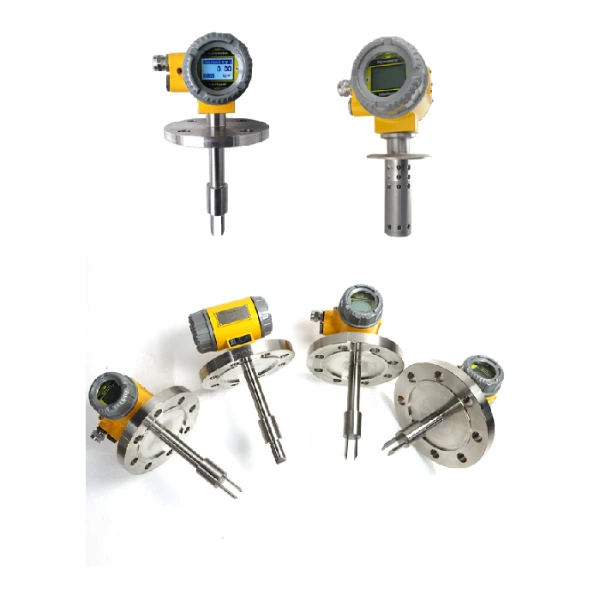 Tuning Fork Density Meter
Lower-cost inline density and concentration probe.
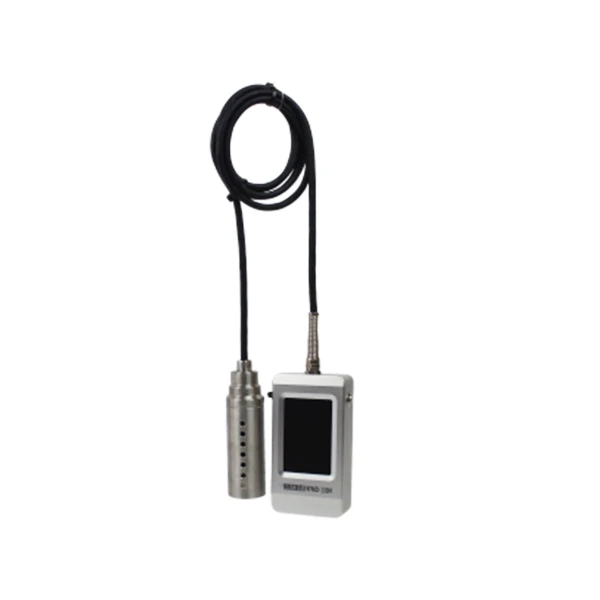 Handheld Density Meter
Portable digital density meter for petroleum: reads density and API gravity from a sample on site.
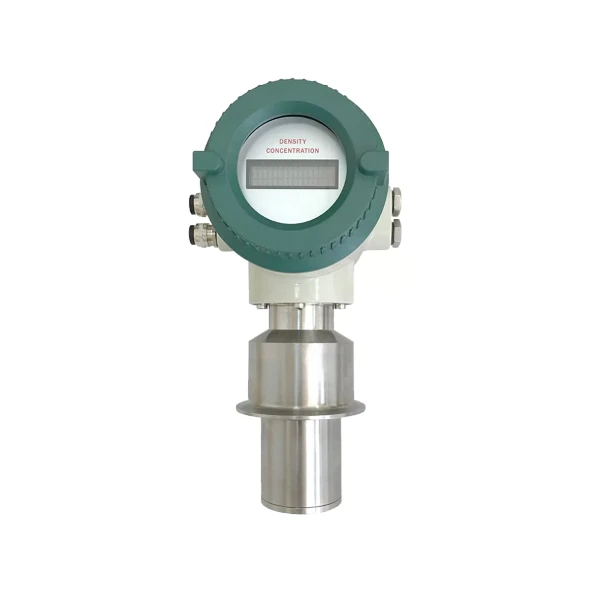 Optical Density Meter
Inline optical concentration meter for clear process liquids where light passes through the fluid.
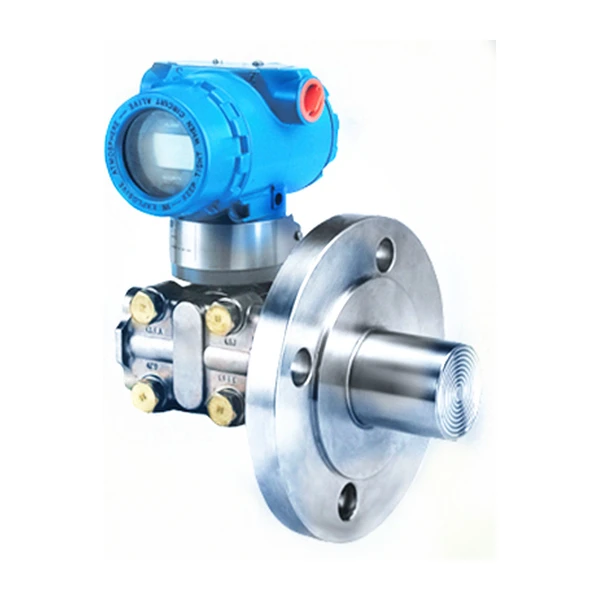 DP Density Meter
Hydrostatic DP density for slurry, acid, and viscous fluids where Coriolis and tuning fork foul.
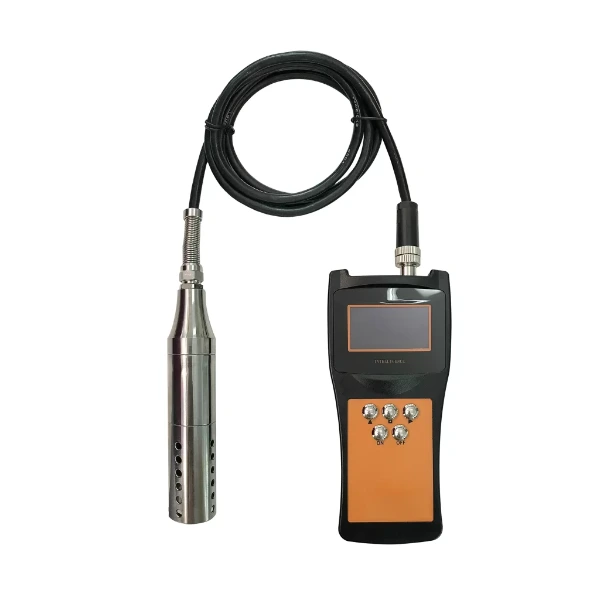 Portable Density Meter
Handheld field density and concentration checks.
FAQ
How does a Coriolis density meter work?
A measuring tube is vibrated at its resonant frequency while the liquid flows through it. The mass of the fluid in the tube sets the frequency, so a denser fluid lowers it. The transmitter measures that frequency, corrects for temperature, and converts it to density.
How accurate is a Coriolis density meter?
This meter reads density to ±0.001 g/cc (±1 kg/m³), with the same repeatability, within a 0.6 to 1.25 g/cc calibration range. The pressure effect is corrected and negligible, and temperature is compensated.
What is the difference between a Coriolis and a tuning fork density meter?
A Coriolis meter passes the whole stream through a vibrating tube and reaches the tightest density figure, and it can also measure mass flow. A tuning fork density meter is a simpler, lower-cost probe that dips into the line. Choose Coriolis for accuracy and a full-bore tube, the fork for cost and simplicity.
Can a Coriolis density meter measure concentration?
Yes. Because concentration follows from density for a known fluid, the meter outputs percent by weight, Brix, Baume, or a custom scale once the relationship is set, usually referenced to 20 °C.
Does a Coriolis density meter also measure flow?
The same vibrating-tube sensor can measure mass flow when configured as a Coriolis flow meter. This page covers the density and concentration function; tell us if you also need mass flow and we specify the right configuration.
Request a quote
Send the fluid, the density or concentration range, the line size and pressure, and any area approvals, and we configure one density meter for the line.
About this page: written by Instranova application engineers from real Coriolis density meter product data.