Flow Meters › Ultrasonic Flow Meters › Doppler Ultrasonic Flow Meter
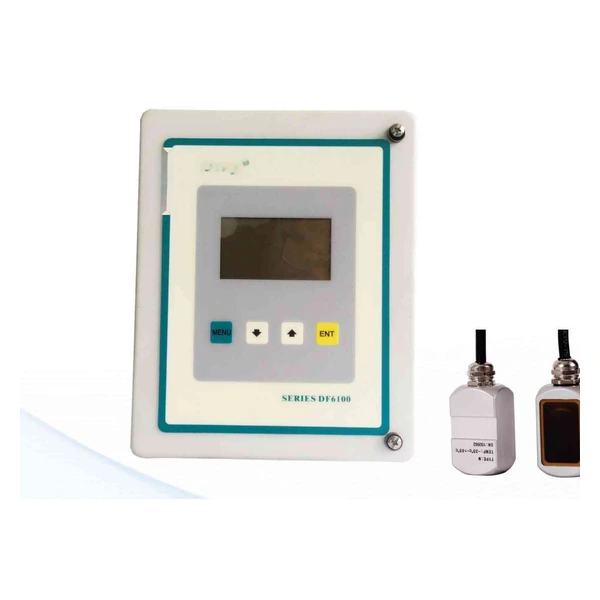
Doppler Ultrasonic Flow Meter (DF6100)
A clamp-on flow meter for the dirty, solids-bearing liquids a transit-time meter cannot read. The transducers strap to the outside of a full pipe and bounce ultrasound off the suspended solids and bubbles in the flow; the frequency shift is the velocity. Nothing is cut and nothing touches the liquid, so it goes on a live line carrying sewage, sludge, or slurry.
- Principle: clamp-on Doppler; needs particles or bubbles
- Pipe size: DN40 to DN4000
- Velocity: 0.05 to 12 m/s; accuracy 2% of span
- Liquid: solids-bearing or aerated; full pipe
- Output: 4-20 mA, relay, OCT; IP66 / IP68 sensor
Overview
A transit-time ultrasonic meter needs a clean acoustic path: it fails the moment the water turns muddy. A Doppler meter is built for exactly that water. It transmits an ultrasonic tone into the pipe, the suspended solids and air bubbles carried by the flow reflect it back at a shifted frequency, and that frequency shift is proportional to the velocity. The dirt that defeats a transit-time meter is what a Doppler meter reads, which is why the DF6100 is the meter for raw sewage, activated sludge, and process slurries in a full pipe.
The transducers clamp to the outside of the pipe, or hot-tap in as an insertion sensor on a very large or coated line, so the meter goes on without cutting the pipe or stopping the flow. It covers DN40 to DN4000, reads from 0.05 to 12 m/s, and drives 4-20 mA, relay, and OCT outputs. The one rule is that the liquid must carry reflectors. For a clean, full pipe with no solids, use a transit-time meter instead, the clamp-on or inline ultrasonic flow meter.
Features
Everything follows from where this meter works: full pipes of dirty, solids-bearing liquid.
Reads dirty, solids-bearing liquid
Sewage, sludge, and slurry that defeat a transit-time or turbine meter are what it measures.
Clamp-on, no shutdown
Transducers strap to the outside of a live pipe, so there is no cutting and no flow stoppage.
Wide size and low flow
DN40 to DN4000, and it still reads a slow line down to 0.05 m/s.
High-temperature option
A PEEK high-temperature transducer takes the liquid up to 200 C where the standard one stops at 85 C.
IP68 transducer
The transducer is sealed to IP68 and the transmitter to IP66, for wet and buried pits.
4-20 mA, relay, OCT
Rate and totalizer on the display, plus analog, relay, and pulse outputs for control and logging.
Working principle
The meter transmits a steady ultrasonic tone into the pipe from a clamp-on transducer. Solid particles and air bubbles suspended in the liquid act as sonic reflectors: as they move with the flow, they bounce the sound back at a frequency shifted from the one sent, the Doppler shift, and the size of that shift is directly proportional to the speed of the particles. The meter reads the shift and converts it to velocity, then to flow from the pipe bore. The requirement is real reflectors, not just a trace: the liquid needs around 100 ppm of particles or bubbles, with a useful fraction larger than 100 micron, or the signal is too weak. In genuinely clean liquid there is nothing to reflect, and a transit-time meter is the right tool. As with any clamp-on meter, give the transducers straight pipe: about 10 diameters upstream and 5 downstream.
Technical specifications
| Parameter | Specification |
|---|---|
| Measurement principle | Doppler ultrasonic, clamp-on or hot-tap insertion |
| Pipe size | DN40 to DN4000 |
| Velocity range | 0.05 to 12 m/s; resolution 0.25 mm/s |
| Accuracy | 2.0% of calibrated span; repeatability 0.5% of reading |
| Liquid | Solids-bearing or aerated; about 100 ppm of reflectors, a useful fraction over 100 micron |
| Liquid temperature | -35 to 85 C standard; -35 to 200 C high-temperature transducer |
| Outputs | 4-20 mA, relay, OCT |
| Display | 2 line by 8 character LCD; rate and 8-digit totalizer |
| Power supply | AC 85 to 265 V or DC 24 V; solar option |
| Protection | Transmitter IP66 (fiberglass); transducer IP65, IP67, or IP68 |
| Transducer | Clamp-on; aluminum standard, PEEK high-temp; 10 m cable (to 300 m) |
| Operating temperature | -20 to 60 C (transmitter) |
Specifications from the DF6100-EC datasheet. Values typical; confirm per datasheet for your liquid and pipe.
Ordering example. DF6100-EC, 220 VAC, 4-20 mA output, standard clamp-on transducer for DN100, -35 to 85 C, 10 m cable.
Doppler vs transit-time
The two ultrasonic methods need opposite liquids, and that is the whole decision. Both clamp on a full pipe; the question is whether the liquid is clean or dirty.
| Liquid | Use this |
|---|---|
| Dirty, solids-bearing or aerated (sewage, sludge, slurry) | Doppler clamp-on DF6100 (this page) |
| Clean liquid, full pipe, no cutting | Transit-time clamp-on meter |
| Clean liquid, permanent and accurate | Inline transit-time meter |
| Dirty conductive water, full pipe | Magnetic flow meter |
Mounting types
The same DF6100 electronics run three transducer styles. The choice is set by the pipe and whether it can be tapped.
- Wall-mounted clamp-on (DF6100-EC). The fixed transmitter with strap-on transducers, for a permanent monitoring point on a live pipe.
- Portable clamp-on (DF6100-EP). A battery set with the same clamp-on transducers, for surveys, spot checks, and verifying another meter.
- Hot-tap insertion (DF6100-EI). An insertion probe for very large pipes, or lined and heavily coated pipes where a clamp-on signal will not pass through the wall.
Tell us the pipe size and material, the liquid and how much solids it carries, and whether the reading is permanent or a survey, and we set the build.
Applications
The DF6100 goes on the dirty lines that other meters avoid:
- Raw sewage and wastewater process lines
- Activated sludge and return-sludge lines
- Pulp and paper, and chemical, slurries
- Ground water and drainage
- Mining recirculation and tailings
Application example
Wastewater plant, return activated sludge line. A plant needed a flow figure on a return sludge line that no clean-water meter could hold: a transit-time clamp-on lost its signal in the solids, and cutting the line in for an inline meter meant a shutdown the plant could not take. A Doppler clamp-on was the natural fit, because the same suspended solids that blinded the transit-time meter are what it reads. The transducers strapped onto the running line, and the plant had a continuous reading on a stream that had been a blind spot, with no cut and no stoppage.
Related products
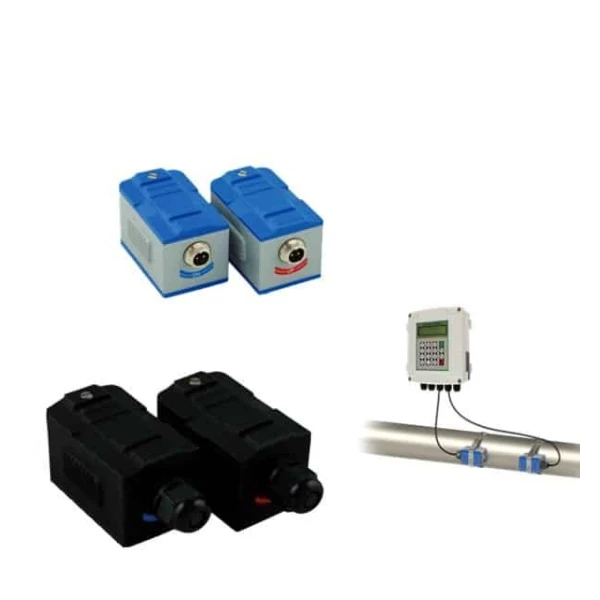 Clamp-On Ultrasonic Flow Meter
Transit-time clamp-on for clean, full pipes.
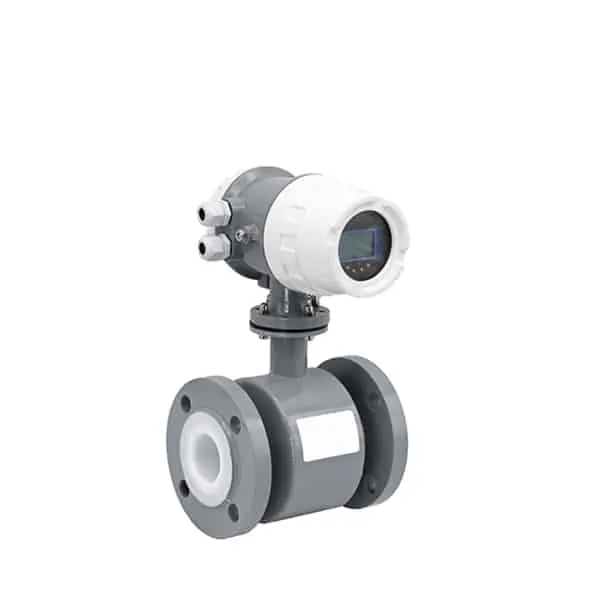 Magnetic Flow Meter
For dirty conductive water in a full pipe.
Browse all ultrasonic flow meters →
Related applications: Wastewater, Slurry.
FAQ
What is a Doppler flow meter?
It is an ultrasonic flow meter that reads velocity from the Doppler frequency shift of ultrasound reflected off solid particles and bubbles in the liquid. Unlike a transit-time meter, which needs clean liquid, a Doppler meter needs dirty liquid: it works on sewage, sludge, and slurry in a full pipe, with clamp-on transducers.
How does a Doppler flow meter work?
A clamp-on transducer sends an ultrasonic tone into the pipe. Suspended solids and bubbles moving with the flow reflect it back at a shifted frequency, and the size of that shift gives the velocity. The meter converts velocity to flow from the pipe bore. It needs real reflectors in the liquid, about 100 ppm with a useful fraction over 100 micron.
What is the difference between Doppler and transit-time?
They need opposite liquids. A Doppler meter needs particles or bubbles to reflect the sound, so it works in dirty water. A transit-time meter needs a clean, clear path, so it works in clean water. For sewage or slurry use Doppler; for clean water in a full pipe use a transit-time clamp-on or inline meter.
Does a Doppler meter work on clean water?
No. With clean liquid and no particles or bubbles, there is nothing to reflect the ultrasound, so there is no Doppler signal. Clean, full-pipe duties belong to a transit-time meter; dirty conductive water in a full pipe can also use a magnetic meter.
Can I install it without stopping the flow?
Yes. The clamp-on transducers strap to the outside of a live pipe, so there is no cutting and no shutdown. For very large or heavily lined pipes where a clamp-on signal will not pass the wall, a hot-tap insertion transducer fits a running line as well.
Request a quote
Send us the pipe size and material, the liquid and roughly how much solids or air it carries, the temperature, and whether you need a fixed or portable meter. We confirm the transducer and the build for your line.