Flow Meters › Positive Displacement Flow Meters › Gear Flow Meter
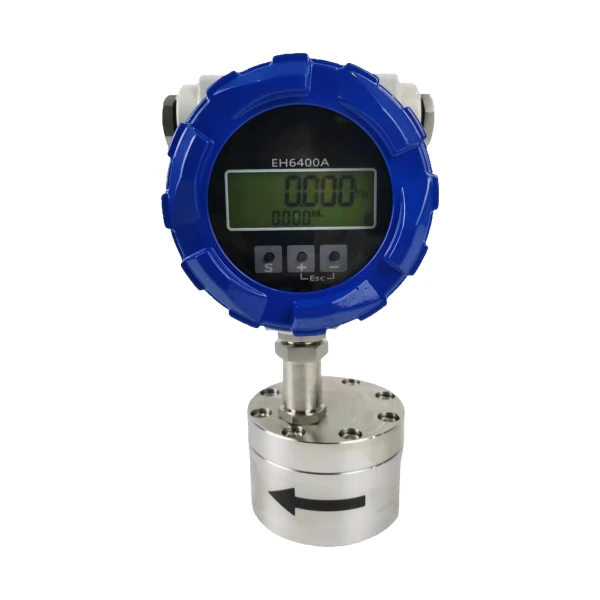
Gear Flow Meter
A small positive displacement flow meter with a pair of meshing spur gears. Each tooth that passes the pickup is a pulse, so the resolution is very high and it measures very small flow, down to a fraction of a liter per hour, on viscous and high-pressure liquid.
- Principle: Positive displacement, twin spur gears
- Size: DN5 to DN25
- Flow: micro flow from 0.1 L/h
- Pressure: 1.6 to 40 MPa
- Output: high-resolution pulse; LCD display
Overview
A gear flow meter is a small positive displacement meter that uses a pair of meshing spur gears, the straight-toothed cylindrical gears of a gear pump. As liquid passes, it turns the gears, and each tooth that sweeps past the chamber wall carries a tiny, fixed volume. A pickup coil counts the teeth without touching them, so every tooth is a pulse and the resolution is very high. That is what lets it measure very small flow, down to a fraction of a liter per hour, where an oval gear meter is already too coarse.
It is built for micro and small flow of clean, viscous liquid, often at high pressure, in dosing, blending, and OEM machine builds: lubricating and hydraulic oil, resin, ink, and additive feeds. Like all displacement meters it needs no straight pipe run, and a filter upstream protects the close-fitting gears. For larger viscous lines, the oval gear flow meter is the base positive displacement meter; for heavy oil at flow, see the spiral rotor flow meter.
Features
Everything here follows from one idea: count tiny volumes with the teeth of two spur gears.
Twin spur gears
A pair of straight-toothed gears carries a fixed volume on every tooth, counting volume directly.
Very high resolution
Each tooth is a pulse, so the resolution is high and the meter reads very small volumes.
Micro flow, from 0.1 L/h
It measures micro and small flow, from a fraction of a liter per hour, that larger meters miss.
To 40 MPa, high viscosity
It handles high pressure to 40 MPa and high-viscosity oil, with a high-temperature build to 120 C.
Pulse and LCD
A non-contact pickup gives a stable pulse, with a digital LCD for total and rate.
No straight pipe run
Displacement metering does not depend on flow profile, so it drops into a tight OEM build.
Working principle
Two spur gears, straight-toothed cylindrical gears, mesh inside a close-fitting chamber. The liquid pressure turns them, and as each gear rotates, the spaces between its teeth and the chamber wall carry small, fixed pockets of liquid from inlet to outlet. A coil outside the chamber senses each tooth as it passes, with no contact, and turns it into a pulse; because there are many teeth per turn, the meter resolves very small volumes. The pulse drives a unit-conversion and totalizing circuit and a digital display, and feeds a frequency-to-current stage for a rate output. Because it meters by displacement, viscosity does not bias the reading, and segmented calibration widens the range and trims the accuracy.
Technical specifications
| Parameter | Specification |
|---|---|
| Measurement principle | Positive displacement; twin spur (cylindrical) gears, pulse per tooth |
| Medium | Clean viscous liquid: lube and hydraulic oil, resin, ink, additives |
| Size | DN5 to DN25 (G1/8 and threaded connections) |
| Flow range | Micro flow from 0.1 L/h (for example 0.1 to 10 L/h on the smallest size); larger by model |
| Accuracy | 0.5% of reading (representative; set per build with segmented calibration) |
| Viscosity | Low (L, to 2 mPa s), or high-viscosity build (N, 200 mPa s and above) |
| Medium temperature | -20 to +60 C; high-temperature build (T) to 120 C |
| Nominal pressure | 1.6 to 40 MPa by model |
| Output | High-resolution pulse; digital LCD; frequency-to-current rate output |
| Sensing | Non-contact pickup coil, one pulse per tooth |
| Straight pipe | Not required; fit a filter upstream |
Representative specifications; confirm per datasheet for the fluid, flow, viscosity, and pressure you need.
Ordering example. Gear flow meter, DN8, hydraulic oil, 0.5 to 10 L/h at 25 MPa, high-viscosity build, pulse plus LCD, threaded connection.
Spur gear or oval gear
Both are positive displacement gear meters; the choice is about flow size and pressure:
- Spur gear. Many small teeth give very high resolution, so the spur gear meter reads micro and small flow, from a fraction of a liter per hour, and takes high pressure to 40 MPa. It is the OEM and dosing choice.
- Oval gear. The oval gear flow meter handles larger flow on DN10 to DN200 lines, with the same displacement accuracy on viscous fluid.
- Both need a filter. Each meters with close-fitting gears, so a filter upstream is essential, the smaller the meter the finer the filter.
Applications
Gear flow meters suit micro and small viscous flow:
- Lubrication and oil dosing on machines
- Resin, adhesive, and additive metering and blending
- Ink and coating feed
- Hydraulic and high-pressure oil measurement
- OEM and laboratory dosing skids
Application example
Additive dosing. A machine builder dosing a small, steady feed of a viscous additive needed to count a flow too small for an oval gear meter. A gear flow meter resolved it tooth by tooth, held accuracy as the additive thickened, and sent a high-resolution pulse to the machine control on a high-pressure line. A fine filter upstream kept the close gears clear, which was the one install detail to confirm.
Related products
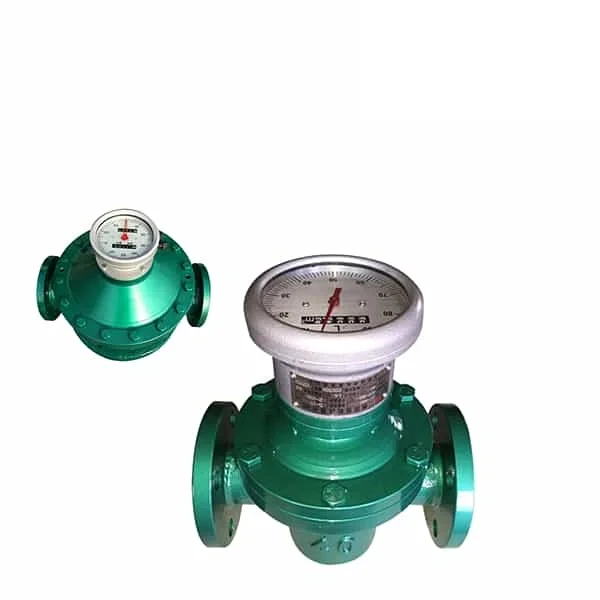 Oval Gear Flow Meter
The positive displacement meter for larger viscous lines, DN10 to DN200.
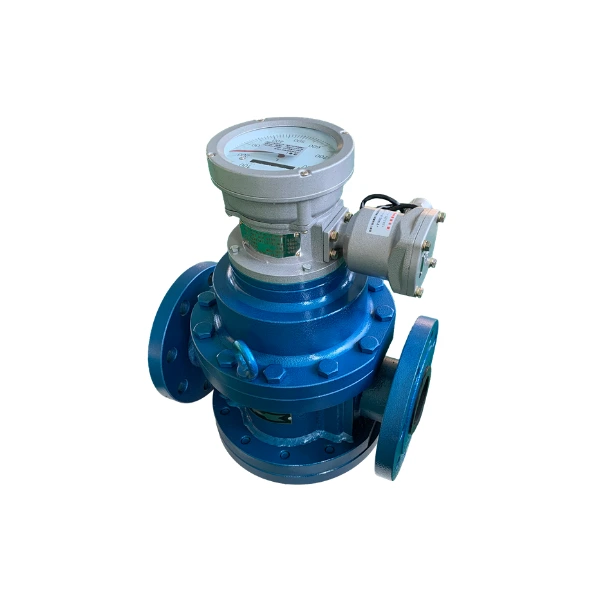 Spiral Rotor Flow Meter
For heavy, high-temperature oil at higher flow.
Browse all positive displacement flow meters →
Related applications: Diesel, High viscosity.
FAQ
What is a gear flow meter?
It is a small positive displacement meter that uses a pair of meshing spur gears. The liquid turns the gears, and each tooth carries a tiny fixed volume past a pickup that counts it as a pulse. Because there are many teeth, the resolution is very high and it measures very small flow.
How is it different from an oval gear meter?
Both are gear-type positive displacement meters. The spur gear meter has many small teeth and very high resolution, so it reads micro and small flow at high pressure, while the oval gear meter handles larger flow on DN10 to DN200 lines.
How small a flow can it measure?
The smallest sizes read from about 0.1 liter per hour, with the range set by the size and the build. Tell us the lowest and highest flow you need and we set the size and the calibration.
Does it work on high-viscosity and high-pressure oil?
Yes. A high-viscosity build handles thick oil and resin, a high-temperature build reads to 120 C, and the body takes pressure up to 40 MPa. Fit a fine filter upstream to keep grit out of the close gears.
Request a quote
Send us the fluid, the flow range, the viscosity, and the pressure, and we set the gear size, the build, and the output.