By Wu Peng, Senior Process Instrumentation Engineer · Last reviewed August 26, 2026
An LPG flow meter measures liquefied petroleum gas either as a liquid held under its own vapor pressure or as a vapor downstream of a vaporizer and regulator. The choice follows the phase at the metering point. Coriolis and positive displacement meters serve the liquid line. Rotary, vortex, turbine and thermal meters serve the vapor line.
Propane stores at about 8.4 bar absolute at 20 °C. The same product can be metered at 500 kg/m³ on one side of a skid and at a few kg/m³ on the other.
That density gap is why a propane flow meter installation can read wrong even when nothing is broken. The meter is fine, but it is measuring a phase the buyer did not plan for. This guide maps the metering points in an LPG system. It puts numbers on flashing and thermal expansion, compares the technologies with their accuracy classes, and covers custody approvals, hazardous area marking and materials.
Contents
- Where to meter
- Flashing and vapor pressure
- Mass or corrected volume
- Technology comparison
- Custody transfer approvals
- Hazardous area basics
- Materials and sealing
- FAQ
Where to meter
LPG sits in the storage tank as a liquid with a vapor space above it. Everything upstream of the vaporizer normally carries liquid; everything downstream of the vaporizer and regulator carries vapor. Before comparing meter brands, place the metering point on this map. The two sides call for different instrument groups and different units.
| Metering point | Phase | Meters that fit |
|---|---|---|
| Truck loading and unloading | Liquid | Coriolis or positive displacement, sized for the pump rate |
| Dispensers and cylinder filling | Liquid | Positive displacement or Coriolis with temperature correction |
| Process feed before the vaporizer | Liquid | Coriolis, oval gear, turbine on clean product |
| After the vaporizer and regulator | Vapor | Rotary gas meter, precession vortex, gas turbine, thermal |
| Burner and pilot lines | Vapor, low pressure | Rotary gas meter or thermal at low flow |
A liquid propane flow meter and a vapor meter for the same energy throughput differ in size, principle and output units; neither substitutes for the other.
Flashing and vapor pressure
LPG is stored at its boiling point for the tank temperature. Any pressure drop between the tank and the meter pushes the liquid toward that boiling line. Once local pressure falls below the vapor pressure, part of the stream flashes to vapor inside the pipe. Rounded saturation pressures for the two main components:
| Temperature | Propane, bar abs | n-Butane, bar abs |
|---|---|---|
| 0 °C | 4.7 | 1.0 |
| 20 °C | 8.4 | 2.1 |
| 40 °C | 13.7 | 3.8 |
Commercial LPG blends sit between the two columns depending on the propane and butane split.
Vapor in a liquid line is the classic cause of a meter that reads high and repeats badly. A volume meter counts the bubbles as product. A Coriolis meter shows a falling density reading with rising drive current, which is a useful early warning.
Three placement rules keep the stream in one phase. Hold the meter back pressure above the tank vapor pressure with margin. Keep throttling valves and dirty strainers away from the meter inlet. Take the tap from the liquid space, with the meter at or below tank level where the layout allows.
A pump adds head and helps, but a part-closed valve after the pump can undo it. For DP-type elements the same rule appears as permanent pressure loss; the straight run guide covers the piping side.
Mass or corrected volume
Liquid LPG expands quickly with temperature. Saturated liquid propane runs about 507 kg/m³ at 15 °C and about 484 kg/m³ at 30 °C. That is a change of roughly 0.3 percent per degree, several times steeper than diesel or water.
The same tank fill takes up visibly more volume on a warm afternoon. This is also why storage tanks are only filled to 80 percent.
20 m³/h of liquid propane at 15 °C is 20 × 507 = 10.1 t/h; the same indicated 20 m³/h at 30 °C is only 20 × 484 = 9.7 t/h, a 4.5 percent difference on nothing but temperature.
Uncorrected volume is therefore a poor billing unit for LPG. There are two clean answers. Measure mass directly with a Coriolis mass flow meter, which also delivers the density reading.
Or measure volume and correct it to a 15 °C or 60 °F reference with the LPG tables of ASTM D1250 and API MPMS Chapter 11. The automatic temperature compensation in a dispenser does exactly that. The background math between mass and volume units is covered in our mass vs volumetric flow guide. The mass flow rate calculator converts between the two for a given density.
Technology comparison
| Technology | Phase | Typical accuracy | Notes for LPG service |
|---|---|---|---|
| Coriolis | Liquid or vapor | 0.1 to 0.5% of rate | Direct mass, no moving parts, density diagnostic flags vapor breakout |
| Oval gear PD | Liquid | 0.5% of rate | Dispensing and batching; needs a strainer; low lubricity wears gears over time |
| Turbine | Liquid | 0.5% of rate | Clean liquid only; same lubricity caution on the bearings |
| Gas turbine | Vapor | 0.5 to 1.5% of rate | Built-in temperature and pressure correction to standard volume |
| Precession vortex | Vapor | Per model class | No moving parts, tolerant of wet vapor, common on LPG gas lines |
| Rotary gas meter | Vapor | Class 1.0 or 1.5 | Low pressure loss, wide turndown, corrector outputs Nm³ |
| Thermal mass | Vapor, dry | 1.5 to 2.5% | Direct gas mass; keep well away from the dew point, droplets skew the reading |
Accuracy figures follow the specification pages linked in each row; confirm the value for the ordered configuration.
One property cuts across the whole liquid-side list. LPG is a dry, low viscosity liquid with little lubricity. Meters that ride on bearings and gear faces wear faster on propane than they would on fuel oil.
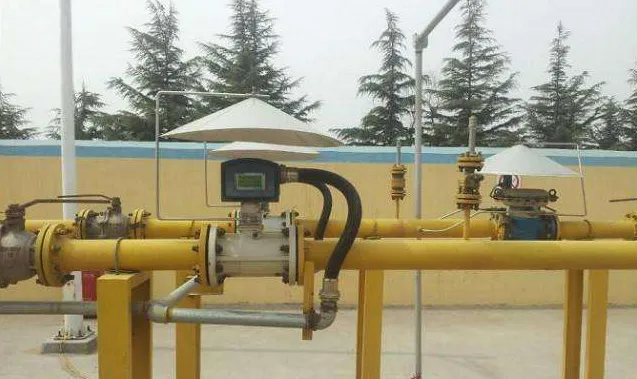
That is a maintenance-interval argument for Coriolis on continuous services. On the vapor side, a digital LPG gas flow meter with a local display and pulse output remains the economical answer. Inline propane flow meter bodies for the liquid line are usually compact; the pump rate, not the pipe size, should set the meter size.
Application example
Oil and gas company, Ecuador. The inquiry specified a Coriolis mass flow meter for LPG: a DN15 sensor with DN50 flange connections, at a working pressure of 2.5 to 3 barg. We quoted it as specified. The combination makes engineering sense at that pressure: the small measuring tube keeps the reading in the strong part of the meter range, instead of running at the bottom of a line-sized unit.
Custody transfer approvals
When LPG changes ownership at the meter, most jurisdictions require a legal-metrology approval on top of ordinary accuracy. In the United States that means an NTEP Certificate of Conformance under NIST Handbook 44. Canada uses Measurement Canada approvals. The EU uses an MID MI-005 examination, which builds on OIML R117 for liquid meters other than water.
A meter can be well within its published accuracy and still be inadmissible for billing without the certificate. The RFQ for a custody application should therefore name the market and the approval regime up front. For internal allocation, batching and process control, a factory calibration certificate is normally sufficient, and that is what our meters ship with. Legal-metrology approval for a specific market is a per-order item to confirm with our engineers.
Hazardous area basics
Propane and butane are NEC Group D gases, IIA under the IEC scheme. LPG skids are commonly classified Class I Division 1 or 2, or Zone 1 or 2, depending on ventilation and distance from relief points.
The meter, its display and the signal loop all need marking that matches the drawing, not just the meter body. The reasoning behind the two systems is covered in our Division guide and the Zone vs Division comparison. For the meter itself, state the classification in the inquiry so the certificate matches the site.
Materials and sealing
Metallurgy is the easy part: carbon steel and stainless bodies both handle LPG, and copper alloys are acceptable, unlike ammonia service. The seals need more care. Nitrile and neoprene are the standard elastomers for LPG hoses and meter seals. EPDM and natural rubber swell in liquid hydrocarbons and do not belong in the wetted path.
PTFE is unaffected and covers the higher temperature trims. On the vapor side after odorization, the ethyl mercaptan concentration is small and does not change the material picture.
What matters more in practice is pressure rating. Liquid-line components see full tank vapor pressure plus pump head, so PN25 and PN40 ratings are normal. A natural gas line of the same size sees far less pressure, one reason a natural gas flow meter page is the wrong starting point for an LPG liquid line.
For conventional liquid fuels that stay liquid at line conditions, gasoline through heavy fuel oil, the fuel flow meter selection page covers that side of the yard.
Level on the storage tank itself is a separate selection, driven by whether the vessel can be opened at all. That side is covered under propane and LPG tank level sensors.
FAQ
How can I measure the flow of propane gas?
Meter propane gas downstream of the vaporizer and regulator with a rotary gas meter, precession vortex, gas turbine or thermal mass meter. Rotary and turbine meters read volume and use a corrector for temperature and pressure. A thermal meter reads gas mass directly but needs dry vapor away from the dew point.
What is the 80/20 rule for propane?
Storage tanks are filled to about 80 percent of the water capacity, leaving 20 percent vapor space. Liquid propane expands roughly 0.3 percent per degree Celsius. The headspace absorbs that expansion without lifting the relief valve. The same expansion is why metered LPG volume should be temperature-corrected or measured as mass.
How accurate are gas flow meters?
On LPG vapor, rotary gas meters run in accuracy class 1.0 to 1.5. Gas turbine meters hold about 0.5 to 1.5 percent of reading, and thermal mass meters about 1.5 to 2.5 percent. On the liquid side, Coriolis meters reach 0.1 to 0.5 percent of rate and positive displacement meters about 0.5 percent.
How can I tell how much gas is left in a propane tank?
That is a level measurement rather than a flow measurement. On pressurized LPG and butane tanks a clamp-on option is an external ultrasonic tank level sensor. It reads through the steel wall without any tapping into the pressure envelope.
Request a quote
Tell us the phase at the metering point, the flow range, working pressure and temperature, and the line size. Note whether the meter must carry a custody or hazardous area certificate. We will propose an LPG or propane flow meter with the calibration paperwork to match. Reach our application engineers or use the form below.
Written and technically reviewed by Wu Peng and the Instranova engineering team.