Flow Meters › Differential Pressure Flow Meters › V-Cone Flow Meter
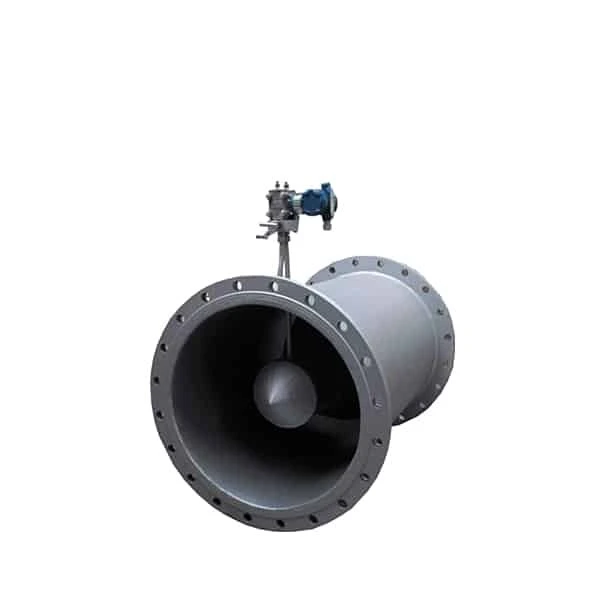
V-Cone Flow Meter
A V-cone flow meter is a differential pressure sensor with a cone suspended on the axis of the pipe. The cone conditions the flow as it throttles it, so the meter holds its accuracy with very little straight pipe, gives a wide turndown, and a stable, low-noise signal. It is the differential pressure element to reach for in tight piping and on dirty or wet service.
- Principle: Differential pressure, central cone element
- Accuracy: Class 0.5; repeatability better than 0.1%
- Turndown: 10:1 typical, up to 50:1
- Straight runs: 0 to 3D upstream, 0 to 1D downstream
- Line size: DN15 to DN2000
- Output: Pairs with a 4-20 mA DP transmitter, HART
Overview
A V-cone flow meter, also called a cone-type or inner-cone flow meter, is a differential pressure flow element. Instead of a plate or a tube that narrows the pipe from the wall inward, the V-cone hangs a cone in the center of the pipe. Flow has to pass through the ring-shaped gap between the cone and the pipe wall, which raises its speed and drops its pressure. A differential pressure transmitter reads the difference between the upstream pressure and the pressure just behind the cone, and flow follows the square root of that difference, the same law as an orifice or a venturi.
What makes the V-cone different is where the restriction sits. Because the cone works near the pipe wall and mixes the flow as it passes, it flattens the velocity profile instead of fighting it. That gives the V-cone three things an orifice cannot: it needs almost no straight pipe, it holds accuracy over a wide flow range, and its signal is steady and quiet. It is used on gas, steam, water, and dirty or wet fluids from DN15 up to very large pipe.
Features
Everything here follows from one idea: condition the flow with a central cone instead of restricting it from the wall.
Very short straight runs
The cone conditions the flow itself, so it needs only 0 to 3D of upstream and 0 to 1D of downstream straight pipe.
Wide turndown
A range ratio of 10:1 is normal and up to 50:1 is reachable, far wider than a plain orifice.
Stable, low-noise signal
The mixed flow downstream of the cone settles quickly, so signal fluctuation is about a tenth of an orifice.
Low pressure loss
For the same beta, permanent loss runs about one third to one fifth of an orifice, which saves pumping energy.
Resists wear and clogging
No sharp edge to erode and no pocket to trap solids, so the V-cone holds calibration on dirty and wet service.
Wide size and service range
Built DN15 to DN2000 and usable down to low Reynolds numbers, for gas, steam, water, and wet gas.
Working principle
The V-cone follows the same square-root law as every differential pressure meter. The cone reduces the open area of the pipe, the fluid speeds up through the ring-shaped gap at the wall, and its static pressure falls. The transmitter reads the upstream pressure and the pressure at the back face of the cone; the volumetric flow is proportional to the square root of that difference, scaled by the discharge coefficient and the effective beta ratio set by the cone size.
The trick is that the cone forces the flow to mix near the wall, which evens out the velocity profile before and after the element. That self-conditioning is why a V-cone keeps its accuracy right behind an elbow, a valve, or a pump, where an orifice would need many diameters of straight pipe to settle down.
Technical specifications
| Parameter | Specification |
|---|---|
| Measurement principle | Differential pressure across a central cone; flow follows the square root of the drop |
| Element type | Inner-cone (V-cone) sensor, cone suspended on the pipe axis |
| Accuracy | Class 0.5 (about 0.5% of reading) |
| Repeatability | Better than 0.1% |
| Turndown (range ratio) | 10:1 typical; up to 50:1 with the right parameters |
| Permanent pressure loss | Low; about one third to one fifth of an orifice at the same beta |
| Straight pipe runs | 0 to 3D upstream, 0 to 1D downstream |
| Reynolds number range | 8 x 10^3 to 5 x 10^6 |
| Operating pressure | Up to 16 MPa standard; 42 MPa maximum |
| Process temperature | -160 C to 700 C depending on build (about 450 C is a common maximum) |
| Nominal diameter | DN15 to DN2000 (1/2 in to 120 in) |
| Minimum flow velocity | About 0.1 m/s |
| Secondary instrument | DP transmitter, 4-20 mA with HART; the transmitter sets the output and the working accuracy |
| Media | Water, steam, air, natural gas, nitrogen, coke oven gas, and other clean or dirty fluids |
Cone size and beta, materials, and pressure rating are set per line and service. Send the line size, fluid, flow range, pressure, and temperature and we size the cone.
V-cone vs orifice
The V-cone and the orifice plate both read flow from a differential pressure and both follow the square-root law, so the choice is about installation and service rather than the math. An orifice plate restricts the pipe from the wall inward, which trips the flow and needs long straight runs to settle; a V-cone restricts from the center and mixes the flow, so it stays accurate in tight piping. The orifice is cheaper and a known standard; the V-cone costs more but saves straight pipe, holds a wider turndown, and shrugs off dirty service.
| Point | V-cone vs orifice |
|---|---|
| Straight pipe | V-cone needs 0 to 3D; an orifice often needs 10 to 40D. Choose the cone in tight piping. |
| Turndown | V-cone 10:1 and up; orifice closer to 3:1 to 4:1. |
| Dirty or wet service | V-cone resists wear and clogging; an orifice edge wears and the upstream tap can plug. |
| Cost and standard | Orifice cheaper and standardized in ISO 5167; the V-cone costs more and is a proprietary form. |
Applications
The V-cone fits best where straight pipe is short, the fluid is dirty or wet, or a wide flow range has to stay accurate:
- Natural gas, coke oven gas, and process gas in plants with tight piping
- Saturated and superheated steam metering
- Chilled water and process water on packed skids
- Wet, dirty, or abrasive fluids that would clog an orifice tap
- Retrofits where there is no room for the straight runs an orifice needs
Challenge: A trading and distribution customer in the Middle East had to select a flow element for a process line from a project P&ID, on a layout with limited straight pipe.
Solution: A V-cone flow meter sized to the P&ID, chosen so the short 0 to 3D straight-run requirement fit the existing layout without rework.
Result: The cone gave the project a differential pressure element that dropped into the tight piping and held accuracy where an orifice would have needed straight pipe the layout did not have.
Related products
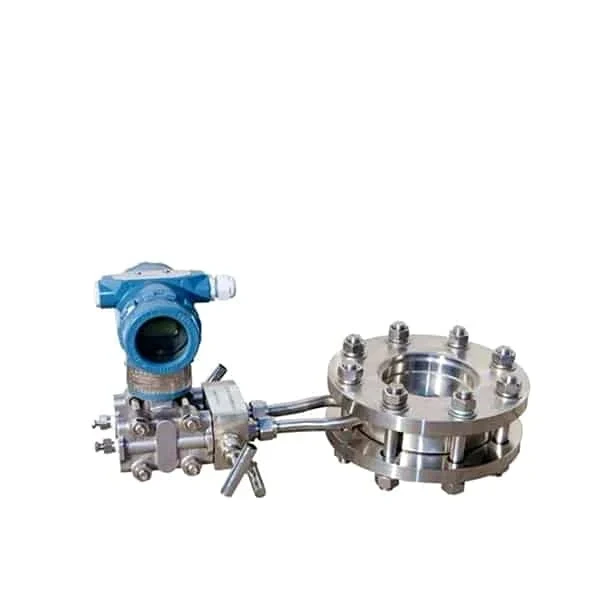 Orifice Plate Flow Meter
The standard, low-cost DP element for clean lines with room for straight pipe.
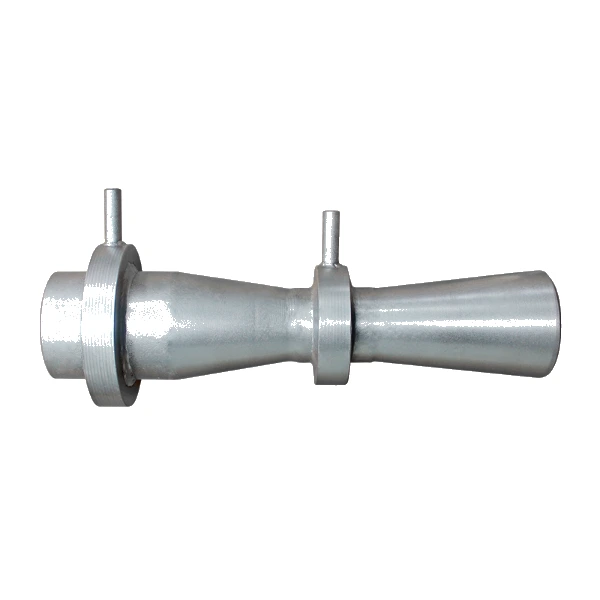 Venturi Flow Meter
A classical venturi tube with low permanent head loss for large pipes.
Browse all differential pressure flow meters →
For gas service on NH3 lines, the guide to metering ammonia compares V-cone against the other technologies by phase.
FAQ
What is a V-cone flow meter?
A V-cone flow meter is a differential pressure flow element with a cone suspended in the center of the pipe. Flow passes through the ring-shaped gap between the cone and the wall, the pressure drops, and a DP transmitter reads the difference to compute flow. It is also called a cone-type or inner-cone flow meter.
How does a V-cone flow meter work?
It uses Bernoulli’s principle. The cone reduces the open area, so the fluid speeds up and its pressure falls. The meter reads the upstream pressure and the pressure behind the cone, and flow follows the square root of that difference. Because the cone mixes the flow near the wall, the velocity profile stays even.
What is the difference between a V-cone and an orifice plate?
Both read flow from a pressure drop, but a V-cone restricts from the center and conditions the flow, while an orifice restricts from the wall. The V-cone needs far less straight pipe, holds a wider turndown, and resists clogging; the orifice is cheaper and is a published ISO 5167 standard.
What are the advantages and disadvantages of a V-cone meter?
Advantages: very short straight runs, 10:1 or wider turndown, a stable low-noise signal, low pressure loss, and good tolerance of dirty and wet service. Disadvantages: it costs more than an orifice plate and is a proprietary geometry rather than a published standard element.
Where are V-cone flow meters used?
On natural gas, coke oven gas, steam, chilled and process water, and wet or dirty fluids, and especially on skids and retrofits where there is not enough straight pipe for an orifice or a venturi.
Request a quote
Send us the line size, the fluid, the flow range, and the pressure and temperature, and we size the V-cone and set the transmitter.