Flow Meters › Differential Pressure Flow Meters › Wedge Flow Meter
Wedge Flow Meter
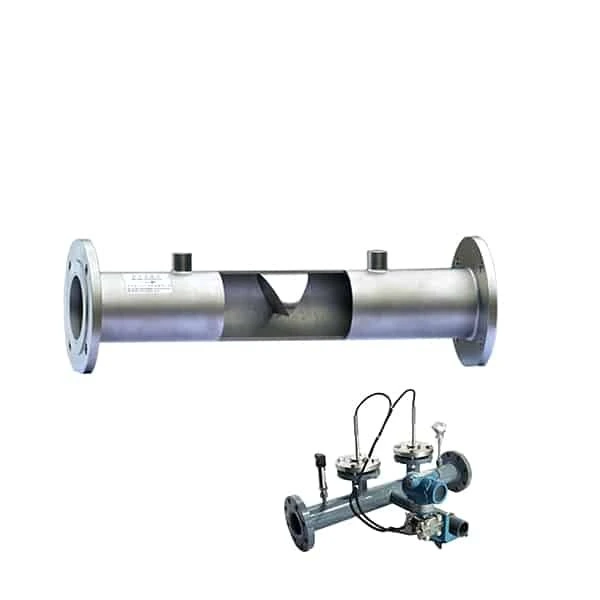
A wedge flow meter measures flow from the pressure drop across a V-shaped wedge set into the top of the pipe. The open throat below the wedge does not trap solids and does not clog, so the wedge reads viscous, dirty, and two-phase fluids that would foul an orifice, and it stays accurate down to very low Reynolds numbers.
- Principle: Differential pressure, V-shaped wedge
- Best for: Viscous, dirty, slurry, and two-phase fluids
- Accuracy: 0.5% of full scale; stability 0.1% FS/year
- Low Reynolds: Works down to about Re 500
- Line size: DN10 to DN1200 (to DN2500 special)
- Output: Pairs with a 4-20 mA DP transmitter, HART
Overview
A wedge flow meter is a differential pressure flow element built for the fluids that defeat a plain orifice. Instead of a thin plate with a sharp-edged hole, the wedge is a solid V-shaped block set into the top of the pipe. Flow passes through the open throat under the wedge, speeds up, and drops in pressure; a differential pressure transmitter reads the difference and computes flow from the square root of the drop, the same law as any DP meter.
The open throat is the point. There is no pocket to pack with solids and no sharp edge to wear, so the wedge stays clean and keeps its calibration on viscous, sticky, abrasive, and two-phase service. It also holds a linear, accurate reading down to very low Reynolds numbers, well into the laminar range, which is where most other flow meters give up. That is why the wedge is the element of choice for heavy oil, sludge, slurry, asphalt, and dirty gas.
Features
Everything here follows from one idea: read flow from a wedge in the top of the pipe instead of a hole in a plate.
Non-clogging V-wedge
The open throat under the wedge sheds solids and sticky media, so it does not pack, deposit, or plug like an orifice.
Viscous and low Reynolds
It stays linear and accurate down to about Reynolds 500, well into laminar flow, for high-viscosity and low-flow service.
Wide turndown
A range ratio of 1:25 is normal and 1:33 is reachable, wider with a smart transmitter.
Two-phase capable
It reads single-phase fluids and two-phase mixes of gas-liquid, gas-solid, and liquid-solid.
Rugged, no moving parts
The solid wedge resists abrasion and has no moving parts, so it runs for years with little maintenance.
Wide size and rating
Built DN10 to DN1200 and up to DN2500 special, for -0.1 to 42 MPa and -160 to 450 C.
Working principle
The wedge follows the same square-root law as every differential pressure meter. The V-shaped wedge narrows the bore from the top, the fluid accelerates through the open throat below it, and its static pressure falls. The transmitter reads the pressure upstream of the wedge and downstream of it; the flow is proportional to the square root of that difference, scaled by the wedge ratio H/D, which is the wedge height divided by the pipe diameter and is offered as 0.2, 0.3, 0.4, or 0.5 to suit the flow range.
Because the throat sits at the bottom of the pipe and stays open, solids and bubbles pass through instead of building up on the element. For sticky or crystallizing fluids the pressure taps are usually fitted with remote seals or flushing connections, so even the impulse lines stay clear.
Technical specifications
| Parameter | Specification |
|---|---|
| Measurement principle | Differential pressure across a V-shaped wedge; flow follows the square root of the drop |
| Element type | Solid V-shaped wedge set into the top of the pipe |
| Wedge ratio (H/D) | 0.2, 0.3, 0.4, or 0.5, selected for the flow range |
| Accuracy | 0.5% of full scale |
| Long-term stability | 0.1% of full scale per year |
| Turndown (range ratio) | 1:25 typical, up to 1:33; over 1:100 with a smart transmitter |
| Reynolds number | Linear down to about Re 500, into the laminar range |
| Nominal diameter | DN10 to DN1200 (up to DN2500 special) |
| Operating pressure | -0.1 to 42 MPa |
| Process temperature | -160 C to 450 C (up to 700 C special) |
| Viscosity | 500 mPa s and higher |
| Phases | Single-phase and two-phase (gas-liquid, gas-solid, liquid-solid) |
| Secondary instrument | DP transmitter, 24 VDC, 4-20 mA with HART; the transmitter sets the output and accuracy |
| Wetted materials | Stainless steel and higher alloys, selected for the service |
| Media | High-viscosity, dirty, dusty, crystallizing, suspended-solids, and corrosive fluids; also clean gas, liquid, and steam |
Wedge ratio, materials, taps, and pressure rating are set per line and service. Send the line size, fluid, viscosity, flow range, pressure, and temperature and we size the wedge.
Wedge vs orifice
The wedge and the orifice plate both read flow from a differential pressure, but they are built for opposite fluids. An orifice plate is a thin, sharp-edged plate that is cheap and standard, and it is the right choice on clean liquid, gas, and steam. A wedge is a solid block with an open throat and costs more, but it is the right choice on the fluids that defeat an orifice: viscous, sticky, abrasive, dirty, and low-Reynolds service.
| Point | Wedge vs orifice |
|---|---|
| Dirty and viscous | Wedge stays clean and accurate; an orifice clogs and its edge wears. |
| Low Reynolds | Wedge holds linearity to about Re 500; an orifice needs high, turbulent flow. |
| Clean service and cost | Orifice is cheaper and standardized; the wedge costs more and is built to order. |
| Pressure taps | Wedge uses remote seals or flushed taps so sticky media cannot plug the lines. |
Applications
The wedge fits best where the fluid is thick, dirty, or two-phase and a plain orifice would foul or read low:
- Crude oil, fuel oil, and heavy oil slurry
- Asphalt, bitumen, and coal tar at high temperature
- Wastewater, sewage sludge, and pulp
- Iron ore slurry, carbon black, and mineral slurries
- High-dust gas and other two-phase or particle-laden flow
Challenge: A refinery in the Middle East needed flow measurement on an oil-sludge line. The fluid was oily and particle-laden, and a standard orifice would have fouled and plugged on it.
Solution: A wedge flow meter with an open throat and no obstruction to trap solids, so the oily, gritty sludge passed through while the meter read flow.
Result: The wedge gave the refinery a flow element that kept reading on a fluid that defeats an orifice, with no moving parts to maintain on the dirty line.
Related products
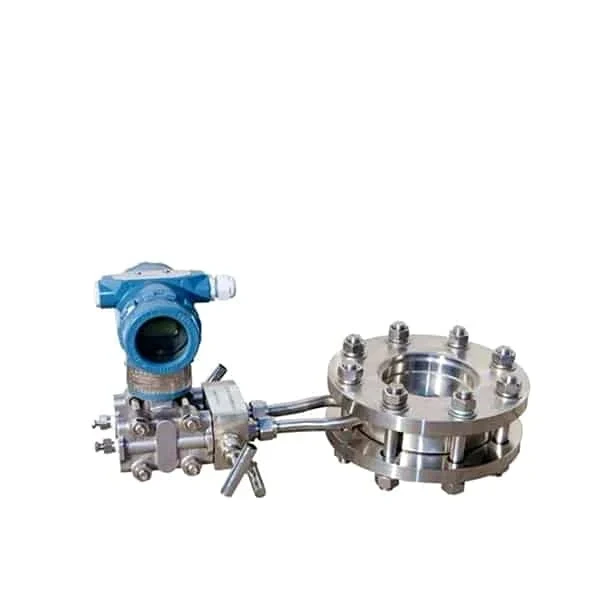 Orifice Plate Flow Meter
The standard, low-cost DP element for clean liquid, gas, and steam.
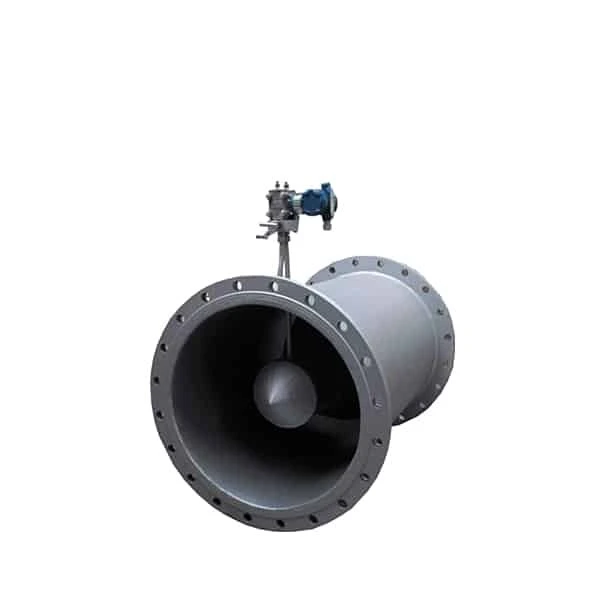 V-Cone Flow Meter
An inner-cone DP sensor with very short straight runs and a stable signal.
Browse all differential pressure flow meters →
FAQ
What is a wedge flow meter?
A wedge flow meter is a differential pressure flow element with a solid V-shaped wedge set into the top of the pipe. Flow passes through the open throat under the wedge, the pressure drops, and a DP transmitter reads the difference to compute flow. Because the throat stays open, the wedge does not clog on dirty or viscous fluids.
How does a wedge flow meter work?
It uses the same square-root law as any DP meter. The wedge narrows the bore from the top, the fluid speeds up through the throat, and its pressure falls. The meter reads the upstream and downstream pressure and flow follows the square root of that difference, scaled by the wedge ratio H/D.
What is a wedge flow meter used for?
It is used for viscous, dirty, abrasive, and two-phase fluids that foul an orifice, such as crude and fuel oil, oil sludge, asphalt and coal tar, wastewater and sewage sludge, iron ore and mineral slurry, carbon black, and high-dust gas.
What is the difference between a wedge meter and an orifice plate?
Both read flow from a pressure drop, but a wedge has an open throat that does not clog and stays accurate at low Reynolds numbers, while an orifice is a sharp-edged plate that clogs on dirty fluids and needs high turbulent flow. The orifice is cheaper for clean service; the wedge is built for difficult fluids.
Can a wedge flow meter measure low flow and high viscosity?
Yes. The wedge stays linear and accurate down to about Reynolds 500, well into the laminar range, so it handles high-viscosity fluids and low flow rates where most other meters lose accuracy.
Request a quote
Send us the line size, the fluid and its viscosity, the flow range, and the pressure and temperature, and we size the wedge and set the transmitter.