Flow Meters › Differential Pressure Flow Meters › Venturi Flow Meter
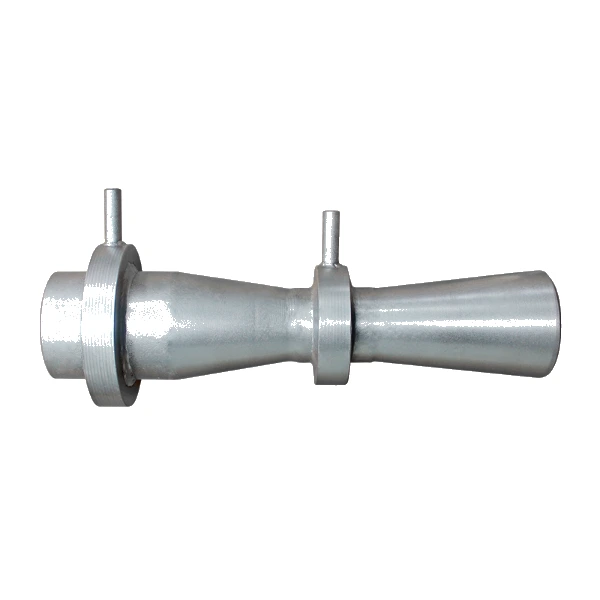
Venturi Flow Meter
A classical venturi tube measures flow from the pressure drop between the pipe and a smooth converging throat. The streamlined shape recovers most of that pressure, so permanent head loss stays low, which makes the venturi the differential pressure element of choice on large pipes, clean or mildly dirty service, and lines where pumping energy matters.
- Principle: Differential pressure, classical venturi tube
- Line size: DN50 to DN1200
- Beta ratio: 0.3 to 0.75
- Accuracy: Class 1, about 1% of reading
- Output: Pairs with a 4-20 mA DP transmitter, HART
- Standard: ISO 5167-4 / GB/T 2624
Overview
A venturi flow meter, also called a classical venturi or venturi tube, is a differential pressure flow element. Fluid passes through a converging cone into a short cylindrical throat and then through a gentle diverging cone. The throat speeds the flow up and drops its pressure, and the difference between the upstream pressure and the throat pressure rises with the square of the flow rate. A differential pressure transmitter reads that difference and computes flow.
What sets the venturi apart from an orifice plate is the diverging cone. It slows the fluid back down smoothly and gives most of the pressure back, so the permanent loss the pump has to overcome is small. The venturi is durable, stable over time, and tolerant of mildly dirty and abrasive fluids, which is why it is used on water mains, gas headers, and refinery and power lines from DN50 up to DN1200 and beyond.
Features
Everything here follows from one idea: read flow from the pressure drop across a smooth, recoverable restriction.
Low permanent head loss
The diverging cone recovers most of the differential, so the venturi loses far less pressure than an orifice or nozzle.
Class 1, no flow rig needed
A standard venturi reaches about 1% accuracy from its geometry to ISO 5167-4, with no real-flow calibration inside the standard range.
Large line sizes
Built from DN50 to DN1200, including welded sheet-steel forms for big water mains and gas headers.
Tolerant of dirty service
No sharp edge to wear, so the venturi holds calibration on mildly dirty, abrasive, and erosive fluids better than an orifice.
Short straight runs
The smooth contraction needs less upstream and downstream straight pipe than most DP elements.
Works with any DP transmitter
The venturi is the primary element; pair it with a 4-20 mA DP transmitter with HART for the signal and totalizing.
Working principle
The venturi follows Bernoulli’s principle. As the bore narrows from diameter D to the throat diameter d, the fluid speeds up and its static pressure falls. Conservation of mass and energy ties the pressure difference to the flow rate: the volumetric flow is proportional to the square root of the differential pressure, scaled by the discharge coefficient, the area, and the beta ratio (d divided by D). Because flow follows the square root of the drop, a venturi gives a usable turndown of roughly 3 to 1 from one element, and wider with a smart or multi-range transmitter.
The pressure is sensed through four or more wall taps at the inlet and at the throat, joined around the pipe by a piezometer ring so the reading averages out small swirl and asymmetry. Because the venturi profile is fixed and well defined, its discharge coefficient is known from the standard, which is why a correctly made standard venturi needs no flow-rig calibration within its Reynolds range.
Technical specifications
| Parameter | Specification |
|---|---|
| Measurement principle | Differential pressure across a classical venturi; flow follows the square root of the drop |
| Element type | Classical (standard) venturi tube, LG-WQL series |
| Convergent section forms | As-cast, machined, or rough-welded sheet steel |
| Nominal diameter (DN) | 50 mm to 1200 mm overall (as-cast DN100 to DN800; machined DN50 to DN250; rough-welded DN200 to DN1200); larger sizes by calibration |
| Beta ratio (d/D) | 0.3 to 0.75 (as-cast 0.3 to 0.75; machined 0.4 to 0.75; rough-welded 0.4 to 0.7) |
| Reynolds number range | 2 x 10^5 to 2 x 10^6 |
| Accuracy | Class 1, about 1% of reading; no real-flow calibration required within the standard range |
| Permanent pressure loss | Low; the diverging cone recovers most of the differential, far less than an orifice or nozzle |
| Pressure taps | Four or more wall taps at inlet and throat, joined by a piezometer (equalizing) ring |
| Materials and ends | Carbon steel or stainless steel; flanged or welded end arrangements |
| Secondary instrument | DP transmitter, 4-20 mA with HART; the transmitter sets the output and the working accuracy |
| Media | Clean gas, liquid, or steam; also high-temperature, high-pressure, large-bore, and mildly abrasive service |
| Standards | GB/T 2624 (ISO 5167-4); verification per JJG 640 |
Throat diameter, materials, and pressure rating are set per line and service. Send the line size, fluid, flow range, pressure, and temperature and we size the venturi to the standard.
Venturi vs orifice
The venturi and the orifice plate both read flow from a differential pressure, and both follow the same square-root law. The difference is what happens to the pressure after the restriction. An orifice plate is a thin bored plate with a sharp edge, so the jet does not recover and the permanent loss is high, but the plate is cheap, compact, and easy to replace. A venturi is a fabricated tube that recovers most of the pressure, costs more, and is longer, but it saves pumping energy and shrugs off dirty service.
| Point | Venturi vs orifice |
|---|---|
| Permanent loss | Venturi low; orifice high. Choose venturi where pumping energy or available head is tight. |
| Dirty or abrasive media | Venturi keeps its shape; an orifice edge wears and drifts. |
| Cost and length | Orifice cheaper and shorter; venturi larger and more costly to build. |
| Large pipes | Venturi scales to big mains; an orifice on a large pipe wastes a lot of head. |
Applications
The venturi is the differential pressure element to reach for when permanent pressure loss, large pipe size, or mildly dirty fluid rules out a plain orifice:
- Cooling water, raw water intake, and water mains where head loss must stay low
- Natural gas, coal gas, and air headers in plants
- Refinery and petrochemical process lines
- Power, metallurgy, and large industrial utilities
- Mildly abrasive or dirty service that would wear an orifice edge
Challenge: A South American oil refinery needed a differential pressure element for a DN100 (4 in) process line and wanted to hold permanent pressure loss low while supplying dimensional data for the project engineering package.
Solution: A classical venturi tube sized to ISO 5167-4 at DN100, chosen over an orifice plate for its low permanent loss, supplied with a dimensional drawing for the line.
Result: The streamlined venturi met the head-loss target on the refinery line and gave the project team a defined, standards-based element with the layout data they needed to design the run.
New to the technology? Our venturi tube guide covers the Bernoulli math, ISO 5167-4 discharge coefficients, a worked sizing example, and when to choose a venturi over an orifice.
Related products
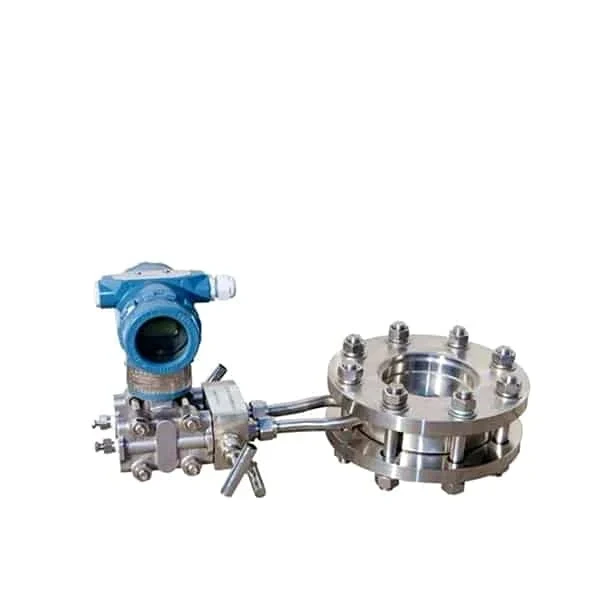 Orifice Plate Flow Meter
The compact, low-cost DP element for clean lines where some head loss is acceptable.
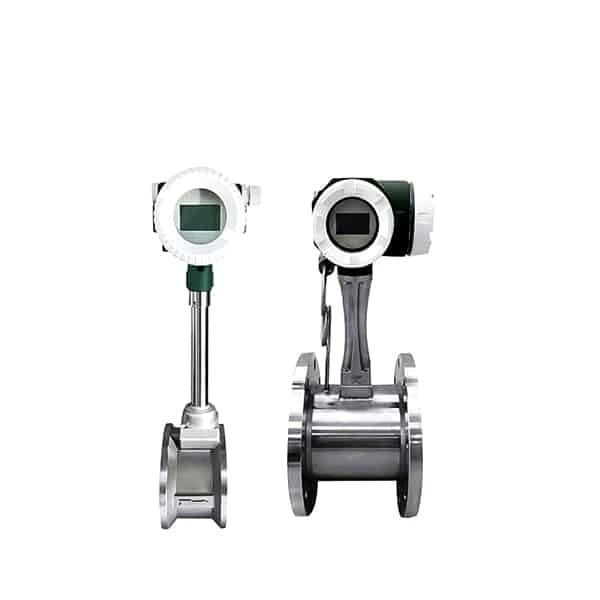 Vortex Flow Meter
A no-moving-parts meter for steam and gas with a wider turndown.
Browse all differential pressure flow meters →
The equation shared by every DP element, and a worked example in SI units, are covered in our guide to the flow rate and pressure relationship.
On fire protection systems, a calibrated venturi is the element inside most pump test meters. The fire pump flow meter page maps the NFPA 25 test rules to the metering options.
FAQ
What is a venturi flow meter?
A venturi flow meter is a differential pressure flow element built as a tube with a converging cone, a throat, and a diverging cone. The throat drops the pressure, a DP transmitter reads the difference, and flow is computed from the square root of that drop. The diverging cone recovers most of the pressure, so permanent head loss is low.
How does a venturi meter measure flow?
It uses Bernoulli’s principle. The narrowing throat speeds the fluid up and lowers its static pressure. The difference between the upstream pressure and the throat pressure rises with the square of the flow rate, so a differential pressure transmitter reading that difference can compute the volumetric or mass flow.
What is the difference between a venturi meter and an orifice plate?
Both read flow from a pressure drop, but a venturi recovers most of the pressure through its diverging cone, while an orifice plate does not. The venturi has much lower permanent head loss and handles dirty service better; the orifice is cheaper, shorter, and easier to replace.
What are the advantages and disadvantages of a venturi meter?
Advantages: low permanent pressure loss, stable class 1 accuracy with no flow-rig calibration, short straight runs, and good tolerance of large pipes and mildly dirty fluids. Disadvantages: it is larger, heavier, and more expensive than an orifice plate, and its turndown from one element is limited by the square-root law.
Where are venturi flow meters used?
On water mains, cooling and raw water lines, natural gas and coal gas headers, refinery and petrochemical process lines, and power and metallurgy utilities, especially on large pipes and wherever low pressure loss saves pumping energy.
Request a quote
Send us the line size, the fluid, the flow range, and the pressure and temperature, and we size the venturi to ISO 5167-4 and set the transmitter.