By Wu Peng, Senior Process Instrumentation Engineer · Last reviewed August 26, 2026
An ammonia flow meter has to match the form of the ammonia first. Anhydrous NH3 runs as a liquid under about 8.6 bar absolute at 20 °C, as a vapor after evaporation, or as an aqueous solution in water. Coriolis meters handle the liquid, thermal and vortex meters handle the gas, and magnetic meters work only on the aqueous form.
That last point is the classic trap. Anhydrous ammonia barely conducts electricity, so the magnetic flow meter, the default choice for so many conductive liquids, is the one meter that cannot read it. This guide maps the three forms, explains the magnetic meter limit with the conductivity rule, sets out vapor pressure and material constraints, and compares the technologies for refrigeration, SCR dosing and fertilizer service.
Contents
- Three forms of ammonia
- Why magnetic meters fail
- Vapor pressure and flashing
- Materials for ammonia
- Technology comparison
- Refrigeration service
- Dosing and fertilizer
- FAQ
Three forms of ammonia
Ammonia reaches a flow meter in one of three forms, and each behaves like a different fluid. The meter shortlist changes completely between them.
| Form | Key properties | Meter shortlist |
|---|---|---|
| Anhydrous liquid | 610 kg/m³ at 20 °C, 682 kg/m³ at −33 °C; stored at its vapor pressure | Coriolis first; turbine or vortex on clean subcooled liquid |
| Ammonia vapor | Light gas, well under 1 kg/m³ near ambient pressure | Thermal mass, vortex, V-cone, gas turbine |
| Aqueous ammonia | NH3 dissolved in water, commonly 19 to 25 percent | Magnetic or Coriolis, like other conductive solutions |
Density values are rounded saturation data; confirm against the operating temperature when sizing.
The liquid carries a lot of mass in a small pipe. A line moving 1,270 kg/h of liquid ammonia at 610 kg/m³ passes only about 2.1 m³/h, roughly 1 m/s in a DN25 line. Small Coriolis sensors therefore cover surprisingly large ammonia throughputs.
One more note on units. On the vapor side, 1 kg of ammonia is about 1.32 normal cubic meters, so mass flow and standard volume convert cleanly once temperature and pressure are fixed. Mixing actual volume, standard volume and mass is a common paper error on gas contracts; the conversion logic is laid out in our mass vs volumetric flow guide.
Why magnetic meters fail
A magnetic flow meter needs a conductive fluid, with a common minimum around 5 µS/cm. Anhydrous liquid ammonia sits orders of magnitude below that floor. It is a poor conductor in the same class as pure hydrocarbons, so the electrodes see almost no signal and the reading is meaningless. Several catalog sites still list an ammonia magnetic meter, which is a specification error, not an option.
Dissolve the ammonia in water and the picture reverses. Aqueous ammonia is an electrolyte, conducts well above the threshold, and meters cleanly on a standard magnetic flow meter with suitable electrode and liner materials. The rule of thumb is short: anhydrous means no magnetic meter; aqueous means magnetic is often the economical pick.
If an inherited specification calls for a magnetic meter on anhydrous NH3, treat it as a drafting error and re-spec, usually to Coriolis. If the stream is described only as ammonia, confirm the form and concentration in writing first. The two fluids share a name and almost nothing else that matters to a flow meter.
Vapor pressure and flashing
Anhydrous ammonia boils at −33 °C at atmospheric pressure. Stored at ambient temperature it holds about 4.3 bar absolute at 0 °C and 8.6 bar absolute at 20 °C. Like LPG, the liquid rides on its boiling line, so any pressure dip below vapor pressure flashes part of the stream to gas. Bubbles make a volume meter read high and pull a Coriolis density reading down, which is a usable diagnostic.
Keep the back pressure at the meter above the vapor pressure with margin, avoid throttling just upstream, and tap liquid from a subcooled point.
The same physics applies in reverse on vapor lines. Ammonia gas that cools condenses in the meter, so vapor-service meters should be mounted so condensate drains out of the measuring section. A trace of liquid in a gas meter reading is also an early warning that an upstream vaporizer is running behind. The placement logic mirrors our LPG flow meter guide, which covers the liquid and vapor split in more depth.
Materials for ammonia
Ammonia with even a trace of moisture attacks copper, brass, bronze and zinc, and it cracks copper alloys under stress. Wetted parts should be carbon steel or stainless steel, with no brass fittings, sight glass frames or gauge internals in the path. This is the opposite of LPG practice, where copper alloys are routine.
Elastomers need the same care. FKM compounds are generally not recommended for ammonia, while EPDM, chloroprene and PTFE hold up well. A pressure gauge or transmitter on the same line follows the same rule: stainless wetted parts, ammonia-rated seals. Our pressure gauge range covers stainless-wetted options for NH3 service.
Technology comparison
Buyers phrase the same job several ways: a liquid ammonia flow meter for a pump discharge, an ammonia gas flow meter for the line after a vaporizer, an anhydrous ammonia flow meter for either. The shortlist behind all of them is the same six technologies.
| Technology | Works on | Typical accuracy | Notes for NH3 |
|---|---|---|---|
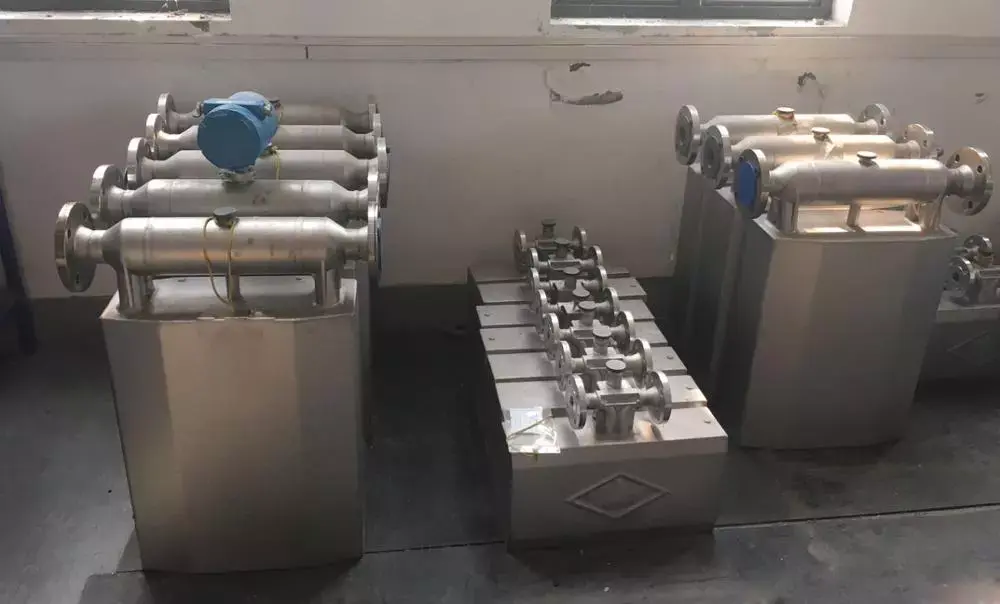
| Coriolis | Liquid, gas, aqueous | 0.1 to 0.5% of rate | Direct mass, 316L tubes, density flags flashing; first choice on anhydrous liquid |
| Thermal mass | Dry vapor | 1.5 to 2.5% | Direct gas mass; keep the gas warm and dry, condensate skews the reading |
| Vortex | Vapor or clean liquid | 1.0 to 1.5% of rate | No moving parts; add temperature and pressure compensation on gas |
| V-cone DP | Vapor | Class 0.5 | Short straight runs, stable in dirty or pulsating gas |
| Turbine | Clean subcooled liquid | 0.5% of rate | Low viscosity limits bearing life; flashing damages the rotor |
| Magnetic | Aqueous only | 0.5% | Not usable on anhydrous NH3; good on ammonia water and urea solution |
Accuracy figures follow the linked specification pages; confirm the value for the ordered configuration.
Refrigeration service
R717 systems run between an evaporating side that can sit tens of degrees below zero and a condensing side around 25 to 40 °C. They meter ammonia for capacity checks, oil management and energy accounting.
The practical place to meter is the warm liquid line after the condenser, where the ammonia is subcooled and a Coriolis or clamp-on reading is stable. The suction side is the difficult place. Wet suction gas is two-phase, cold and often carries oil, and most meters give numbers there that look plausible and mean little.
Hot gas discharge can be metered for performance monitoring, with attention to temperature ratings and pulsation from reciprocating compressors. A clamp-on ultrasonic flow meter is useful for survey work on the liquid line without breaking into a charged system, within the transducer temperature limits.
Dosing and fertilizer
SCR and DeNOx systems inject ammonia in small, controlled flows, often tens of kilograms per hour. Vaporized anhydrous NH3 is commonly metered with a small Coriolis or thermal meter; aqueous ammonia and urea solution move the job to magnetic or Coriolis meters on the liquid side. Whichever form, over-injection wastes reagent and slips ammonia into the stack, so dosing meters are judged on repeatability more than on absolute accuracy.
Fertilizer service runs the other direction: big seasonal flows of anhydrous liquid from terminals to plants and applicators. Seasonal operation also means wide turndown, which favors Coriolis over fixed-range DP elements.
Field applicator kits chill or condense the ammonia before the metering section, because vapor in the liquid stream reads as phantom volume. For plant-side transfer and reactor feed, mass flow is the unit of record. The same holds for green ammonia projects, where the product doubles as a hydrogen carrier and every plant balance is written in tonnes. Velocity meters such as vortex still need their upstream piping allowance; the straight run guide gives the lengths by meter type.
Application example
Fertilizer group, India. The inquiry covered a mass flow meter for anhydrous ammonia on a 1 inch line at a heat exchanger: 2,800 lb of NH3 per hour, 15 to 30 bar, digital display, 12 VDC power. We proposed a Coriolis mass flow meter and flagged the stainless steel compatibility check for confirmation before ordering, since wetted materials are part of the specification on NH3, not an afterthought.
R717 refrigeration circuits also follow the placement and phase rules that apply to every refrigerant, from subcooled liquid lines to superheated suction; those rules are set out in our refrigerant flow metering guide.
FAQ
How do you measure ammonia?
For flow, match the meter to the form: Coriolis on anhydrous liquid, thermal or vortex on vapor, magnetic or Coriolis on aqueous solution. Measuring ammonia concentration in air is a different task for a gas detector, and concentration in solution is an analyzer measurement.
Is there an ammonia detector?
Yes. Fixed and portable gas detectors monitor ammonia in air for leak and safety coverage around refrigeration rooms and storage. That is a separate instrument from a flow meter; see our fixed gas detector for NH3-capable sensing heads.
What is the best pressure gauge for ammonia gas?
Use a gauge with stainless steel wetted parts and ammonia-compatible seals, and keep brass or bronze internals out of the line. Many refrigeration gauges are sold specifically for R717 with dual pressure and temperature scales.
Request a quote
Tell us the form of the ammonia, flow range, pressure and temperature, line size and output signal. We will propose an ammonia flow meter with materials suited to NH3 and calibration documents included. Reach our application engineers or use the form below.
Written and technically reviewed by Wu Peng and the Instranova engineering team.