Home › Products › Gas Analysis Instruments › Fixed Gas Detector
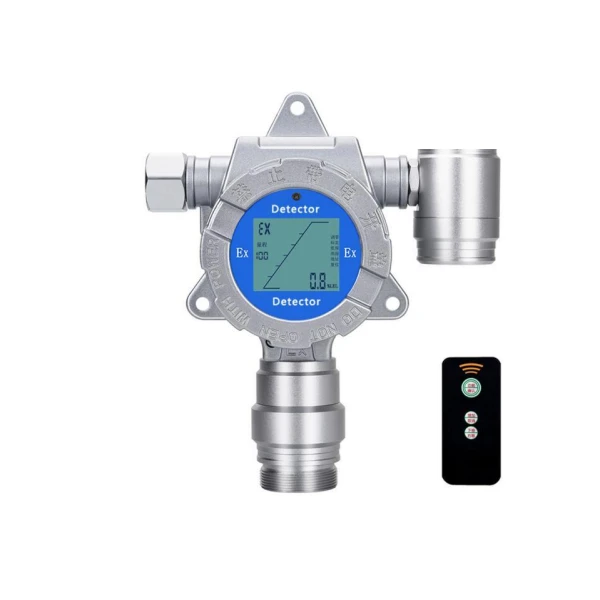
Fixed Gas Detector (Single & Multi-Gas)
An explosion-proof, wall-mounted gas detector that monitors one to four gases continuously and signals a control system before a leak becomes a hazard. Combustible, toxic, oxygen, and VOC sensing in one modular housing, with 4–20 mA, RS485, and relay output.
- Detects: 1 to 4 gases (combustible, toxic, oxygen, VOC)
- Ranges: 0–100 %LEL, %VOL, or ppm by gas
- Output: 4–20 mA + RS485 Modbus, relay, wireless option
- Rating: Ex d IIC T6, IP66, aluminum-alloy housing
- Alarm: two-level standard (three-level optional); 24 VDC
Overview
A fixed gas detector is mounted in place and left to watch a hazard around the clock, unlike a portable unit that an operator carries for a spot check. The sensor and transmitter sit at the point of risk, and the detector sends a continuous signal to a PLC, DCS, or dedicated controller so that ventilation, an alarm, or a shutdown can act the moment a concentration climbs. This model is modular: one housing takes a sensor for combustible gas, a toxic gas, oxygen, or a volatile organic compound, and can carry up to four channels.
The enclosure is explosion-proof to Ex d IIC T6 and rated IP66, so it belongs in the hazardous areas where it is needed: pump rooms, compressor houses, confined spaces, and process plant. Output is the industry-standard 4–20 mA plus RS485 Modbus, with a relay for a direct alarm or fan, and an optional wireless link. The sensor can be hot-swapped and zero-calibrated, and the detector is configured by remote control without opening the cover in a classified area.
Features
Modular channels for combustible, toxic, oxygen, and VOC sensing.
Catalytic, electrochemical, NDIR, PID, thermal, or semiconductor by gas.
Analog, Modbus, a passive relay, and an optional wireless link.
Flameproof aluminum housing for hazardous areas.
Set alarms and calibrate by remote control; hot-swap the sensor.
Local sound and light, remote controller, or software alarm.
Sensor principles and which gas they suit
The detection element is matched to the gas, and the right sensor principle is the first selection decision. A combustible-gas channel and a toxic-gas channel use entirely different physics, which is why the housing is modular.
| Sensor principle | Best suited to | Usual unit |
|---|---|---|
| Catalytic (pellistor) | Combustible and flammable gases | % LEL |
| Electrochemical | Toxic gases (CO, H2S, NH3, Cl2) and oxygen | ppm; % VOL for O2 |
| Infrared (NDIR) | Hydrocarbons and carbon dioxide | % LEL / % VOL / ppm |
| Photoionization (PID) | Volatile organic compounds | ppm |
| Thermal conductivity | High-concentration gases (H2, CO2) | % VOL |
| Semiconductor | Broad combustible and toxic, lower cost | ppm / % LEL |
%LEL, %VOL, and ppm
A gas detector reports in one of three units, and reading the wrong one hides the hazard. Match the unit to what you are protecting against.
| Unit | What it means | Use for |
|---|---|---|
| % LEL | Percent of the lower explosive limit; 100 %LEL is the start of an explosive mixture | Flammable-gas safety |
| % VOL | Percent by volume; 1 %VOL = 10,000 ppm | Oxygen and high concentrations |
| ppm | Parts per million; one molecule in a million | Toxic gases at trace levels |
A combustible gas is watched in %LEL for explosion risk; the same gas at toxic levels, or a poison such as H2S or CO, is watched in ppm; oxygen depletion or enrichment is watched in %VOL. One detector can carry channels in different units at the same time.
Technical specifications
| Parameter | Specification |
|---|---|
| Channels / media | 1 to 4 gases: combustible, toxic, oxygen, or organic vapor |
| Sensor principle | Catalytic, electrochemical, NDIR infrared, PID, thermal conductivity, or semiconductor (by gas) |
| Range | 0–100 %LEL; 0–1 / 10 / 30 / 100 %VOL; 0–5 / 10 / 100 / 1000 / 10000 ppm; mg/m3 |
| Accuracy | ≤ ±3% FS; repeatability ≤ ±1%; linearity ≤ ±1% |
| Response (T90) | ≤ 30 s; resolution 0.001 / 0.01 / 0.1 / 1 by range |
| Output | 4–20 mA (12-bit, 1 km) and RS485 Modbus-RTU (1 km); voltage 0.4–2 / 0–5 / 0–10 V optional; relay 220 VAC 3 A / 24 VDC 3 A; wireless GPRS, 4G, WiFi, LoRa, ZigBee optional |
| Alarm | Two-level standard, three-level optional; local sound and light, remote controller, software |
| Supply | 24 VDC (12–30 V) |
| Environment | −20 to +50°C (special −40 to +70°C); 10–95 %RH non-condensing; 86–106 kPa |
| Sensor life | 2 to 3 years (3 to 5 years by sensor type and environment) |
| Protection / housing | Ex d IIC T6; IP66; aluminum-alloy flameproof enclosure |
| Connection / size | M20 × 1.5 (3/4 NPT, 1/2 NPT optional); 220 × 205 × 97 mm; dot-matrix LCD |
Representative specifications; the sensor, range, unit, and certification depend on the gas and area, so confirm per datasheet for your order.
Mounting by gas density
A gas detector only works if the leak reaches it, so mounting height follows the density of the target gas. Put the detector where the gas will collect, near the likely leak source, in a spot with enough airflow to carry a leak to the sensor.
- Heavier than air (propane, butane, LPG, most solvent vapors): mount low, near floor level.
- Lighter than air (hydrogen, methane, ammonia): mount high, near the ceiling.
- Close to air density (CO and many toxics): mount at head height, roughly 1.2 to 1.8 m.
Place the detector near compressors, valves, flanges, and cable trenches where a leak is most likely, and keep it out of dead air pockets.
Applications
Fixed gas detectors guard process plant and confined spaces: refineries and chemical plants, compressor and pump rooms, LPG and natural-gas facilities, boiler rooms, wastewater and biogas plant, paint and coating booths, battery rooms, parking structures, and laboratories. A combustible channel watches for explosion risk while a toxic or oxygen channel watches for a health hazard at the same point.
Application example
LPG pump room, combustible-gas monitoring. An LPG transfer pump room needs continuous cover because a seal leak can build an explosive atmosphere with no one present. A fixed combustible detector on a 0–100 %LEL catalytic channel is mounted low, since LPG is heavier than air and settles toward the floor, and placed near the pump seals where a leak is most likely. Its two alarm levels are wired through the relay so a low alarm starts the extraction fan and a high alarm trips a beacon and a horn; the 4–20 mA signal also goes to the plant DCS for trend and record. The detector is sited and the alarm levels are set per the site hazard assessment.
Related products
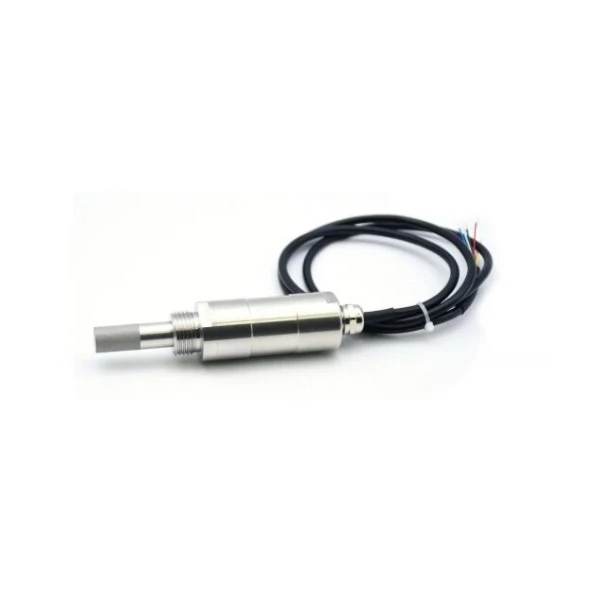 Online Dew Point Meter
In-line transmitter for moisture and pressure dew point in compressed air and gas.
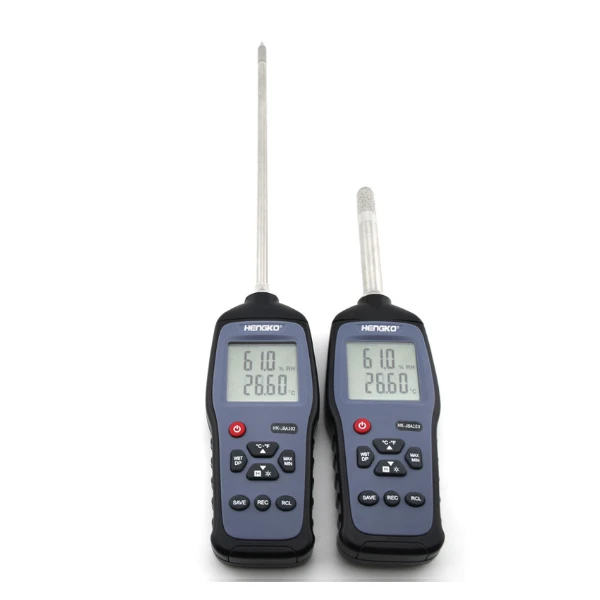 Portable Dew Point Meter
Handheld temperature, humidity and dew point meter for spot checks.
A portable gas detector and an integrated zirconia oxygen analyzer in this series are available. Ask our application engineers for the gas, range, and certification you need.
FAQ
What is a fixed gas detector?
It is a gas detector mounted permanently at a point of risk to monitor a gas concentration continuously and signal a control system, rather than a portable unit carried for spot checks. This model covers one to four gases in an explosion-proof housing with 4–20 mA, RS485, and relay output.
How does a fixed gas detector work?
A sensor matched to the target gas converts the gas concentration into an electrical signal: catalytic for combustible gases, electrochemical for toxics and oxygen, infrared for hydrocarbons, and others. The transmitter turns that into a 4–20 mA or Modbus reading and drives alarms and relays when the level crosses a set point.
What is the difference between %LEL, %VOL, and ppm?
%LEL is the percent of the lower explosive limit, used for flammability safety; %VOL is percent by volume, used for oxygen and high concentrations, where 1 %VOL equals 10,000 ppm; ppm is parts per million, used for toxic gases at trace levels. A multi-gas detector can read different channels in different units.
Where should a fixed gas detector be installed?
Mount it where the gas will collect: low for gases heavier than air such as LPG, high for lighter-than-air gases such as methane or hydrogen, and at head height for gases near air density such as carbon monoxide. Place it near the likely leak source in a ventilated spot, not in a dead air pocket.
About this product page
Specifications drawn from the single and multi-gas detector datasheet and reviewed by the Instranova engineering team — last reviewed 2026-06-30. Sensor-principle, unit, and mounting guidance follow established gas-detection practice. Questions? Reach our application engineers.
Request a quote
Tell us the gas or gases, the area classification, and the range and unit you need, and we will configure the right detector and sensor for the application, not a shelf part.