By Wu Peng, Senior Process Instrumentation Engineer · Last reviewed August 13, 2026
Wetted parts are the surfaces of an instrument that touch the process media: the diaphragm, the process connection, any o-ring or gasket at the joint, and the fill fluid sealed behind an isolation diaphragm. Wetted materials are the alloys, polymers, and elastomers those surfaces are made of. The term covers gases as well as liquids; a sensor on a dry nitrogen line has wetted parts too, and “wetted” has nothing to do with being wet with water.
Pick the wrong wetted material and the instrument corrodes through, drifts, or contaminates the product. This guide maps which surfaces are wetted on a typical instrument, walks the four material groups, gives a media-to-material matrix with the numbers behind it, covers seal elastomers and their temperature windows, decodes the standards a datasheet cites, and ends with the six lines a clean RFQ needs. It is about process instrumentation, not the surface physics of contact angles that shares the word “wetting”.
Contents
- What wetted means
- Wetted and non-wetted
- Material groups
- Media selection matrix
- Elastomer seal selection
- Why diaphragms fail
- Standards worth citing
- Writing the RFQ
- Avoiding exotic alloys
- Related guides
- FAQ
- Request a quote
What wetted means
A wetted surface sits on the process side of the pressure boundary. Whatever flows in the pipe, and that can be brine, hydraulic oil, 93 percent sulfuric acid, wet H2S, steam, or clean nitrogen, presses directly against it. Everything on the other side of that boundary is non-wetted: the housing, the terminal compartment, the electronics, the display.
The split matters because the two sides fail for different reasons. Non-wetted parts fail from the ambient environment: condensation in the terminal box, vibration, temperature cycling. Wetted parts fail from the media itself: corrosion, abrasion, chemical attack on a seal, deposits that stiffen a diaphragm. A datasheet lists wetted materials as a separate line item because that one line decides whether the instrument survives your process, and it is the line a buyer is expected to check against the media before ordering.
One definition detail trips people up. Some glossaries limit wetted parts to liquid service, and some limit them to the sensing element. Both are too narrow. Gas service wets the same surfaces, and the process connection with its threads and sealing faces is wetted just as much as the diaphragm behind it.
Wetted and non-wetted
On a standard process transmitter the wetted list is short, which is why it is worth knowing exactly. The table below uses a pressure transmitter as the example; the same logic applies to a flow meter body and its electrodes or a level probe and its wetted rod.
| Component | Wetted | Why it matters |
|---|---|---|
| Isolation or sensing diaphragm | Yes | Thinnest wetted part; corrosion shifts zero long before it leaks |
| Process connection, port, flange face | Yes | Threads and sealing faces sit in the media; crevices start pitting here |
| Fill fluid behind the diaphragm | Yes, on rupture | A torn diaphragm releases it into the process; specify food-grade or inert fill where that matters |
| O-ring, gasket, thread sealant | Yes | Often the first part to fail; chemical swell and heat harden it |
| Remote seal flange, capillary, its fill | Yes | The whole seal assembly joins the wetted list when you add one |
| Housing, electronics, display | No | Ambient exposure only; covered by the IP rating, not the wetted spec |
| Flange bolting | Usually no | Outside the seal, but still specified for the service temperature |
A wet-to-wet differential transmitter has two wetted ports and two diaphragms. A gauge unit vented to atmosphere has one wetted face and one dry reference side.
Material groups
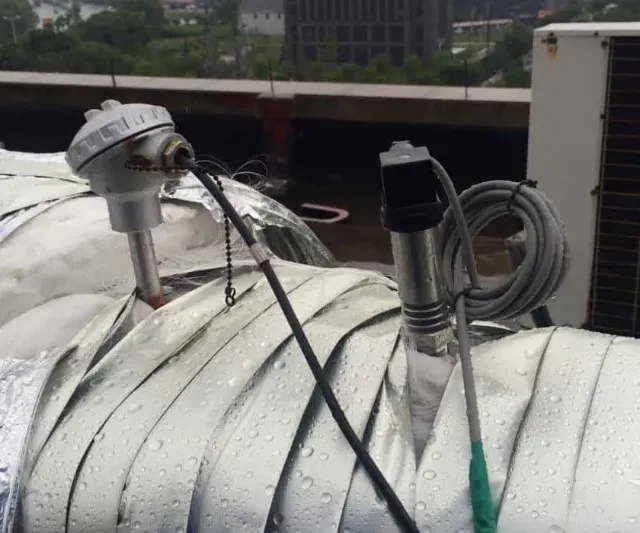
Wetted materials sort into four groups, and picking the right group is most of the decision.
Stainless steels. 316L (UNS S31603) is the default wetted metal for water, steam, air, neutral hydrocarbons, and general utility service. 304 covers clean water and instrument air at lower cost. “Stainless steel” on its own is not a specification: the grade decides the corrosion behavior, and 316L that handles condensate for decades will pit in warm seawater within months.
A useful screening number is PREN, the pitting resistance equivalent, computed from composition as %Cr + 3.3 × %Mo + 16 × %N. 316L lands near 25; Hastelloy C-276 lands near 70. In the standard ferric chloride pitting test, 316L starts pitting around room temperature while C-276 resists to well above 100 °C. That gap is what you are buying when you step up an alloy.
Nickel alloys and beyond. Hastelloy C-276 (UNS N10276) is the usual answer when chlorides or mixed oxidizing and reducing acids defeat 316L. Monel 400 handles hydrofluoric acid and seawater, and Alloy 625 appears in sour offshore service. Tantalum survives hot strong acids that attack everything above it, at a price that usually justifies a lined or non-contact alternative first.
Fluoropolymers and linings. PTFE and PFA are nearly universal against chemicals and show up as diaphragm foils, probe coatings, and pipe liners. Their limits are mechanical, not chemical: PTFE creeps under bolt load and permeates slowly, so it works better as a liner or foil than as a structural gasket.
Ceramics. Aluminum oxide (96 to 99.6 percent Al2O3) diaphragms resist abrasion and almost all chemicals, which is why a ceramic pressure sensor is the step after 316L on slurries and chloride-bearing water. One caution: a ceramic cell cannot be welded shut, so an elastomer seal ring sits somewhere in the wetted path, and that seal, not the ceramic, sets the chemical limit.
Media selection matrix
The table below is a starting point for the most common services. Concentration and temperature move the answer, so confirm against corrosion data for your exact stream before ordering.
| Process media | Wetted metal | Seal | Avoid |
|---|---|---|---|
| Potable water, condensate, saturated steam | 316L | EPDM | Brass in soft, low-pH water |
| Crude and refined hydrocarbons | 316L | FKM | EPDM (swells in oil) |
| Seawater, brine, chlorinated cooling water | Hastelloy C-276, titanium, or ceramic cell | FKM | 316L (chloride pitting) |
| Hydrofluoric acid, dilute | Monel 400 | PTFE-faced | Glass, ceramic, 316L |
| Sulfuric acid, 93 to 98 percent, ambient | Carbon steel, Alloy 20, or tantalum | PTFE-faced | 304/316 in the mid-concentration band |
| Sour gas, wet H2S | Per NACE MR0175: alloy 625, qualified duplex | NACE-rated FKM | High-strength steels (sulfide cracking) |
| WFI, CIP and SIP food or pharma lines | 316L electropolished, Ra ≤ 0.8 µm | EPDM, FDA grade | Carbon steel, any crevice design |
| Abrasive slurry, paper pulp | Ceramic flush diaphragm | FKM | Thin metal diaphragms |
| Hydrogen service | Annealed 316L; gold-plated diaphragm against permeation | FFKM | High-strength steels (embrittlement) |
Sulfuric acid deserves its own warning because the concentration reverses the answer. At 93 to 98 percent and ambient temperature, the acid forms a protective sulfate film on carbon steel and corrosion stays in the range of a few tenths of a millimeter per year, which is why concentrated acid ships in plain steel tanks.
Below roughly 60 percent the same steel corrodes rapidly, and water ingress that dilutes a concentrated stream can multiply the attack rate by around ten. The instrument that survived the storage tank will not survive the diluted drain line beside it.
Elastomer seal selection
More instruments are killed by a two-dollar o-ring than by the alloy choice. Each compound has a chemical list and a temperature window, and both have to hold at the same time.
| Compound | Typical window | Use for / never for |
|---|---|---|
| NBR (Buna-N) | −30 to +100 °C | Oils, fuels, air at low cost; never ozone, sunlight, or steam |
| EPDM | −45 to +150 °C | Steam, hot water, CIP chemicals; never mineral oil or grease |
| FKM (Viton is one trade name) | −20 to +200 °C | Oils, fuels, many acids; never steam, hot water, or amines |
| VMQ (silicone) | −55 to +200 °C | Food contact, dry heat, wide cold range; weak against abrasion and many solvents |
| FFKM (perfluoroelastomer) | Up to about +300 °C | When one seal must survive both steam and oil, or aggressive solvents; priced accordingly |
| PTFE (not an elastomer) | −200 to +260 °C | Chemically near-universal as a foil or liner; creeps under load as a gasket |
Windows are typical continuous-service figures; compound grades vary, so hold the supplier to the datasheet of the specific compound.
The field rule that prevents most seal failures: EPDM for steam and hot water but never oil, FKM for oil but never steam, FFKM when the service sees both. The classic mistake is an EPDM seal on a line that alternates water flushing with oil batches; it swells within days on the first oil cycle.
Why diaphragms fail
Piping engineers tolerate measurable corrosion because pipe is thick and carries a corrosion allowance. An instrument diaphragm has no allowance. The arithmetic is short:
Life = thickness available / corrosion rate
At a rate of 0.1 mm per year, a pipe with a 3 mm corrosion allowance lasts 3 / 0.1 = 30 years. A 0.1 mm isolation diaphragm at the same rate is gone in 0.1 / 0.1 = 1 year.
So a corrosion rate the piping specification calls acceptable can still destroy the transmitter on that line within a turnaround cycle. This is why the wetted diaphragm is often specified one alloy step above the pipe it mounts on. Pitting makes the picture worse: a single pit through the foil is a failure even when the average rate looks fine, and chloride attack on austenitic stainless gets worse with temperature; above roughly 60 °C stress corrosion cracking joins the pitting risk.
Corrosion on a diaphragm rarely announces itself with a leak first. It thins the foil, softens its spring rate, and walks the zero. If as-found calibration checks show a drifting zero on an aggressive line, inspect the diaphragm before re-trimming; the pressure transmitter calibration guide covers how as-found data separates instrument drift from process damage.
Standards worth citing
A wetted-parts specification that names standards is enforceable; one that names only material nicknames is not. Five citations cover most orders.
- ASTM A240 / A276: chemistry and condition of stainless plate and bar, so the 316L on the certificate is actually 316L.
- NACE MR0175 / ISO 15156: material limits for sour service. It applies once H2S partial pressure exceeds 0.3 kPa (0.05 psi), and it caps hardness, 22 HRC for austenitic stainless, because harder material cracks under sulfide stress. NACE MR0103 is the refinery counterpart.
- 3-A Sanitary Standards: hygienic design for food and dairy, including product-contact surface finish of Ra ≤ 0.8 µm (32 µin) and crevice-free geometry.
- FDA 21 CFR 177: the polymer and elastomer compounds allowed in food contact.
- EN 10204: the certificate itself. A type 2.1 or 2.2 document is a manufacturer declaration; a type 3.1 certificate ties the delivered metal to a specific heat with test results. If traceability matters, write “EN 10204 3.1” on the order, because a declaration is what you get otherwise.
For hygienic buyers, one more check: ask for the surface-finish certificate, not only the alloy certificate. A 316L cert says nothing about Ra, and finish failures outnumber alloy failures in food plants.
Writing the RFQ
A complete wetted-parts specification on a quote request takes six lines. With these, a supplier can confirm compatibility instead of guessing at it.
- Diaphragm material, with grade and standard: “316L per ASTM A240”, “Hastelloy C-276 (UNS N10276)”.
- Process connection material, usually the same alloy as the diaphragm.
- Fill fluid: silicone for general service, inert fluorinated fill for oxygen or chlorine, food-grade fill where a rupture must not contaminate.
- Seal compound: FKM, EPDM, FFKM, with the FDA or NACE grade where it applies.
- Surface finish for hygienic lines: the Ra number and the 3-A reference.
- Standards and certificates: NACE MR0175 compliance statement, EN 10204 3.1 certificate, as required.
Add the media name, concentration, and temperature range to the same request. A supplier who knows the stream is 30 percent hydrochloric at 60 °C will refuse a 316L build that a bare parts list would have let through.
Avoiding exotic alloys
Solid exotic alloy is not the only route through a corrosive service, and often not the cheapest. Four alternatives cover most cases.
Line it. A PTFE or PFA liner puts a fluoropolymer between the media and a standard body. That is how a magnetic flow meter runs acids with only its two small electrodes in an upgraded alloy, and how a PTFE-lined rotameter meters corrosive dosing lines with a standard tube behind the liner.
Switch the sensing surface. A ceramic measuring cell replaces the thin metal foil entirely; a flush diaphragm sensor removes the crevices and dead pockets where attack concentrates. On hygienic lines the same job falls to a sanitary pressure transmitter with polished 316L and clamp connections.
Move the instrument away. A diaphragm seal transmitter concentrates the exotic alloy in one replaceable seal element while the transmitter itself stays standard.
Stop touching the media. For level, a radar level sensor for corrosive liquids keeps only a PTFE antenna face near the vapor space. For flow on chemical lines, the chemical flow meter page maps which technology fits which stream.
Application example
Food plant, Southeast Asia. The line to be instrumented was a CIP circuit, where strongly corrosive cleaning chemicals alternate with rinse water and the wetted set has to survive the whole cycle. The order was specified as a DN50 magnetic flow meter with a PTFE liner and tantalum electrodes, with a conductivity instrument alongside to track the cleaning cycle, and it was supplied on that specification. The wetted-parts line on the RFQ did the selection work before the meter ever saw the chemicals.
Related guides
Wetted materials decide whether an instrument survives; the surrounding guides cover what it must also do. The pressure transmitter installation guide covers the piping geometry around those wetted connections, and the flow meter types overview compares measuring technologies whose wetted sets differ widely. Browse all pressure instruments for the builds referenced above.
FAQ
What are wetted parts?
Wetted parts are the components of an instrument or valve that are in direct contact with the process media during normal operation: typically the diaphragm, the process connection, seals and gaskets at the joint, and the fill fluid behind an isolation diaphragm. The term applies to gas service as well as liquids.
What are wetted materials?
Wetted materials are the alloys, polymers, ceramics, and elastomers used to build the wetted parts: 316L stainless, Hastelloy C-276, Monel, tantalum, PTFE, aluminum oxide ceramic, and seal compounds such as FKM or EPDM. Datasheets list them separately so a buyer can check compatibility with the process media.
What are the wetted parts of a pressure gauge?
The Bourdon tube or diaphragm, the socket and process connection, and the case fill only if the sensing element leaks. The case, window, movement, and pointer are non-wetted. On a diaphragm-type gauge for corrosive service, the diaphragm face and the flange sealing surface carry the material specification.
What is a wetting fluid?
A wetting fluid is a liquid that spreads over and adheres to a solid surface, a term from surface physics rather than instrumentation. On an instrument datasheet the related entry is the fill fluid, the sealed liquid behind an isolation diaphragm, which is chosen for temperature range and for what happens if it ever reaches the process.
Request a quote
Send us the media, concentration, temperature, pressure range, and any standard the line must meet, and we will return a wetted-parts specification with the instrument quote. Tell us the application and we configure one unit, not a shelf part. Reach our application engineers or use the form below.
Written and technically reviewed by Wu Peng and the Instranova engineering team.