By Wu Peng, Senior Process Instrumentation Engineer · Last reviewed July 30, 2026
Industrial flow meters fall into eleven main types: differential pressure, variable area, positive displacement, turbine, magnetic, vortex, ultrasonic, Coriolis, thermal mass, target, and open channel. Nine of them measure volume or velocity; Coriolis and thermal mass meters measure mass directly. Which type fits a given line depends on the fluid, the accuracy you need, and the pipe you have to work with.
Picking the wrong type costs more than the meter itself. A vortex meter on a swinging compressed air line can read zero all night, and a rotameter specified by full scale can be 7.5 percent off at low flow while its datasheet says 2.5 percent. This guide compares all eleven types of flow meters in one table, explains how each one works, and walks through a real selection with numbers.
Contents
Volumetric or mass
Every flow meter answers one of two questions: how much volume passed, or how much mass passed. Volumetric meters either trap and count volume directly (positive displacement) or infer it from velocity times pipe area (magnetic, turbine, ultrasonic, vortex, differential pressure, variable area, target). Mass meters read mass without knowing density in advance: a Coriolis meter weighs the fluid through tube vibration, and a thermal meter senses how much heat a gas stream carries away.
The split matters because density changes with temperature and pressure. If you bill by the kilogram or feed a reactor by mass, either measure mass directly or convert the volumetric reading with a live density value. The conversion math and its traps are covered in our guide to mass flow rate vs volumetric flow rate.
The eleven types
The table below compares the eleven types on the four numbers that decide most selections: accuracy, size range, turndown (the ratio between the largest and smallest flow the meter reads within its stated accuracy), and required straight pipe. Values are representative of our current product lines; confirm per datasheet for a specific size and build.
| Type | Accuracy | Sizes | Turndown | Straight run |
|---|---|---|---|---|
| Differential pressure | 0.5-2% rate, by element | DN10-5000 | ~4:1; wider for cone, wedge | 0D-40D+ |
| Variable area | 1.5-2.5% FS | DN15-150 | 10:1 or 20:1 | None |
| Positive displacement | 0.5% rate (0.2% opt.) | DN10-200 | 5:1-10:1 | None; strainer |
| Turbine | 0.5% rate (0.2% spec.) | DN4-200 | 10:1-20:1 | 10D / 5D |
| Magnetic | 0.5% rate (0.2% opt.) | DN6-2000 | Wide; low-flow limit | 5D / 3D |
| Vortex | 1.0-1.5% rate | DN15-1000 | 20:1 | To 40D / 20D |
| Ultrasonic | 1% reading (clamp-on) | DN15-6000 | 0.01-7 m/s | 10D / 5D |
| Coriolis | 0.1-0.5% rate (mass) | DN3-200 | 10:1-20:1 | None |
| Thermal mass | 1.5-2.5% | DN10-4000 | 0.1-100 Nm/s | Per datasheet |
| Target | 0.5-1.5% by connection | DN15-5000 | 5:1 liquid, 10:1 gas | Per datasheet |
| Open channel | 1% (part-full mag) | DN300-6000 | Level + velocity | Not applicable |
Representative values from the Instranova product lines linked in the sections below. D = pipe diameters of straight run. Confirm exact figures per datasheet for the chosen size and build.
Watch the accuracy basis. Percent of rate (or of reading) scales with the actual flow; percent of full scale does not. A 2.5% FS variable area meter running at one third of its scale can be off by 7.5 percent of what it actually shows, while a 0.5% of rate positive displacement meter stays at 0.5 percent across its turndown. Two meters with the same headline number can behave very differently at the bottom of the range.
How each type works
Differential pressure flow meters
A restriction in the line creates a pressure drop, and flow follows the square root of that drop. The family covers orifice plates, venturi tubes, flow nozzles, averaging pitot tubes, V-cones, and wedge elements, all standardized under ISO 5167 or thoroughly documented practice. They remain the default for steam and for lines where a proven, weld-in element beats electronics. See the differential pressure flow meters range, or the math in our guide to the flow rate and pressure relationship.
Variable area flow meters
A float rides up a tapered tube until the annular gap grows enough for drag to balance its weight, and the float position reads flow directly. The float actually sits at a near-constant pressure differential, which is why some directories file rotameters under differential pressure; the industry classes them as variable area because the reading comes from the changing flow area. No power, no straight run, a local pointer you can read at a glance. See metal tube rotameters.
Positive displacement flow meters
Rotors trap a fixed pocket of liquid on every revolution, so the meter counts volume directly instead of inferring it from velocity. Oval gear, spiral rotor, roots, and spur gear designs cover fuels, oils, and additives, and reading quality holds as viscosity rises. Fit a strainer upstream; the clearances are tight. See positive displacement flow meters.
Turbine flow meters
Flow spins a rotor, and a pickup converts the revolutions into pulses proportional to velocity. Turbine meters give 0.5 percent of reading on clean, low-viscosity liquids at moderate cost, which keeps them on demineralized water, fuels, and gas custody skids. The paddle wheel meter is a simplified cousin of the same idea. See turbine flow meters.
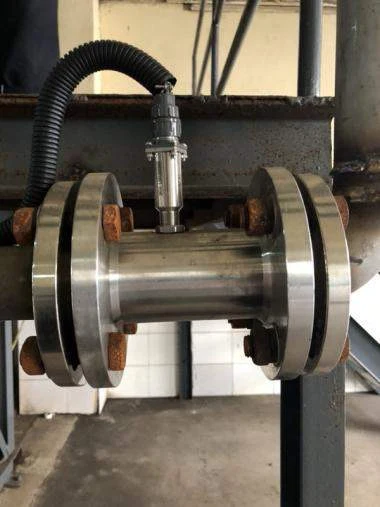
Magnetic flow meters
A conductive liquid moving through a magnetic field generates a voltage proportional to velocity, per Faraday’s law of induction. There is nothing in the bore, so pressure loss is zero and dirty or abrasive liquids pass straight through. The one hard requirement is conductivity of at least 5 uS/cm, which rules out oils and demineralized water. See magnetic flow meters.
Vortex flow meters
A bluff bar in the stream sheds vortices alternately from each side, and the shedding frequency, not the count of vortices, is proportional to velocity. Vortex meters handle liquid, gas, and steam with the same body, which makes them the standard pick for saturated steam with temperature and pressure compensation. They need a minimum velocity to shed cleanly; our line starts at 1.5 m/s on gas. See vortex flow meters.
Ultrasonic flow meters
Transit-time units send sound pulses upstream and downstream and read velocity from the time difference; Doppler units bounce sound off particles and bubbles in dirty liquids. Clamp-on transducers strap to the outside of the pipe, so you can meter a DN1200 main without cutting it or stopping the process. See ultrasonic flow meters.
Coriolis flow meters
Fluid passing through a pair of vibrating tubes shifts the vibration phase in proportion to mass flow. The tubes vibrate; no part rotates. One instrument delivers mass flow, density, and temperature at 0.1 percent of rate, with no straight run requirement, which is why custody transfer and batching specs so often name it. See Coriolis flow meters.
Thermal mass flow meters
Two probes sit in the gas stream: one heated, one sensing temperature. The heat the flow strips from the heated probe tracks gas mass flow, so the meter outputs standard volume directly with no separate temperature and pressure compensation. It reads from about 0.1 Nm/s, low enough to register leaks. See thermal mass flow meters.
Target flow meters
Flow pushes on a disc, and a force sensor reads the drag, which scales with density times velocity squared. With no pressure taps and no rotating parts, target meters survive dirty, viscous, and extreme-temperature service from −196 to 500 °C. See target flow meters.
Open channel flow measurement
Gravity sewers and culverts rarely run full, so a full-pipe meter reads wrong or not at all. Open channel measurement combines a level reading with a velocity reading, or uses a partially filled pipe magnetic flow meter that does both in one body for circular mains from DN300 to DN6000. Weirs and flumes with a level transmitter remain the classic alternative for true channels.
Selection criteria
Select a flow meter type by working through the fluid first, the accuracy second, and the installation third. In order:
- Media. Conductive liquid points to magnetic. Clean gas points to thermal or vortex. Steam points to vortex or a DP element. High viscosity points to positive displacement, Coriolis, or target. Dirty liquid points to magnetic or Doppler ultrasonic.
- Mass or volume. Billing by weight, blending, or reactor feed favors Coriolis or thermal; otherwise volumetric is cheaper.
- Accuracy and its basis. Decide the number you need at the lowest flow you care about, and check it as percent of rate, not full scale.
- Flow range. Size for the real minimum and maximum, not the largest flow the pipe could ever carry, and check the turndown column above against that swing.
- Installation. Count the straight pipe you actually have. Large mains take insertion versions of magnetic, turbine, ultrasonic, and vortex meters at a fraction of full-bore cost; clamp-on ultrasonic needs no cutting at all.
- Cost of ownership. Moving parts (turbine, PD) wear and need recalibration; no-obstruction types (magnetic, ultrasonic, Coriolis) cost more up front and less to keep.
Here is how the numbers play out on a real line. A DN50 header carries compressed air at 7 barg and 30 °C, averaging 100 Nm³/h. In actual conditions that is only 14.0 m³/h, which works out to 2.0 m/s in the pipe, barely above the 1.5 m/s minimum a vortex meter needs on gas.
At these line conditions that cutoff equals about 76 Nm³/h, three quarters of the average demand, so every night when consumption drops to 20 Nm³/h (0.4 m/s) the vortex meter reads zero. A thermal mass meter sees the same 20 Nm³/h as 2.8 Nm/s of standard velocity, well above its 0.1 Nm/s floor, and keeps totalizing.
Application example
Industrial plant, South Asia. The site metered compressed air with a vortex meter and the reading did not meet the metering requirement. We proposed a DN65 thermal mass gas flow meter for the line, ambient up to about 40 °C: it reads standard volume directly, with no separate compensation, and keeps registering at low flows a velocity meter cannot see. The proposal is with the customer.
Meters by media
Most selections collapse quickly once the medium is named. The table gives the usual first pick and the common alternates; the linked sections above carry the reasoning.
| Medium | First pick | Also consider |
|---|---|---|
| Clean water | Magnetic | Ultrasonic clamp-on, turbine |
| Wastewater, sludge | Magnetic; part-full magnetic on gravity mains | Doppler ultrasonic |
| Compressed air, nitrogen | Thermal mass | Vortex, gas turbine |
| Natural gas | Gas turbine with corrector | Thermal mass, ultrasonic |
| Steam | Vortex with T and P compensation | DP flow nozzle |
| Corrosive chemicals | Magnetic, PTFE lined | PTFE rotameter, Coriolis |
| Heavy oil, high viscosity | Positive displacement | Coriolis, target |
| Low-flow dosing | Coriolis, low-flow build | Gear PD meter |
| Custody transfer | Coriolis | PD, turbine |
For deeper media-specific guidance, including steam, natural gas, chemicals, and slurry pages, browse flow meters by application, or start from the full flow meters range. If you are still converting between GPM, LPM, and m³/h while comparing datasheets, keep our flow rate units guide open in a second tab.
Whichever technology you pick, most installations also need a cumulative reading for inventory or billing. The flow totalizer vs flow meter guide covers where that function should live.
If an existing meter is misreading rather than missing from the lineup, start with our flow meter troubleshooting guide before changing technology.
Two cross-cutting checks apply to every technology above: the Reynolds number limits that decide which meters hold accuracy on viscous or slow lines, and the turndown ratio that decides whether one meter covers your full flow range.
Two applications sit slightly outside the standard lineup. Metering thermal energy rather than volume pairs a flow meter with a matched temperature pair, covered in the BTU meter guide; and liquefied gases at cryogenic temperature narrow the field further, which the cryogenic flow meter guide works through.
Once you have shortlisted a technology, our flow meter cost guide shows the published price bands each one sells in.
FAQ
What is the most accurate flow meter type?
Coriolis meters lead, at 0.1 percent of rate on mass flow in standard builds. Positive displacement and turbine meters reach 0.2 percent of reading in special builds on suitable liquids. Compare accuracy at your lowest operating flow and always on the same basis, percent of rate rather than full scale.
How many types of flow meters are there?
Eleven core technologies cover industrial work: differential pressure, variable area, positive displacement, turbine, magnetic, vortex, ultrasonic, Coriolis, thermal mass, target, and open channel. Vendors subdivide these further by construction, such as insertion, clamp-on, or sanitary versions, but the measuring principles come down to this list.
What are the three types of water meters?
Utility water meters group into positive displacement meters for homes and small services, velocity meters for larger lines (turbine and Woltman designs, plus magnetic and ultrasonic versions with no moving parts), and compound meters that combine both to catch low and high flows in one body.
What are the other names for flow meters?
You will see flowmeter as one word, plus flow sensor, flow transducer, flow indicator, flow gauge, and flow totalizer. A flow transmitter is a meter with a process output such as 4-20 mA or a fieldbus signal; an indicator only displays locally; a totalizer accumulates the volume passed.
Request a quote
Send us the medium, line size, minimum and maximum flow, temperature, pressure, and the output you need, and we will come back with the right type and a configured quote. Tell us the application and we configure one unit, not a shelf part. Reach our application engineers or use the form below.
Written and technically reviewed by Wu Peng and the Instranova engineering team.