By Wu Peng, Senior Process Instrumentation Engineer · Last reviewed July 19, 2026
Mass flow rate is the mass of fluid passing a point per unit of time, in units like kg/h or lb/h. Volumetric flow rate is the volume passing per unit of time, in units like m³/h or GPM. Density links the two: mass flow equals density times volume flow. For liquids the two numbers track each other closely. For gases they separate, because gas density moves with every change in pressure and temperature.
That separation is not academic. On a compressed air header running between 4 and 6.5 bar, the same actual cubic meter holds 50 percent more air at the top of that band than at the bottom. A volumetric reading cannot tell you how much air a machine consumed; a mass reading can. This guide covers the definitions, the conversion with worked numbers, the standard-volume unit trap, a density reference table, and which flow meters give you mass directly.
Contents
- The two flow rates
- The density conversion
- Why gas readings separate
- Standard volume units
- Liquid services
- Density reference table
- Choosing the meter
- FAQ
The two flow rates
Volumetric flow rate, symbol Q, counts the space the fluid sweeps past a cross-section each second. Mass flow rate, symbol ṁ (spoken “m-dot”), counts the material itself. Two meters can watch the same pipe and both be right while showing numbers that drift apart, because they answer different questions.
| Property | Volumetric flow rate (Q) | Mass flow rate (ṁ) |
|---|---|---|
| What it counts | Volume per unit time | Mass per unit time |
| Common units | m³/h, L/min, GPM, CFM | kg/h, kg/s, lb/h, t/h |
| Built from | Velocity × pipe area | Density × velocity × pipe area |
| Moves with temperature and pressure? | Yes, on gases strongly | No; mass is conserved |
| Typical services | Water distribution, HVAC, tank filling | Gas metering, dosing, steam, energy balances, billing |
Chemical reactions, combustion, and invoices all run on mass. Pumps, pipes, and tanks are sized on volume.
The density conversion
One line of algebra covers both directions:
ṁ = ρ × Q and therefore Q = ṁ / ρ
where ρ (rho) is the fluid density at the conditions actually in the pipe, not at some catalog condition. That single caveat carries most of the difficulty, and all of the errors we get called about.
A worked example from a loading rack. A truck-loading line moves diesel at 40 m³/h. EN 590 diesel sits between 820 and 845 kg/m³ at 15 °C; take a measured 835 kg/m³. Then:
ṁ = 835 kg/m³ × 40 m³/h = 33,400 kg/h = 33.4 t/h
The terminal invoices in metric tons, the meter totalizes in cubic meters, and the density is the bridge. Fiscal systems take this seriously enough to correct every batch to 15 °C reference density before settlement. If the unit conversions themselves are the sticking point, GPM to m³/h and friends, our flow rate units guide has the full tables and a converter. For the density conversion itself, the mass flow rate calculator works both directions and adds a gas mode with pressure and temperature built in.
Why gas readings separate
A liquid barely compresses; a gas does nothing but. The ideal gas law, PV = nRT, says the volume of a fixed mass of gas shrinks in proportion to pressure and grows in proportion to absolute temperature. So the moment pressure or temperature moves, a volumetric gas reading and a mass reading part company.
Put numbers on a familiar line. Compressed air at 6 bar gauge and 35 °C has a density of about 7.93 kg/m³, versus 1.204 kg/m³ for ambient air at 20 °C. A meter reading 100 m³/h of actual volume at those line conditions is passing:
- 100 m³/h × 7.93 kg/m³ = 793 kg/h of air, which is
- 793 / 1.293 = 613 Nm³/h expressed at normal conditions (0 °C, 1 atm).
Six times more air than the actual-volume number suggests. And because header pressure is never constant, the gap is never constant either: between 4 and 6.5 bar gauge at 35 °C, air density runs from 5.67 to 8.49 kg/m³, a factor of 1.5 across the normal working band of one compressor system.
Standard volume units
Units like SCFM, SLPM, and Nm³/h look volumetric. They are not. They state the volume a gas parcel would occupy if it were brought to a fixed reference temperature and pressure, and because that reference never moves, a standard-volume number always represents the same number of molecules. It is a mass flow unit written in volumetric form.
The trap is that “standard” is not one standard:
| Convention | Reference temperature | Reference pressure |
|---|---|---|
| Normal (Nm³/h, European) | 0 °C | 101.325 kPa (1 atm) |
| US natural gas (SCFM, SCFH) | 60 °F (15.6 °C) | 14.696 psia |
| ISO 13443 (gas trade) | 15 °C | 101.325 kPa |
| “Standard” in many lab specs | 20 °C or 25 °C | 101.325 kPa |
Always confirm the reference pair on the datasheet. The abbreviation alone does not pin it down.
The cost of mixing them is easy to compute. Air density is 1.293 kg/m³ at 0 °C and 1.204 kg/m³ at 20 °C, so two instruments reporting the same physical flow against those two references disagree by 1.293/1.204 = 1.074, a 7.4 percent standing error that looks exactly like a real process change. We put the reference conditions in writing on every gas meter order for this reason, and we suggest you do the same on the purchase order side.
Liquid services
Liquid density moves little, so for most liquid services the two flow rates are interchangeable in practice. Water at 15 m³/h carries 14,973 kg/h at 20 °C and 14,577 kg/h at 80 °C: a 2.6 percent shift across a 60-degree swing. Cooling water, distribution, and tank filling live comfortably on volumetric meters, which is why magnetic flow meters and turbine flow meters dominate there.
Three liquid situations still call for mass. Hot services, condensate and thermal oil, where the density shift stops being small. Recipe and dosing work, where stoichiometry runs on kilograms rather than liters; one bakery came to us for two 1-inch Coriolis units at 0 to 4,000 kg/h precisely so the recipe would see mass, not volume that moves with water temperature. And billing, wherever the invoice is written in tons.
Density reference table
Every conversion in this guide runs through density, so here are working values for common fluids at stated conditions:
| Fluid and condition | Density | 1 m³/h equals |
|---|---|---|
| Water, 20 °C | 998.2 kg/m³ | 998 kg/h |
| Water, 80 °C | 971.8 kg/m³ | 972 kg/h |
| Diesel (EN 590), 15 °C | 820 to 845 kg/m³ | about 835 kg/h |
| Air, 0 °C, 1 atm | 1.293 kg/m³ | 1.29 kg/h |
| Air, 20 °C, 1 atm | 1.204 kg/m³ | 1.20 kg/h |
| Compressed air, 6 bar g, 35 °C | 7.93 kg/m³ | 7.93 kg/h |
| Saturated steam, 8 bar abs (170 °C) | 4.16 kg/m³ | 4.16 kg/h |
| Methane, 0 °C, 1 atm | 0.72 kg/m³ | 0.72 kg/h |
Values typical at the stated condition; liquid densities vary with temperature, gas densities with both temperature and pressure, and natural gas with composition. Confirm against your fluid data before settlement use.
Choosing the meter
There are three routes to a mass flow number, and they are not equal in cost or in error budget.
| Route | Meters | How the mass number is produced |
|---|---|---|
| Direct mass | Coriolis mass flow meters (liquid and gas); thermal mass flow meters (gas) | The sensing principle responds to mass itself: tube inertia for Coriolis, heat carried off by molecules for thermal. No density input, no compensation. |
| Volumetric plus compensation | Vortex with temperature and pressure sensors for steam; rotary gas meters with a built-in corrector for fuel gas | The meter measures volume; a computer converts to mass or standard volume using live temperature and pressure. Accurate when the compensation inputs are. |
| Volumetric as-is | Magnetic, turbine, ultrasonic | Volume only. Convert on paper with a known density; fine for stable liquids, risky for gases. |
The selection logic is short. Stable liquid, volume is enough. Gas or steam, get mass one way or the other: directly if the line justifies a dedicated compressed air flow meter or Coriolis unit, by compensation if a volumetric meter is already the right mechanical fit.
Application example
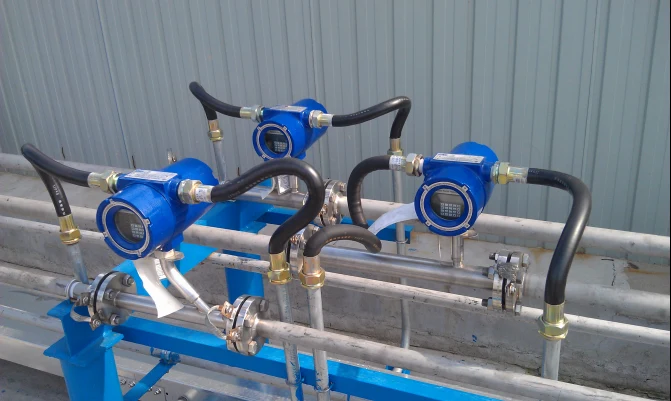
Compressed air monitoring, Pakistan. A plant team asked us to meter the air consumption of individual machines across lines from 1/2 inch to 4 inch, with the header swinging between 4 and 6.5 bar gauge at 35 to 40 °C. Across that band the air density changes by a factor of 1.5, so any actual-volume reading would follow the compressor cycle as much as the machines. We specified thermal mass flow meters sized per line, reading directly in mass and normal volume, so consumption per machine can be compared and totalized regardless of header pressure.
Density conversion is only one piece of choosing an instrument. For the full landscape of measuring principles, see our comparison of flow meter types.
Entrained gas is the extreme case of the mass-volume gap: a bubble is large by volume and nearly weightless by mass, which is why metering foamy liquids favors mass-based meters.
FAQ
Is volumetric flow rate the same as mass flow rate?
No. Volumetric flow rate measures the space the fluid occupies per unit time; mass flow rate measures the material itself. They are related through density, and for a liquid at steady temperature they move together. For a gas they diverge whenever pressure or temperature changes, because the same mass occupies a different volume.
How do you convert volumetric flow rate into mass flow rate?
Multiply by the fluid density at the actual line conditions: mass flow = density × volume flow. For example, 40 m³/h of diesel at 835 kg/m³ is 33,400 kg/h. For gases, compute the density from the ideal gas law at line pressure and temperature first, or use a meter that does the compensation for you.
What is the relationship between mass flow and volume flow?
Density is the bridge: ṁ = ρ × Q, and Q = ṁ / ρ. The relationship holds at every instant, but only at the conditions where the density was taken. Quoting a gas volume flow without stating pressure and temperature leaves the mass flow undefined.
Is GPM a mass flow rate?
No, gallons per minute is a volumetric unit. To get mass flow from a GPM reading, convert to volume per hour and multiply by density, or multiply GPM by density in lb/gal to get lb/min. Units with the prefix S or N, such as SCFM and Nm³/h, are the exception: they look volumetric but represent a fixed mass of gas at reference conditions.
Request a quote
Tell us the fluid, the line size, the operating pressure and temperature, and whether the number you report is in cubic meters or in kilograms. We will route you to a direct mass meter or a compensated volumetric meter and quote the matching build. Reach our application engineers or use the form below.
Written and technically reviewed by Wu Peng and the Instranova engineering team.