By Wu Peng, Senior Process Instrumentation Engineer · Last reviewed September 24, 2026
A boiler pressure gauge reports the pressure inside the boiler, and what counts as normal depends entirely on the boiler. A residential hot water system sits near 12 psi cold and stays under its 30 psi relief valve. A steam heating boiler runs on ounces of pressure but carries a 0 to 30 psi dial because the code requires it. An industrial steam boiler carries a gauge scaled to roughly double its safety valve setting.
This guide covers the readings, the dial range rules in the ASME boiler code, the combined temperature and pressure gauge on hydronic boilers, and the siphon that keeps steam out of the gauge. How to read any dial correctly is covered in the pressure gauge reading guide.
Contents
- Two boiler worlds
- Normal readings
- Code range rules
- Tridicator gauges
- The siphon rule
- Low pressure resolution
- Selecting the gauge
- FAQ
Two boiler worlds
The phrase covers two audiences. Homeowners are usually looking at a heating boiler: a sealed hydronic loop in North America, a combi boiler in the United Kingdom, or a low pressure steam heating boiler. Engineers mean a code stamped steam or hot water boiler in a plant, where the gauge is a legal fitting with its own paragraph in the ASME boiler code. This page answers the first group briefly and serves the second in depth; espresso machine boiler gauges are a separate, smaller product outside its scope.
The two worlds meet in one shared habit. The gauge is the first instrument anyone consults when a boiler misbehaves, so its range, its condition and its protection from live steam all matter out of proportion to its cost.
Normal readings
| System | Cold | Running | Relief or limit |
|---|---|---|---|
| US hydronic (2 story) | about 12 psi | up to about 25 psi hot | 30 psi relief valve |
| UK combi boiler | 1 to 1.5 bar | 1.5 to 2 bar | relief near 3 bar (43.5 psi) |
| Residential steam heating | 0 psi | 0.2 to 0.5 psi typical | 15 psi MAWP, safety valve at 15 psi |
| Industrial steam boiler | 0 psi | set by the process design | safety valve at or below MAWP |
Hydronic and combi figures from manufacturer service guidance; a taller building needs a higher cold fill, about 15 psi for three stories, so the top radiators stay flooded.
Two of these rows call for explanation. A hydronic gauge climbing from 12 to 20 psi as the water heats is thermal expansion doing its job, not a fault; the fault begins when the needle parks at 30 psi and the relief valve drips.
A steam heating boiler that shows next to nothing on its 0 to 30 psi gauge while heating the whole building is behaving correctly. Ounces of steam pressure barely move a dial that the code sizes for fault conditions, not for daily running.
Code range rules
The ASME boiler code writes the dial range into law, and it does so differently for power boilers and heating boilers. For power boilers, Section I asks for a dial of approximately double the safety valve setting, and never less than 1.5 times it.
For heating boilers, Section IV fixes the steam gauge dial between 30 and 60 psi, and scales the hot water gauge dial to between 1.5 and 3.5 times the relief valve setting. Some jurisdictions key the same arithmetic to the boiler MAWP instead of the valve setting.
The arithmetic explains the gauges you see in the field. A steam heating boiler is limited to 15 psi, and twice that lands exactly on the 0 to 30 psi dial in the code window. A hot water boiler with a 30 psi relief valve needs a dial between 45 and 105 psi. The ubiquitous 0 to 75 psi gauge sits at 2.5 times the relief setting, near the middle of that window.
A power boiler with a 150 psi safety valve gets a 0 to 300 psi dial by the same doubling rule.
The doubling has a second job beyond code compliance. It puts the working point near mid scale, where dial gauges hold their tightest accuracy band. It also leaves headroom so an overpressure event registers as a reading instead of a bent pointer, a point developed in the Bourdon tube guide.
Tridicator gauges
Hydronic boilers usually carry a combination instrument: a boiler temperature and pressure gauge, sold as a tridicator or PT gauge. One needle reads pressure, a second reads water temperature, and the pressure needle often sweeps a third scale marked in feet of water. That altitude scale is the same pressure on a different ruler. One psi supports 2.31 feet of water, so a 0 to 75 psi gauge can equally be read as 0 to about 173 feet.
The altitude scale is a holdover from gravity fed heating, and it still has a use on fill day. The cold fill pressure must hold water at the highest radiator, so 12 psi corresponds to about 27.7 feet of elevation above the gauge.
Many tridicators add a red set hand: the installer parks it at the correct fill point, and anyone can later see whether the live needle has wandered from it. Typical specifications for these gauges are a 2.5 or 3 inch dial, ranges like 0 to 75 psi with 70 to 320 °F, and a 3-2-3 percent accuracy grade.
The same combined measurement exists in transmitter form for control systems; see the combined pressure and temperature sensors page.
The siphon rule
A steam boiler pressure gauge never connects to the steam space directly. The code requires a siphon, the familiar pigtail coil or U, with an inside diameter of at least 1/4 inch. Condensate collects in the loop and forms a water seal, so the gauge element feels the pressure but touches only warm water.
Steam at even half a psi is a few degrees above 212 °F, enough to overheat a soldered Bourdon element in continuous service. The seal passes the pressure through, offset only by its own few inches of water head, which matters on an ounce range gauge and not on a code dial.
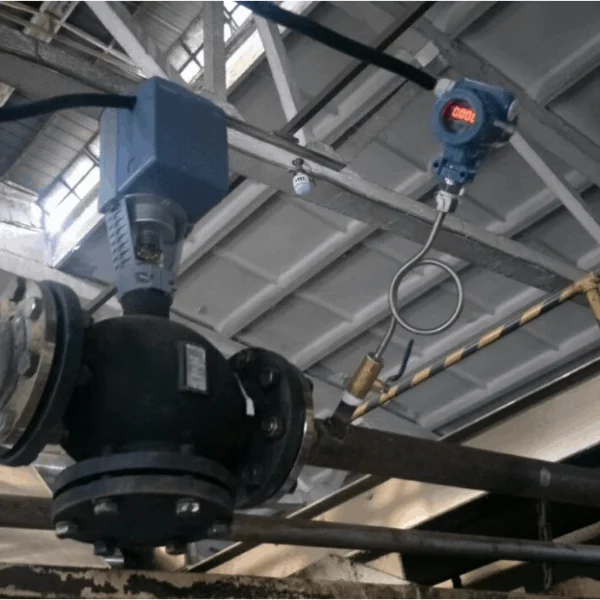
Fill a new siphon with water before start-up, because the seal otherwise forms only after the first steam has already reached the gauge. And watch the failure mode. A pigtail plugged with sediment blinds the gauge, and on heating boilers the pressure control often shares the same protected connection, so one blockage can silence the instrument and the control together.
A gauge that reads a steady few psi with the boiler cold is not stuck at an operating value; it is a failed gauge or a plugged line, and either one is a service item. Transmitter installations on steam follow the same logic, covered on the steam pressure transmitter page.
Low pressure resolution
The code gauge on a steam heating boiler is nearly useless for tuning, and the code itself is why. Ounces of operating pressure occupy the first few percent of a 0 to 30 psi dial. Steam fitters therefore add a second, low range gauge: 0 to 3 psi, 0 to 5 psi, or one scaled in ounces. It tees off the protected connection alongside the code gauge, which stays in place to satisfy the inspector.
The arithmetic shows why the add-on is worth the fitting. One ounce per square inch is 1.73 inches of water column. A well tuned residential steam system cycles at 8 ounces or less, which is half a psi, about 2 percent of the code dial.
On a 0 to 3 psi gauge the same half psi sits at a readable 17 percent of scale. Diaphragm and capsule elements serve this range well; the SI-D100 diaphragm gauge line covers low spans that a Bourdon tube cannot resolve.
Selecting the gauge
For a replacement or a new specification, five decisions cover it. Range comes from the code rules above, never from the operating pressure alone. The connection is commonly 1/4 NPT bottom mount on heating boilers, with the code minimum connection sizes and the siphon on steam. Dial size follows reading distance, and the readability math is in the reading guide.
Accuracy grades in the 3-2-3 class serve heating plant; process steam calls for Grade A or better. Case fill is a judgment call: a glycerin filled case damps vibration but suffers near hot surfaces, as explained in the liquid filled gauge guide.
Past the gauge itself, a boiler room that feeds a control system usually pairs the local dial with a transmitter for the loop. The boiler code text quoted above governs only the required local gauge. Our pressure gauge range and steam service transmitters cover both halves, and calibration of either follows the pressure gauge calibration guide.
Application example
Power station, Indonesia. The boiler questions that reach us often go past the gauge. This plant asked about steam drum level measurement, where drum temperature called for a high temperature differential pressure transmitter, which we proposed for the drum service. The local pressure gauge stays on the boiler either way, because the code requires it regardless of what the control room reads.
FAQ
What is a boiler pressure gauge?
It is the dial instrument that shows the pressure inside a boiler, required by the boiler code on stamped equipment. On hydronic boilers it is usually combined with a thermometer in one case, and on steam boilers it connects through a siphon that keeps live steam off the measuring element.
What should my boiler pressure gauge be at?
A typical US hydronic boiler shows about 12 psi cold and up to roughly 25 psi hot, staying under the 30 psi relief valve. A UK combi boiler shows 1 to 1.5 bar cold and 1.5 to 2 bar running. A steam heating boiler correctly shows under 1 psi while running.
Is 1.5 too high for boiler pressure?
No. On a combi boiler 1.5 bar is the top of the normal cold band and comfortably inside the normal running band of 1.5 to 2 bar. Investigate when the needle passes about 2.5 bar, and expect the relief valve to open near 3 bar.
How much pressure does a boiler need?
Enough to keep water at the highest point of the system. Each psi supports 2.31 feet of water, so a two story house needs about 12 psi cold fill and a three story house about 15 psi. Steam heating boilers need almost none: ounces of pressure heat the building.
Request a quote
Tell us the application and we configure the instrument, not a shelf part: code range dial gauges with siphons, low range diaphragm gauges for steam heating, or transmitters for the control loop. Reach our application engineers or use the form below.
Written and technically reviewed by Wu Peng and the Instranova engineering team.