By Wu Peng, Senior Process Instrumentation Engineer · Last reviewed July 12, 2026
Flow rate units state how much fluid passes a point per unit of time, as a volume or as a mass. The SI unit is cubic meters per second (m3/s), but industry rarely uses it on a nameplate. Water and process lines in North America run on gallons per minute (GPM), most of the world runs on liters per minute (L/min) or cubic meters per hour (m3/h), and gas lines add standard-volume units such as SCFM and Nm3/h. This guide lists the units you will actually meet, gives exact conversion factors between GPM, LPM, and m3/h, and shows how to check your process figure against a flow meter datasheet written in a different unit.
Contents
- Volumetric flow rate units
- Flow rate conversion table
- GPM to LPM conversion
- GPM to m3/h conversion
- Flow unit converter
- Mass flow rate units
- Gas flow units: standard vs actual volume
- Reading the units on a flow meter datasheet
- FAQ
Volumetric flow rate units
Volumetric flow rate units describe a volume moved per unit of time. Which one you meet depends on the region and the industry, not on the physics. The table lists the units that appear on real instruments and datasheets.
| Unit | Symbol | Where you see it |
|---|---|---|
| US gallons per minute | GPM, gal/min | North American water, pumps, HVAC |
| Imperial gallons per minute | imp gpm | UK and Commonwealth legacy specs |
| Liters per minute | L/min, LPM | Small lines, dosing, lab, medical gas |
| Liters per second | L/s | Municipal water and wastewater design |
| Cubic meters per hour | m3/h | Most industrial datasheets outside the US |
| Cubic feet per minute | CFM, ft3/min | Air handling, compressed air |
| Barrels per day | BPD, bbl/d | Oil and gas production |
| Milliliters per minute | mL/min | Analyzers, chemical injection, lab |
The SI base unit, m3/s, is what the others are defined against. It is large: 1 m3/s is 3,600 m3/h, about 15,850 GPM, which is why working units are minutes and hours, not seconds. A flow meter totalizer usually accumulates in gallons, liters, or cubic meters, while the rate display uses one of the per-minute or per-hour units above.
Flow rate conversion table
All the factors below come from two exact definitions: 1 US gallon = 3.785411784 L and 1 cubic foot = 28.316846592 L. Read across a row to convert one unit into the others.
| 1 unit of | GPM | L/min | L/s | m3/h |
|---|---|---|---|---|
| 1 GPM (US) | 1 | 3.7854 | 0.0631 | 0.2271 |
| 1 imp gpm | 1.2010 | 4.5461 | 0.0758 | 0.2728 |
| 1 L/min | 0.2642 | 1 | 0.0167 | 0.06 |
| 1 L/s | 15.850 | 60 | 1 | 3.6 |
| 1 m3/h | 4.4029 | 16.667 | 0.2778 | 1 |
| 1 CFM | 7.4805 | 28.317 | 0.4719 | 1.6990 |
| 1 BPD | 0.0292 | 0.1104 | 0.0018 | 0.0066 |
For mental checks in the field, three approximations cover most situations: a GPM is about 3.8 L/min, a m3/h is about 4.4 GPM, and an L/s is about 16 GPM. Values here are rounded to four decimals; carry the full factors when you configure a totalizer for billing or custody work.
GPM to LPM conversion
Multiply GPM by 3.785 to get liters per minute, and multiply L/min by 0.2642 to go back. The factor is the size of the US gallon itself: 3.785411784 L, exactly.
L/min = GPM × 3.785
GPM = L/min × 0.2642
Worked both ways: a 50 GPM pump curve is 50 × 3.785 = 189.3 L/min. A rotameter scaled 0 to 200 L/min tops out at 200 × 0.2642 = 52.8 GPM. The quick-reference table covers the flows you meet most often.
| GPM | L/min | m3/h |
|---|---|---|
| 5 | 18.93 | 1.14 |
| 10 | 37.85 | 2.27 |
| 50 | 189.27 | 11.36 |
| 100 | 378.54 | 22.71 |
| 500 | 1,892.71 | 113.56 |
Watch the gallon itself. An imperial gallon is 4.54609 L, about 20% larger than a US gallon, so 100 imp gpm is 120.1 US GPM. On old UK specifications, confirm which gallon the document means before you size anything.
GPM to m3/h conversion
Multiply GPM by 0.2271 to get cubic meters per hour, and multiply m3/h by 4.403 to go back. This is the conversion you meet most often when a US process spec lands on a metric datasheet.
m3/h = GPM × 0.2271
GPM = m3/h × 4.403
Worked both ways: 100 GPM is 100 × 0.2271 = 22.71 m3/h. A magnetic flow meter sized DN80 for 30 m3/h carries 30 × 4.403 = 132.1 GPM. Most of our own datasheets, like the DN2 to DN300 range tables on the turbine flow meter page, quote m3/h, so US customers make exactly this conversion.
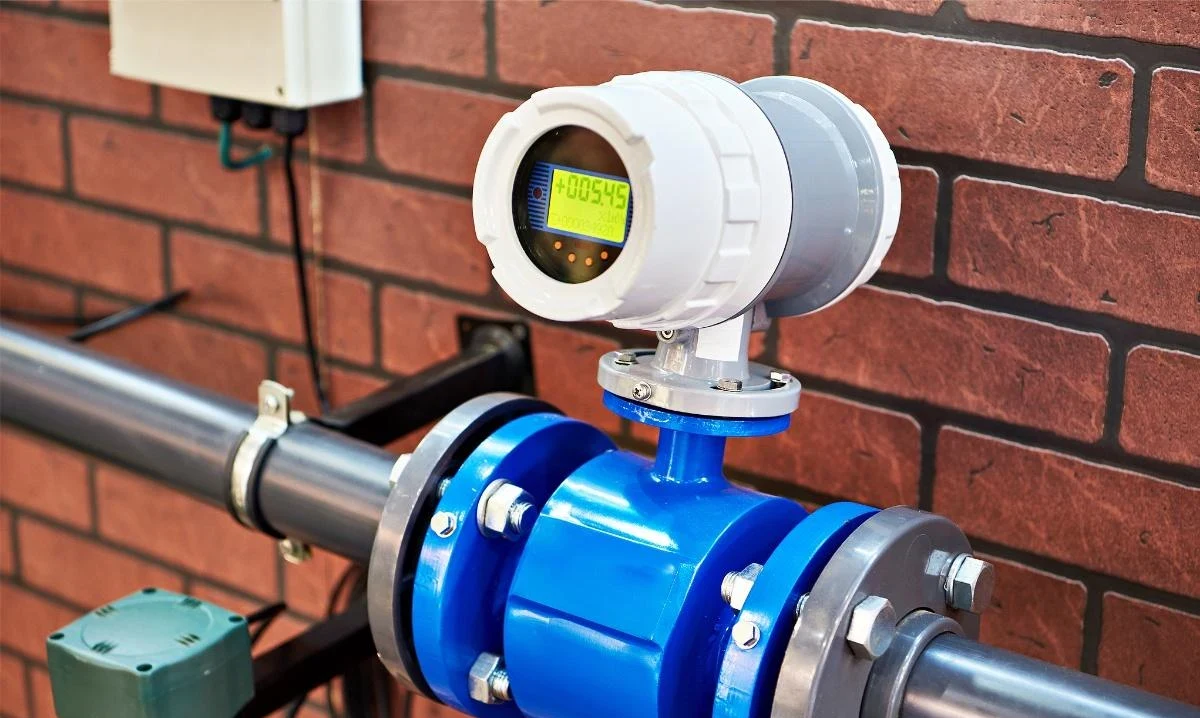
Flow unit converter
Enter a value in any unit and the converter returns the others, using the exact factors from the table above.
Flow unit converter
Volumetric units only; results update as you type. For velocity and pipe sizing, use the pipe velocity calculator; more converters live on the engineering tools page.
Mass flow rate units
Mass flow rate units count kilograms or pounds per unit of time instead of a volume: kg/h, kg/s, t/h, and lb/h are the common ones. Mass and volume connect through density. A water line moving 22.7 m3/h at 998 kg/m3 carries about 22,655 kg/h; the same volumetric flow of hot oil at 850 kg/m3 carries far less mass. That is why steam, gas, and reactor feeds are metered in mass units: the energy and the chemistry follow the mass, and density moves with temperature and pressure.
A Coriolis mass flow meter reads mass directly, with no density input. Volumetric meters can output mass only if the density is known or measured. If your process figure is in kg/h and the meter datasheet is in m3/h, divide by the operating density before you compare, and state the density you used on the spec sheet.
Gas flow units: standard vs actual volume
Gas flow adds a trap that liquid flow does not have: a cubic meter of gas is not a fixed amount of gas. Compress it or heat it and the same mass occupies a different volume. Gas units therefore come in two families. Actual-volume units (m3/h, ACFM) count the volume at line conditions. Standard-volume units (Nm3/h, SCFM, SLPM) restate the flow at a reference temperature and pressure, so they behave like a mass unit.
The two families do not convert with a fixed factor; the ratio depends on line pressure and temperature. Air at 7 bar gauge flows about 8 times more standard volume than actual volume through the same pipe. Instruments handle this in one of two ways: a thermal mass flow meter reads standard volume directly, while a gas turbine flow meter or a rotary gas meter measures actual volume and corrects it to standard volume with built-in pressure and temperature sensors. Also confirm the reference conditions themselves: “normal” (Nm3/h) is commonly 0 °C and 101.325 kPa while “standard” definitions vary by industry, and a mismatched reference quietly shifts every reading a few percent.
Reading the units on a flow meter datasheet
Unit conversion is usually the first step of sizing. Datasheets state minimum and maximum flow in one unit, your process runs in another, and the check only works after you put both in the same unit. The workflow we use at the selection desk:
| Step | What to do |
|---|---|
| 1. Fix the unit | Convert your minimum, normal, and maximum flow into the datasheet unit with the exact factors above. |
| 2. Check the span | All three figures must sit inside the documented range for that meter size, with the normal flow ideally in the upper half. |
| 3. Check the gallon and the reference | US vs imperial gallon on liquids; standard vs actual volume and the reference conditions on gases. |
| 4. State the unit on the order | Write the display and totalizer unit into the purchase spec so the meter arrives configured, not defaulted. |
The same discipline applies to the piping questions around the meter: our guides on straight run requirements and the flow rate and pressure relationship both start from a correctly converted flow figure. For billing water lines, meter classes are even defined around specific flow points (Q1 to Q4 on an ultrasonic water meter), so the unit conversion decides which class you are actually buying.
Application example
Power utility, demineralized water. A US power utility specified a gear flow meter for demineralized water at a target of 55 gpm, swinging between 25 and 75 gpm. The meter family documents its ranges in liters per hour, so the check ran through the conversion first: 55 gpm is about 12,492 L/h, and the full swing of 25 to 75 gpm is 5,678 to 17,034 L/h. That window sits inside the documented 2,000 to 20,000 L/h span of the selected size, with the target in the upper half where a gear meter holds its accuracy. Converted once, checked once: the unit change was the whole sizing exercise.
Totalizers fed by a pulse-output meter add one more unit layer: the K-factor is itself stated per gallon or per liter, and it must match the display unit. The flow meter K-factor guide covers that conversion.
When the quantity you need is cumulative rather than a rate, the units change with it: totals are stated in m³, liters, or kilograms. Our flow totalizer guide covers how rate signals become totals.
FAQ
What are the units for flow rate?
Volumetric flow rate is stated in m3/s (the SI unit), m3/h, L/min, L/s, US or imperial gallons per minute, CFM, or barrels per day. Mass flow rate uses kg/s, kg/h, t/h, or lb/h. Gas flow adds standard-volume units such as SCFM and Nm3/h that restate the flow at reference conditions.
Is flow rate the same as GPM?
GPM is one unit of flow rate, not a synonym for it. Gallons per minute expresses a volumetric flow rate in US customary units; the same flow can be written in L/min, m3/h, or any other volume-per-time unit. Say “flow rate” for the quantity and “GPM” only when you mean that specific unit.
Is flow rate m3/s?
m3/s is the SI unit of volumetric flow rate, but it is not the only valid unit and it is rarely used on instruments because it is so large: 1 m3/s equals 3,600 m3/h or about 15,850 GPM. Practical datasheets and displays use m3/h, L/min, or GPM instead.
How do you measure flow rate?
With a flow meter matched to the fluid and the pipe: magnetic meters for conductive liquids, turbine and ultrasonic meters for clean liquids, Coriolis meters for direct mass flow, and thermal or corrected volumetric meters for gases. Each reads out in a configurable flow unit and totalizes the volume or mass passed. See the flow meter range for how the technologies divide the work.
Get the range right in your own units
Send us your minimum, normal, and maximum flow in whatever unit your process uses, plus the fluid and line size, and we will convert, size the meter, and quote with the display set to the unit your operators read. Tell us the application and we configure one unit, not a shelf part.
Written and technically reviewed by Wu Peng and the Instranova engineering team. Conversion factors are computed from the exact definitions of the US gallon (3.785411784 L), imperial gallon (4.54609 L), and cubic foot (28.316846592 L). Questions? Reach our application engineers.