Flow Meters › Ultrasonic Flow Meters › Ultrasonic Water Meter
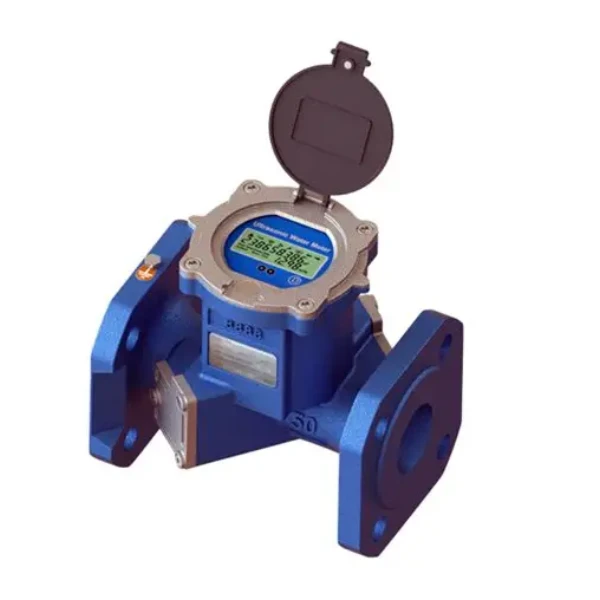
Ultrasonic Water Meter (T3-1)
A static water meter with no moving parts. It times an ultrasonic pulse across the bore to measure flow, so there is nothing to wear or jam, it reads accurately down to a trickle, and it runs about ten years on one battery. Built to ISO 4064 with a wide R200 range and ready for remote reading.
- Principle: ultrasonic transit-time, no moving parts
- Sizes: DN15 to DN40 threaded (larger flanged on request)
- Range: R200 (ISO 4064); accuracy class 2
- Battery: 3.6 V lithium, about 10 years; IP68
- Reading: RS-485, M-Bus, CJ188; NB-IoT or LoRa option
Overview
A mechanical water meter has a spinning element, and that is its weakness: it wears, it slows with age, it under-registers low flow, and grit or weed in the water can jam it. An ultrasonic water meter has none of that. It measures flow by timing an ultrasonic pulse across the bore, so there is nothing to wear and nothing to stall. The practical payoff is that it stays accurate over its life and it captures the slow flow a worn mechanical meter misses, which is exactly the flow that adds up to lost revenue and undetected leaks.
The T3-1 is built to ISO 4064-1, in compact threaded sizes from DN15 to DN40 with larger flanged bodies on request. It carries a wide R200 measuring range, an IP68 body that survives two meters under water, and a lithium battery rated for about ten years. It speaks M-Bus, Modbus, and CJ188 over RS-485, with NB-IoT, LoRa, or Wi-Fi for fixed-network remote reading. For a non-invasive flow check on an existing line, see the clamp-on ultrasonic flow meter; this page is the inline revenue meter.
Features
Everything here follows from one idea: no moving parts, so the meter holds its accuracy and reads the low flow that a worn mechanical meter loses.
No moving parts
Nothing spins, so nothing wears or jams; it handles gritty and weedy water that stalls a turbine meter.
Low-flow accuracy
An R200 range registers a slow trickle, capturing the leak flow and night flow a worn meter misses.
About 10-year battery
A 3.6 V lithium cell powers it for roughly a decade, with a power-save mode when the pipe is empty.
Remote reading
RS-485, M-Bus, and CJ188 as standard; NB-IoT, LoRa, or Wi-Fi for fixed-network smart water.
IP68, submersible
The whole meter is sealed to IP68 and works under two meters of water, so a flooded pit is no problem.
Leak and tamper alerts
Onboard leak detection and status flags flag a continuous-flow leak or a fault for the meter reader.
Working principle
The meter has two ultrasonic transducers facing each other along the bore. Each sends a pulse to the other: the pulse going with the flow arrives sooner, the pulse going against it arrives later, and the difference between the two travel times is proportional to the average water velocity. Multiply by the known bore area and you have flow; add it up and you have the total for billing. Nothing intrudes into the stream and nothing rotates, so there is no pressure-robbing impeller and no bearing to wear. Because the measurement is electronic, the same meter holds its calibration for years and reads a slow trickle as faithfully as full flow, which is where a worn mechanical meter falls down.
Technical specifications
| Parameter | Specification |
|---|---|
| Measurement principle | Ultrasonic transit-time, static (no moving parts) |
| Standards | ISO 4064-1; GB/T 778.1; JJG 162 |
| Sizes | DN15 to DN40 threaded (G3/4 to G2); larger flanged on request |
| Measuring range | R200 (DN15 to DN20); R100 (DN25 to DN40) |
| Accuracy | Class 2 per ISO 4064: 2% from Q2 to Q4, 5% from Q1 to Q2 |
| Medium | Water (sewage and sea water on request); pipe must run full |
| Medium temperature | 0.1 to 30 C (T30 cold water) |
| Working pressure | 1.6 MPa (2.5 MPa optional) |
| Ambient and protection | -25 to 55 C; IP68, submersible to 2 m |
| Communication | RS-485 and infrared; NB-IoT, LoRa, or Wi-Fi optional |
| Protocol | M-Bus, Modbus, CJ188, ASCII |
| Output | Two-way OCT pulse (option); 4-20 mA (option) |
| Display and units | 9-digit total, 6-digit rate; m³, US gallon, liter, cubic foot, acre-foot |
| Power | 3.6 V lithium, about 10 years; or DC 12 to 30 V over M-Bus |
| Material | Copper body; PEEK internals |
Representative specifications. Values typical; confirm per datasheet for your size, range, and approval.
Ordering example. T3-1 ultrasonic water meter, DN20, G1 thread, R200, M-Bus plus pulse output, NB-IoT module, IP68.
Flow ranges by size
The compact threaded sizes carry these ISO 4064 flow points. Q3 is the permanent flow rate; Q1 is the minimum the meter still registers to class.
| Size | Range R | Q1 min (m³/h) | Q3 perm (m³/h) | Q4 max (m³/h) |
|---|---|---|---|---|
| DN15 | 200 | 0.013 | 2.5 | 3.125 |
| DN20 | 200 | 0.016 | 3.2 | 4.0 |
| DN25 | 100 | 0.040 | 4.0 | 5.0 |
| DN32 | 100 | 0.063 | 6.3 | 7.875 |
| DN40 | 100 | 0.200 | 20.0 | 25.0 |
Ultrasonic vs mechanical
The case for an ultrasonic water meter is mostly about what happens after year one. A mechanical meter leaves the factory accurate and drifts down from there as the bearing wears; an ultrasonic meter has no bearing to wear.
| Point | Mechanical | Ultrasonic T3-1 |
|---|---|---|
| Low flow and leaks | Under-registers as it wears | R200 range catches the trickle |
| Wear and jamming | Bearing wears; grit and weed can jam it | No moving parts |
| Remote reading | Add-on encoder | Built in: M-Bus, NB-IoT, LoRa |
| Pressure loss | Impeller adds drag | Clear bore |
Applications
The T3-1 suits the points where the reading turns into a bill or a water balance:
- Urban water supply and residential or commercial revenue metering
- Apartment, campus, and property sub-metering
- District metered areas (DMA) and non-revenue-water programs
- Irrigation and landscape supply, including gritty and weedy water
- Industrial process-water and utility allocation metering
Application example
Water utility, district metering and revenue recovery. A utility was losing water it could not account for across a residential zone where the old mechanical meters had aged. Many were under-registering low overnight flow, so leaks and slow consumption went unbilled. Replacing the worst of them with ultrasonic meters did two things at once: the wide low-flow range began registering the trickle the old meters missed, and the built-in remote reading turned each meter into a data point for a night-flow leak survey. The gain was as much in the data as in the metering, because a meter that reads low flow and reports it nightly is also a leak sensor.
Related products
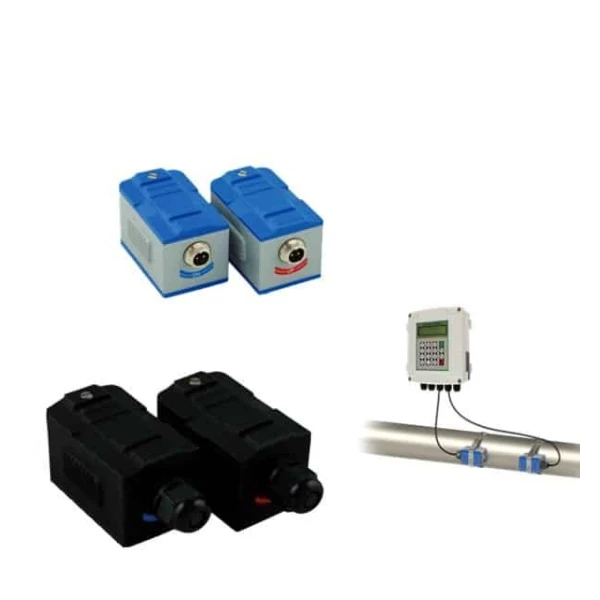 Clamp-On Ultrasonic Flow Meter
Non-invasive flow check on an existing line, no cutting.
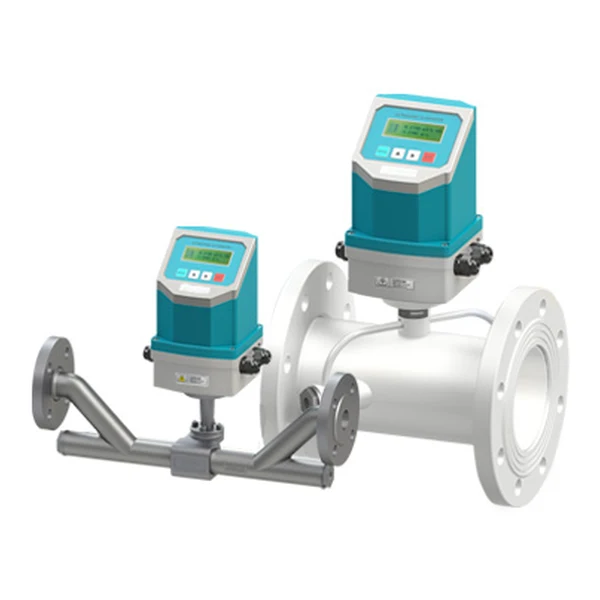 Inline Ultrasonic Flow Meter
Process flow metering for clean liquids, DN15 to DN6000.
Browse all ultrasonic flow meters →
IP68 on a water meter is a declared submersion rating, and the declaration matters more than the number itself; see our IP ratings guide for how to read the code.
Where the totals feed irrigation billing at turnouts, see the irrigation flow meter page for how this meter class sits alongside magmeters and propeller meters.
Choosing between meter families first? Our digital vs mechanical water meter guide compares accuracy classes, R ratios and wear rates.
FAQ
How does an ultrasonic water meter work?
It has two ultrasonic transducers along the bore. Each sends a pulse to the other; the pulse going with the flow arrives sooner than the one going against it, and that time difference is proportional to the water velocity. The meter multiplies by the bore area to get flow and totals it for billing. Nothing rotates and nothing intrudes into the water.
How accurate is an ultrasonic water meter?
The T3-1 meets accuracy class 2 of ISO 4064: within 2% from the transitional flow Q2 up to the overload Q4, and within 5% between the minimum Q1 and Q2. Its wide R200 range means it stays accurate down to a very low flow, where an aged mechanical meter under-registers.
How long does the battery last?
About ten years on the internal 3.6 V lithium cell, helped by a power-save mode that idles the meter when the pipe is empty. For permanent installations it can also run on DC 12 to 30 V supplied over the M-Bus line, with the reading saved through any power loss.
Can it be read remotely?
Yes. RS-485, M-Bus, and CJ188 are standard, so it drops into a walk-by or drive-by reading route. For a fixed network, an NB-IoT, LoRa, or Wi-Fi module reports readings automatically, which is what turns a meter fleet into a smart-water and leak-detection system.
Ultrasonic or mechanical water meter?
Choose ultrasonic when low-flow accuracy, long-term stability, and remote reading matter, or where grit and weed would jam a mechanical meter. A mechanical meter is cheaper up front; an ultrasonic meter usually wins over its life by billing the low flow the mechanical meter loses and by reporting itself for leak detection.
Request a quote
Send us the size, the flow range, the water type, and how you want to read the meter (M-Bus, NB-IoT, LoRa, or pulse). We confirm the body, the range, and the communication module for your network.