Home › Products › Flow Meters › Magnetic Flow Meters › Sanitary Magnetic Flow Meter
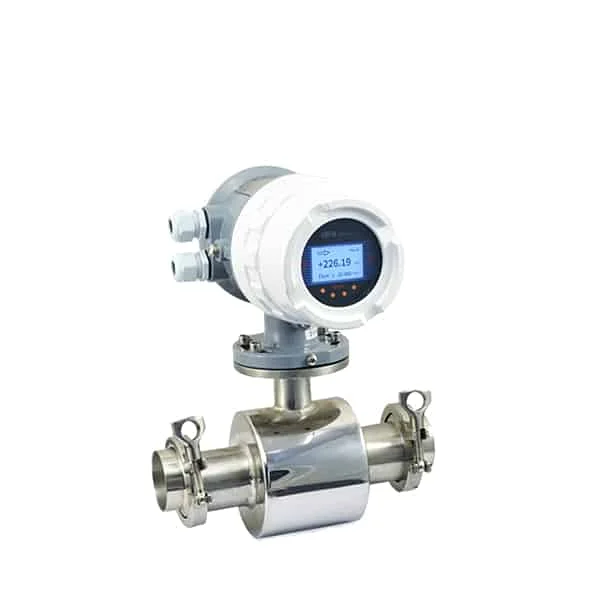
Sanitary Magnetic Flow Meter
A hygienic magnetic flow meter with a PFA lining and tri-clamp connections for food, beverage and pharmaceutical lines. The smooth, crevice-free bore drains clean and takes clean-in-place, so it meters product to plus or minus 0.3% without trapping it.
- Size: DN10 to DN100
- Accuracy: plus or minus 0.3% / 0.5%
- Lining: PFA; tri-clamp connection
- CIP: medium to 80 C, stainless body
- Media: conductive food and process liquids
Overview
A sanitary magnetic flow meter measures the flow of a conductive food or process liquid in a hygienic line. Like any mag meter it has no moving parts and nothing in the bore, but it is built for clean process: a smooth PFA lining, a polished stainless body and tri-clamp connections, so product does not catch in a crevice and the meter takes clean-in-place between batches. It reads to plus or minus 0.3% on sizes from DN10 to DN100.
Because nothing obstructs the flow and the bore is full-port, it does not shear or hold product, which matters for dairy, juice, beer and pharmaceutical fluids. It comes integrated or split, on 220 V AC or 24 V DC, and the medium can run to 80 C for a hot CIP cycle.
Features
Why a sanitary mag meter suits a hygienic line:
Tri-clamp connection
Quick tri-clamp fittings strip down for inspection and leave no thread to trap product.
PFA lining
A smooth, inert PFA lining is food-safe, easy to clean and resists the product and the CIP chemicals.
Full-port, no obstruction
Nothing in the bore, so it does not shear, hold or contaminate the product.
CIP to 80 C
The medium can run to 80 C, so it stays in place through a hot clean-in-place cycle.
0.3% accuracy
Reads to plus or minus 0.3%, enough for batching and filling on a production line.
Stainless body
A polished stainless housing wipes down for a wash-down area, integrated or split.
Working principle
A magnetic flow meter works by Faraday’s law: a conductive liquid moving through a magnetic field generates a voltage proportional to its velocity, picked up by electrodes flush with the lining. The transmitter scales velocity to flow. Because the field and the electrodes do the measuring and nothing sits in the bore, the flow path is a clean, full-port tube, which is exactly what a hygienic line needs.
The liquid must conduct, so it suits water-based food and process fluids such as milk, juice, beer, syrups and many pharmaceutical liquids, but not oils, fats or pure water. The PFA lining and the flush electrodes keep the wetted path smooth so product does not build up and the CIP reaches every surface.
Technical specifications
| Parameter | Specification |
|---|---|
| Nominal diameter | DN10 to DN100 |
| Accuracy / range | Plus or minus 0.3% or 0.5%; 0 to 10 m/s |
| Lining | PFA |
| Electrode | 316L, Hastelloy B, Hastelloy C, titanium or tantalum |
| Body / connection | Stainless steel; tri-clamp quick connector |
| Pressure | 1.6 MPa |
| Medium temperature | −10 to 80 °C (CIP compatible) |
| Power supply | 220 V AC or 24 V DC |
| Structure | Integrated or split |
| Protection | Sensor IP65 (IP68 option); converter IP67 |
Hygienic design and CIP
What makes it sanitary is the wetted path. The PFA lining is smooth and inert, the electrodes sit flush with it, and the tri-clamp ends leave no thread or dead leg, so there is no crevice for product to lodge in and the line drains clean. That lets a clean-in-place cycle, hot caustic or acid to 80 C, reach every wetted surface, and the unit strips down at the clamps for inspection. Site it so the bore self-drains and the electrodes stay wetted, and specify the electrode for the product, 316L for most foods, Hastelloy or tantalum for an aggressive clean.
Installation
Fit the meter on a full pipe with the electrodes on the horizontal axis so air does not sit on them, on a straight run of about five diameters upstream and three downstream. Mount it to self-drain after a batch, support the tri-clamps so the line does not load the meter, and set the pipe size and units in the transmitter. Run a CIP cycle and confirm the empty-pipe alarm so the totaliser does not count the rinse.
Applications
- Dairy, juice and beverage batching and filling
- Brewing and soft-drink process lines
- Pharmaceutical and biotech aqueous fluids
- CIP and SIP supply and return metering
- Hygienic water and ingredient dosing
Challenge: A beverage plant needed flow metering on a hygienic CIP system, where the meter had to be tri-clamp, stainless and able to take the hot clean without trapping product.
Solution: Sanitary magnetic flow meters with a PFA lining and tri-clamp ends on the supply and return, in 316L stainless, metering the flow and holding through the CIP cycle.
Result: Clean, full-port metering to plus or minus 0.3% with a wetted path the CIP reaches and a meter that strips down for inspection.
Related products
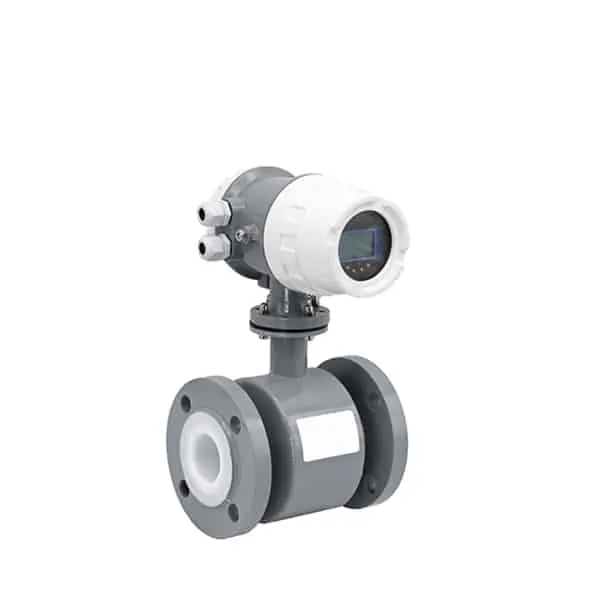 Magnetic Flow Meter
Industrial full-bore mag meter for water, slurry and chemicals to plus or minus 0.5%.
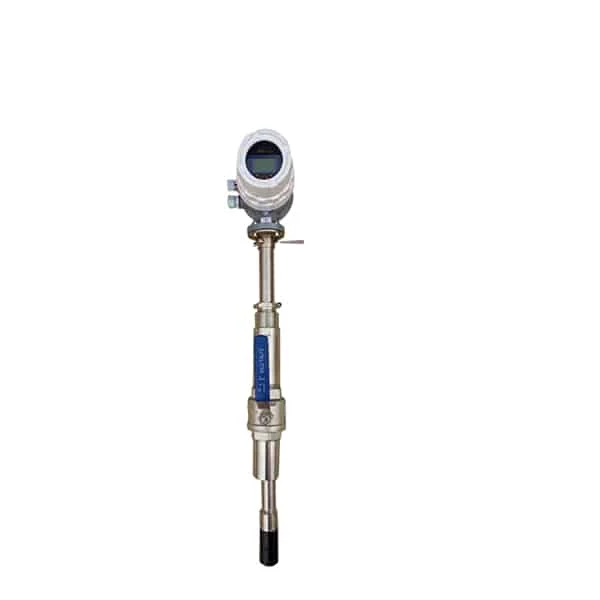 Insertion Magnetic Flow Meter
Low-cost probe for large water and sewage mains, DN300 to DN3000.
Browse all magnetic flow meters →
Related applications: Sanitary.
Breweries are a core service for this meter class, from wort transfers to CIP proof; our beer flow meter guide maps every metering point from brewhouse to tap.
In breweries the same meter covers brewing water, wort, and CIP circuits; the brewery flow meter page maps each of those streams to a build.
FAQ
How does a sanitary magnetic flow meter work?
By Faraday’s law: the conductive product moving through a magnetic field generates a voltage proportional to its velocity, read by electrodes flush with the PFA lining and scaled to flow. Nothing sits in the bore, so the flow path stays clean and full-port.
Can a magnetic flow meter be used for food?
Yes, when it is built hygienic: a PFA or similar food-safe lining, a polished stainless body and tri-clamp ends, with the medium rated for a hot CIP. The product must conduct, so it suits milk, juice, beer and aqueous fluids, not oils or fats.
How accurate is a sanitary magnetic flow meter?
It reads to plus or minus 0.3% or 0.5% over 0 to 10 m/s, which suits batching and filling on a production line. Keeping the pipe full and the electrodes wetted holds that accuracy.
Request a quote
Tell us the line size, the product and the CIP regime, and we configure one sanitary meter with the right lining and electrode, not a shelf part.