Home › Products › Flow Meters › Magnetic Flow Meters › Insertion Magnetic Flow Meter
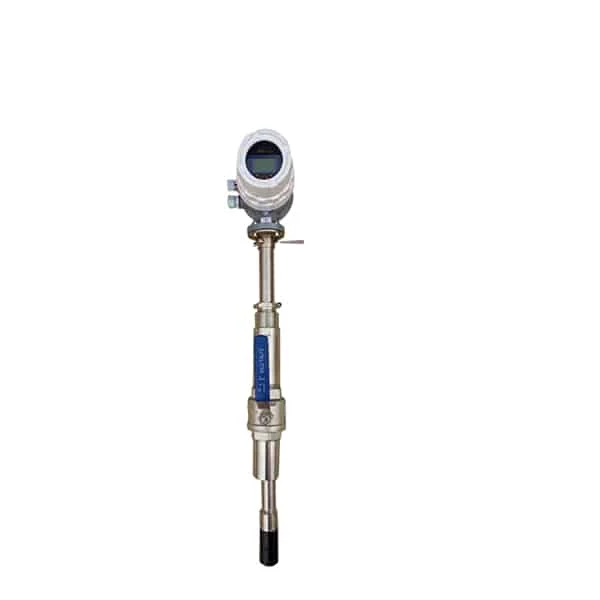
Insertion Magnetic Flow Meter (SI-3121)
A magnetic flow meter whose sensor inserts through a tapping into a large pipe, so one probe meters a DN300 to DN3000 main without a full-bore spool. With a ball valve it goes into a live pipe, which makes it the low-cost way to meter big water and sewage lines.
- Pipe size: DN300 to DN3000
- Accuracy: plus or minus 2.5%; flow 0.5 to 6 m/s
- Install: tapping, with or without a ball valve
- Output: 4-20 mA, pulse; RS485 / HART / GPRS
- Media: conductive water, sewage, acid, alkali
Overview
An insertion magnetic flow meter measures the flow of a conductive liquid with a single sensor that pushes through a tapping into the pipe, rather than a full-bore tube the liquid passes through. On a large main a full-bore mag meter is heavy and costly, so the insertion probe meters the same DN300 to DN3000 line at a fraction of the price, reading the velocity at its tip and scaling it to the pipe area.
Fitted through a ball valve it goes into a pipe that is already in service, with no cut and no shutdown, which is why it suits water, sewage and chemical mains that cannot be taken offline. It reads to plus or minus 2.5% over 0.5 to 6 m/s, outputs 4-20 mA and pulse with RS485, HART or GPRS, and runs on mains, 24 V DC or a lithium battery for a remote site.
Features
Why an insertion mag meter suits a large main:
Low cost on big pipes
One probe meters DN300 to DN3000 for a fraction of the price of a full-bore mag spool.
Hot-tap install
Through a ball valve, the probe goes into a live pipe with no cut and no shutdown.
Conductive media
Water, sewage, acid and alkali, with a 316L, Hastelloy, titanium or tantalum electrode.
Battery option
Mains, 24 V DC or a lithium battery, so it meters a remote main with no power.
No pressure drop
A slim probe leaves the bore clear, so there is no obstruction and no head loss.
4-20 mA to GPRS
4-20 mA and pulse with RS485, HART and GPRS for remote main telemetry.
Working principle
A magnetic flow meter works by Faraday’s law: a conductive liquid moving through a magnetic field generates a voltage proportional to its velocity. In a full-bore meter the field and the electrodes span the whole pipe; in an insertion meter the field coil and the electrodes are in the probe tip, so it reads the velocity at the point where it sits, and the transmitter scales that point velocity to the average across the pipe to give the flow.
Because it samples one point rather than the whole section, an insertion meter is less accurate than a full-bore mag, at plus or minus 2.5%, and it needs the probe set to the right depth in a clean velocity profile. The liquid must conduct, so it suits water, sewage and aqueous chemicals, not oils or demineralised water.
Technical specifications
| Parameter | Specification |
|---|---|
| Model | SI-3121 insertion magnetic flow meter |
| Pipe size | DN300 to DN3000 |
| Accuracy / flow rate | Plus or minus 2.5%; 0.5 to 6 m/s |
| Medium | Conductive water, sewage, acid, alkali |
| Temperature / pressure | −20 to 150 °C; 1.6 MPa |
| Electrode | 316L, Hastelloy C, titanium, tantalum or platinum |
| Installation | Tapping, with or without a ball valve; 5DN up / 3DN down straight run |
| Power supply | 220 V AC, 24 V DC or lithium battery |
| Output / communication | 4-20 mA, pulse; RS485, HART, GPRS |
| Body / protection | Stainless steel; IP65 compact, IP68 remote |
Insertion or full-bore
Both are magnetic flow meters; the difference is whether the sensor spans the pipe or samples a point. Choose a full-bore mag meter when you need the accuracy, to plus or minus 0.5%, and the pipe is a size where a full-bore tube is affordable. Choose the insertion meter on a large main, DN300 to DN3000, where a full-bore spool is heavy and costly and plus or minus 2.5% is enough, or where a ball-valve fit avoids a shutdown. Both need a conductive liquid.
Installation
Fit the probe on a straight run of at least five diameters upstream and three downstream, away from bends, pumps and valves that distort the profile. Tap the pipe and weld the boss, or use a ball valve to insert into a live line, and set the probe to the correct insertion depth so it reads the right point in the profile. Enter the pipe size and wall in the transmitter, and wire the 4-20 mA or pulse output. Confirm the empty-pipe and zero behave before leaving.
Applications
- Large raw-water and distribution mains
- Sewage and effluent trunk mains
- Irrigation and water-resource lines
- Cooling-water and process mains in plants
- Remote mains metered over GPRS on battery
On a large raw-water main a full-bore mag meter was too heavy and costly, and the line could not be shut down to fit one. An insertion magnetic flow meter was hot-tapped through a ball valve, set to depth in the velocity profile, and wired out on 4-20 mA, metering the main to plus or minus 2.5% with no break in supply and a small fraction of the full-bore cost.
Related products
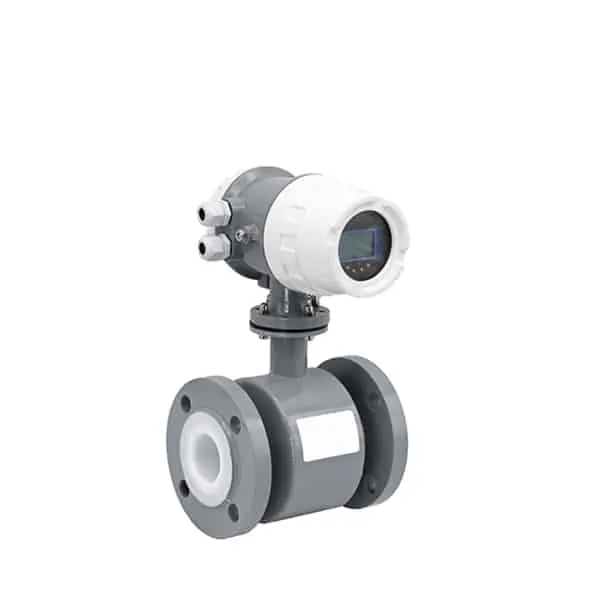 Magnetic Flow Meter
Full-bore mag meter for conductive water, slurry and chemicals to plus or minus 0.5%.
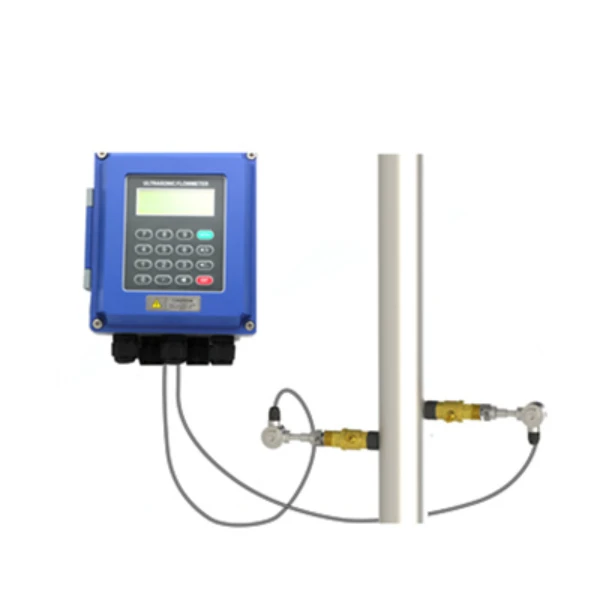 Insertion Ultrasonic Flow Meter
Transit-time insertion probe for large, thick or lined pipes, including non-conductive liquids.
Browse all magnetic flow meters →
FAQ
How does an insertion magnetic flow meter work?
It uses Faraday’s law: a conductive liquid moving through the probe’s magnetic field generates a voltage proportional to its velocity. The probe reads the velocity at its tip, and the transmitter scales that point velocity to the average across the pipe to give the flow.
What is the difference between insertion and full-bore mag meters?
A full-bore meter spans the whole pipe and reads to plus or minus 0.5%; an insertion meter samples one point and reads to plus or minus 2.5%. The insertion meter is far cheaper on a large main and can be fitted through a ball valve without a shutdown.
How accurate is an insertion magnetic flow meter?
It reads to plus or minus 2.5% over 0.5 to 6 m/s when the probe is set to the right depth in a clean velocity profile, with enough straight run. It trades accuracy for low cost on large pipes against a full-bore meter.
Can an insertion mag meter be installed without a shutdown?
Yes. Fitted through a ball valve, the probe inserts into a live, pressurised pipe with no cut and no shutdown, which is a main reason insertion meters are used on large water and sewage mains.
Request a quote
Tell us the pipe size, the liquid and whether you need a ball-valve fit, and we configure one insertion meter for the main, not a shelf part.