Pressure Instruments › SI-303 Low Pressure Transducer
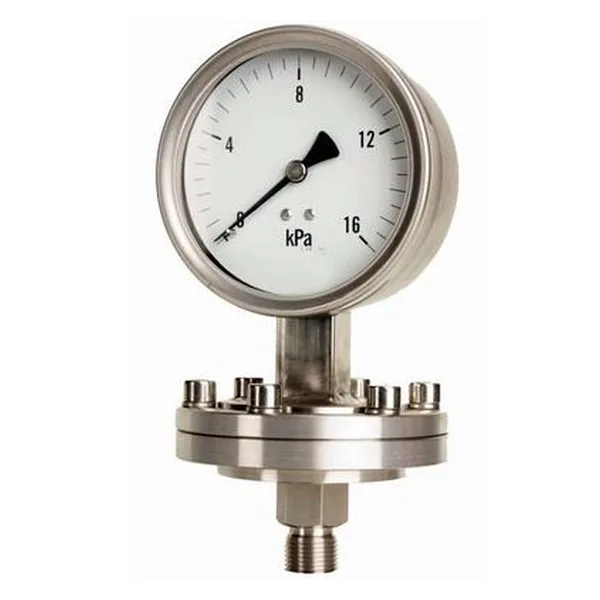 Diaphragm Pressure GaugeEN 837-3 gauge for low and corrosive pressures.
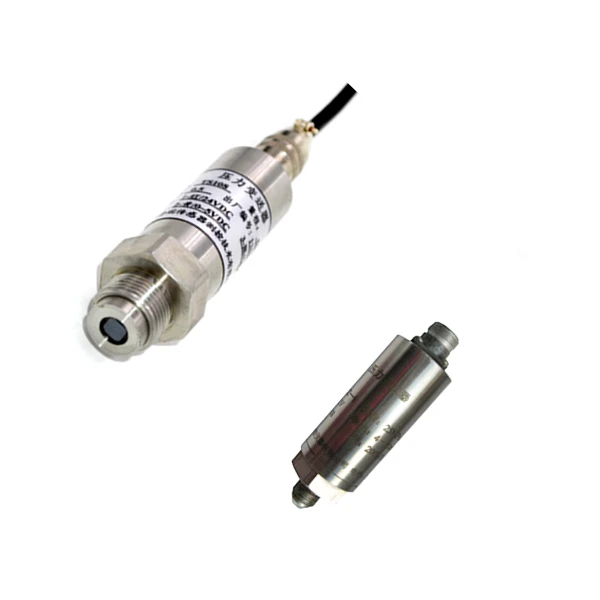
SI-303 Low Pressure Transducer
A piezoresistive low pressure transducer for clean, dry air and non-corrosive gas, built for spans from 0-2.5 kPa to 0-30 kPa (about 10 to 120 inWG). It reads the small pressures that a standard MPa-class transducer cannot resolve.
- Range: 0-2.5 kPa to 0-30 kPa (25 to 300 mbar)
- Accuracy: ±0.2% FS typical (0.4% FS option)
- Output: 4-20 mA (2-wire) or 0-5 V / 1-5 V (3-wire)
- Media: non-corrosive, dust-free, dry gas
- Element: silicon piezoresistive, stainless housing
Working principle
A low pressure transducer is a pressure transmitter tuned to small spans, typically below 1 bar, where ordinary process transducers waste most of their resolution. The SI-303 senses pressure with a micromachined silicon piezoresistive cell: pressure flexes a thin silicon diaphragm, a built-in Wheatstone bridge goes out of balance, and an amplifier turns that tiny imbalance into a clean 4-20 mA or voltage signal. Because the diaphragm is matched to a low full-scale span, a 0-5 kPa job reads in pascals, not in lost counts.
Most of these jobs are air and gas: ventilation pressure, blower and fan discharge, gas-burner manifolds, pneumatic feed lines, and tank head pressure on light gases. The SI-303 handles clean, dry, non-corrosive gas. For corrosive or wet media you want a flush ceramic cell instead, which is why we also build the ceramic pressure sensor line.
Technical specifications
Representative specifications, at room temperature and rated 24 VDC supply unless stated. Confirm the exact build per datasheet at order.
| Parameter | Specification |
|---|---|
| Measurement medium | Non-corrosive, dust-free, dry gas (air and inert gases) |
| Measuring range | 0-2.5 kPa to 0-30 kPa (25 to 300 mbar; 10 to 120 inWG) |
| Overload pressure | 1.5 x rated range |
| Output signal | 4-20 mA DC (2-wire); 0-5 VDC or 1-5 VDC (3-wire) |
| Supply voltage | 24 VDC standard; 16-32 VDC range (constant voltage) |
| Combined accuracy | ±0.2% FS typical; ±0.4% FS maximum (linearity, hysteresis, repeatability) |
| Long-term stability | ±0.25% FS per year |
| Thermal drift (zero / span) | ±1.5% FS (0.2% grade); ±2% FS (0.4% grade) |
| Response time | 1.0 ms |
| Supply effect | Less than 0.02% of span per volt |
| Operating temperature | -20 to +85 °C |
| Compensated temperature | 0 to 70 °C |
| Humidity | 0-100% RH, non-condensing |
| Housing | Stainless steel |
| Process connection | M20x1.5 or M12x1 (special threads on request) |
| Electrical connection | Cable gland, Hirschmann (DIN 43650) plug, or aviation connector |
| Sensing element | Silicon piezoresistive (micromachined Wheatstone bridge) |
Selecting the range
Pick the span by the pressure you actually see, then add a margin, not the other way around. Low pressure work mixes units across trades, so the same SI-303 span shows up as kPa on a datasheet, mbar in the lab, and inches of water column (inWG) on an HVAC drawing. Here are the standard SI-303 spans in the units you are likely to be handed.
| Span (kPa) | mbar | inWG | psi | mmH2O |
|---|---|---|---|---|
| 0-2.5 | 25 | 10.0 | 0.36 | 255 |
| 0-5 | 50 | 20.1 | 0.73 | 510 |
| 0-10 | 100 | 40.1 | 1.45 | 1020 |
| 0-20 | 200 | 80.3 | 2.90 | 2039 |
| 0-30 | 300 | 120.4 | 4.35 | 3059 |
Take a duct running at about 6 kPa working pressure. A 0-10 kPa SI-303 puts the reading near 60% of full scale, which keeps accuracy and overload margin sensible; the 1.5x overload still covers a 15 kPa surge. Putting that same job on a 0-1 MPa industrial transducer would bury 6 kPa in the bottom 0.6% of the range, where drift and resolution swamp the signal. That span discipline is the reason to use a dedicated low pressure transmitter.
Low-range limit: piezoresistive vs capacitive
Use the SI-303 piezoresistive cell from about 2.5 kPa upward. Below that, near room-to-room or duct pressures measured in pascals, a capacitive low-range sensor or a diaphragm gauge resolves better, because a silicon piezoresistive diaphragm stiff enough to survive handling gives up sensitivity at single-pascal spans.
A pharmaceutical client building a cleanroom and a water-for-injection loop asked us to quote low differential pressure monitoring. Room-to-room containment in that kind of facility usually sits in the 0-60 Pa to 0-500 Pa band, which is below the practical floor of a piezoresistive transducer. The honest answer was a dedicated capacitive or diaphragm gauge for the room differential, with SI-303-class transducers reserved for the higher kPa points such as blower and feed-line pressure. For larger room-to-room or duct differentials we point customers to the differential pressure sensor range.
Temperature sets the other boundary. The SI-303 is rated for media from -20 to +85 °C. Hot gas from a furnace or flue needs a high-temperature build or a short impulse line that sheds heat before the cell, not a bare SI-303 bolted to a hot pipe.
Output and wiring
Order the 4-20 mA two-wire version when the signal travels any distance or runs near motors and drives; current loops shrug off voltage drop and electrical noise, and two conductors carry both power and signal. Choose the 0-5 V or 1-5 V three-wire version for short runs into a local PLC or data logger card that expects a voltage input. The three-wire layout keeps a separate signal line and shares a common return with the 24 VDC supply. If you are not sure, send us the receiving device and cable length and we will set it.
Models and ordering
The SI-303 is configured from a short option list. Pick the output, the process thread, the electrical connector, and the accuracy grade.
| Option | Choices |
|---|---|
| Range | Any span from 0-2.5 kPa to 0-30 kPa |
| Output | 4-20 mA (2-wire); 0-5 V (3-wire); 1-5 V (3-wire) |
| Process thread | M20x1.5; M12x1; special on request |
| Electrical termination | Cable gland; Hirschmann DIN 43650; aviation plug |
| Accuracy grade | 0.2% FS; 0.4% FS |
Ordering example: SI-303, range 0-10 kPa, 4-20 mA two-wire output, M20x1.5 thread, Hirschmann plug, 0.2% FS grade.
Quote checklist, send these five points:
1. Pressure span you need (kPa, mbar or inWG) and gauge versus differential.
2. Medium, confirmed clean, dry and non-corrosive, plus process temperature.
3. Output and wiring: 4-20 mA two-wire, or 0-5 V / 1-5 V three-wire.
4. Process thread (M20x1.5, M12x1, or other) and electrical connector.
5. Accuracy grade (0.2% or 0.4% FS) and any approval paperwork you need.
Applications
The SI-303 measures small air and gas pressures across general industry and OEM equipment. Typical work includes ventilation and air-handling pressure, blower and fan discharge, gas-burner manifold pressure, pneumatic feed lines, energy and consumption monitoring, and head pressure on light, dry gases. It also reads low static pressure for open-channel and tank applications when the medium stays gaseous and clean.
For higher industrial spans in the MPa range, use a general-purpose pressure transmitter or, for OEM volume builds, the industrial pressure transducer line. Sanitary process points belong on the sanitary pressure transmitter. The full catalog sits under our pressure instrument range.
For the conversion factors behind every unit in these tables, see our pressure units guide.
Choosing between the current and voltage versions of this transducer is easier after reading convert 4-20 mA to 0-10 V, 1-5 V and 0-5 V, which covers burden resistors and loop compliance.
FAQ
What is a pressure transducer used for?
To measure pressure and report it as a 4–20 mA (or voltage) signal. The SI-303 is built for low pressures in the kilopascal range, for clean gas and air on fans, blowers, ducts, and low-pressure lines.
How do you test a low pressure transducer?
Apply a known low reference pressure from a calibrated low-range source, such as a manometer or micro-manometer, and compare the output at several points; check the zero with the port open to atmosphere. Low ranges are sensitive, so use fine, low-range test gear.
How does a low pressure sensor work?
A thin diaphragm flexes under the small pressure; a piezoresistive bridge on it changes its output with the deflection, and the electronics scale that to 4–20 mA. A larger, thinner diaphragm gives the sensitivity needed at kilopascal levels.
What are the four types of transducers?
In process work the common measurands are pressure, temperature, level, and flow; for pressure the references are gauge, absolute, differential, and sealed. The SI-303 is a low-range gauge pressure transducer.
Request a quote
Tell us the application and we configure one unit, not a shelf part. Send the five points from the quote checklist and our engineers will come back with a range, output and connection that fit the job.