Home › Temperature instruments › RTD temperature sensor
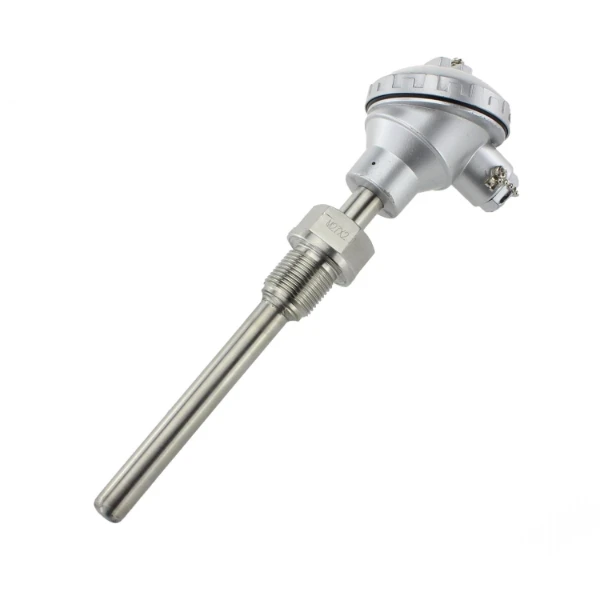
RTD Temperature Sensor (Pt100, WZP Series)
A platinum resistance temperature detector that reads temperature from the change in resistance of a Pt100 element (100 ohm at 0 °C). It is the accurate, stable, drift-resistant choice for process temperature below about 600 °C, in a stainless protection tube with a 2-, 3-, or 4-wire connection. Pair it with a temperature transmitter for a 4-20 mA loop.
- Element: Pt100 (100 ohm at 0 °C); Cu50 option
- Accuracy: Class A or Class B (IEC 60751)
- Range: -200 to +650 °C (element and class dependent)
- Wiring: 2-, 3-, or 4-wire
- Output: resistance; 4-20 mA with a transmitter
- Mounting: threaded or flange, with protection tube; Ex option
If a thermistor is also on the table, the three-way sensor comparison covers where each one fits, with the tolerance and input numbers.
Overview
An RTD measures temperature through resistance. The Pt100 platinum element reads 100 ohm at 0 °C and rises about 0.385 ohm for every degree Celsius, in a smooth, repeatable curve. Because platinum is stable and the relationship is well defined by IEC 60751, a Pt100 RTD holds its calibration for years and drifts far less than a thermocouple. That makes it the default sensor for accurate process temperature from cryogenic ranges up to roughly 600 °C.
The WZP series is an assembled RTD: the Pt100 element sits inside a stainless steel protection tube with a connection head, ready to thread or flange into a vessel or pipe. It outputs a resistance signal, so it is paired with a temperature transmitter (head or field mount) to send 4-20 mA to the control system.
Features
High accuracy
Platinum element to IEC 60751 Class A or B; the most accurate common sensor below 600 °C.
Low drift, stable
Holds calibration for years; far less drift than a thermocouple, so fewer recalibrations.
2, 3, or 4-wire
Three-wire cancels most lead resistance; four-wire gives true Kelvin accuracy.
Rugged assembly
Stainless protection tube and connection head; threaded or flange process fitting.
Transmitter ready
Add a head-mount transmitter to convert the resistance to a 4-20 mA or HART signal.
Hazardous-area option
Splash-proof, waterproof, or explosion-proof connection heads to suit the area.
Working principle
Platinum has a positive temperature coefficient: its electrical resistance rises predictably as it gets hotter. A Pt100 is built to read exactly 100 ohm at 0 °C, and IEC 60751 fixes the curve, so a measured resistance maps to a single temperature. The measuring instrument passes a small, known current through the element and reads the voltage, which gives resistance and therefore temperature. Because the element is passive, it needs an excitation current from the transmitter or input card.
RTD vs thermocouple
Pick the sensing element by temperature and accuracy. RTDs own the moderate range with better accuracy and stability; thermocouples reach far higher and survive rougher service.
| RTD (Pt100) | Thermocouple |
|---|---|
| Higher accuracy and repeatability | Wider temperature range |
| More stable, less drift over time | Survives harsher, higher-heat service |
| Less susceptible to electrical noise | No excitation power needed |
| Needs an excitation current; costs more | Lower cost; more drift, more recalibration |
Accuracy classes (IEC 60751)
RTD accuracy is graded by class, and the tolerance widens with temperature by a fixed formula. Class A is tighter than Class B; tenth-DIN options exist for laboratory work.
| Class | Tolerance | At 0 °C / at 100 °C |
|---|---|---|
| Class A | ±(0.15 + 0.002 |t|) °C | ±0.15 / ±0.35 °C |
| Class B | ±(0.30 + 0.005 |t|) °C | ±0.30 / ±0.80 °C |
Worked example: at 100 °C a Class A Pt100 is within ±0.35 °C, a Class B within ±0.80 °C. Class A also needs a 3- or 4-wire connection to hold its rating.
Wiring: 2-wire vs 3-wire vs 4-wire
Lead resistance is the enemy of an RTD reading, because the instrument cannot tell sensor resistance from wire resistance unless the wiring helps it. The connection decides how much of that error is removed.
- 2-wire: simplest and cheapest, but the lead resistance adds directly to the reading. Use only for short runs or coarse readings.
- 3-wire: the industrial standard. It cancels most lead resistance and is the right default for plant points.
- 4-wire: a true Kelvin measurement that removes lead resistance entirely. Use for the highest accuracy and laboratory references.
Technical specifications
| Parameter | Specification |
|---|---|
| Sensing element | Pt100 (100 ohm at 0 °C); Cu50 option |
| Standard | IEC 60751 (JB/T 8622) |
| Accuracy class | Class A: ±(0.15 + 0.002 |t|) °C; Class B: ±(0.30 + 0.005 |t|) °C |
| Measuring range | Pt100 -200 to +650 °C (Class B from -200 to +420 °C); Cu50 -50 to +150 °C |
| Wiring | 2-, 3-, or 4-wire |
| Output | Resistance; 4-20 mA or HART with a transmitter |
| Protection tube | Stainless steel, diameter 12 mm or 16 mm |
| Process connection | Threaded or flange (fixed or movable); thermowell available |
| Connection head | Splash-proof, waterproof, or explosion-proof |
Representative specifications. Probe length, insertion, and head type are configured to the point; confirm on the datasheet.
Models and ordering
The WZP series is configured by element, mounting form, head type, and protection-tube diameter. Send the working temperature, the connection, and the insertion length, and we build it.
| Option | Choices |
|---|---|
| Element | Pt100 (WZP) or Cu50 (WZC); single or duplex |
| Mounting form | No fixing, fixed thread, fixed or movable flange, pipe-joint |
| Connection head | Splash-proof / waterproof / explosion-proof |
| Protection tube | Diameter 12 mm or 16 mm; length to insertion depth |
| Transmitter | Optional head-mount 4-20 mA or HART transmitter |
Quote checklist, send these five points: element and class (Pt100 Class A or B); working temperature; process connection (thread or flange); insertion length; head type (and Ex if needed).
Ordering example: WZP Pt100, Class A, 3-wire, fixed thread M27, 16 mm tube, 200 mm insertion, waterproof head, with a 4-20 mA head transmitter.
Applications
RTDs sit on almost any process point that needs an accurate, stable temperature below about 600 °C. Common uses:
- Chemical and pharmaceutical: reactors, jackets, and lines where accuracy drives control
- Food, beverage, and HVAC: hygienic and utility temperature with 3-wire heads to the BMS
- Power and water: feedwater, condensate, and process water
- Mining and minerals: process water and slurry lines in stainless protection tubes
- Oil and gas: vessels and exchangers, with explosion-proof heads and thermowells
Application example
Mining plant, process water and slurry lines. The site needed accurate, repeatable temperature on abrasive process water and ore slurry, where a drifting sensor would mean re-checking by hand. It standardized on a batch of Pt100 RTDs in stainless protection tubes, one class and one head type across the lines. The value was consistency: identical sensors and spares, stable readings that hold calibration, and one configuration for the maintenance team to stock.
Related products
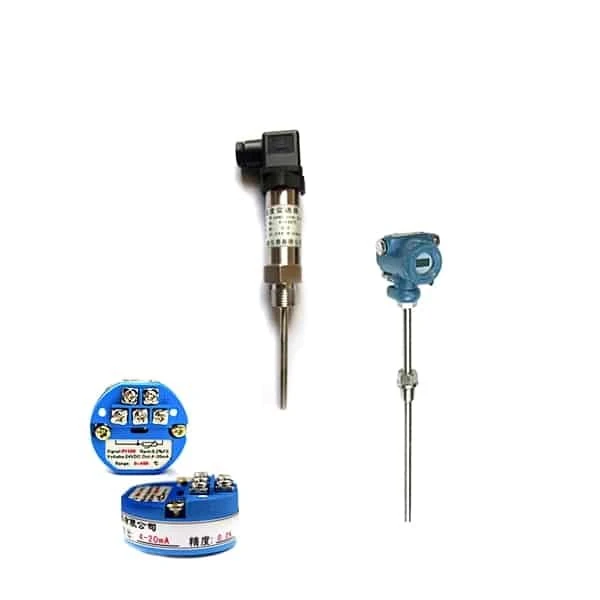 Temperature Transmitter
Converts the RTD signal to 4-20 mA with HART; head or field mount.
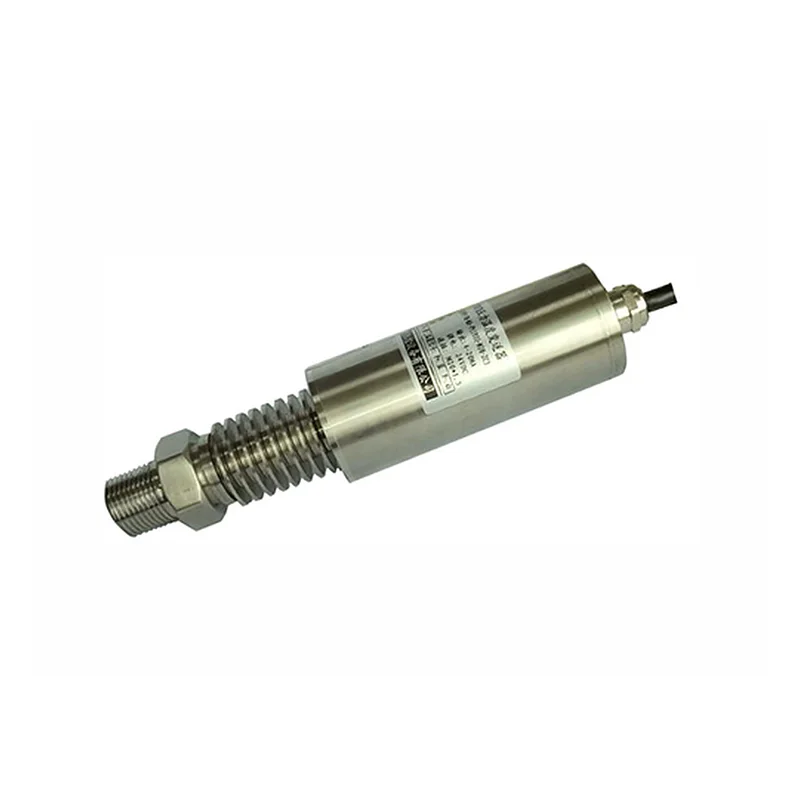 Combined Pressure and Temperature Sensor
One probe for pressure and temperature at the same point (SI-706).
Browse all temperature instruments →
Tolerance classes state how far a sensor may read from the true value, while repeatability is a separate property. The distinction is worked through in our guide to accuracy vs precision in measurement.
For help choosing between 2, 3 and 4-wire hookups, and the error each one adds as the cable gets longer, see our RTD wiring guide.
For the full comparison with tolerance formulas, range limits and drift figures, see our RTD vs thermocouple guide.
FAQ
What is an RTD sensor?
An RTD (resistance temperature detector) measures temperature from the change in electrical resistance of a metal element. The most common is the Pt100, a platinum element that reads 100 ohm at 0 °C and rises predictably with temperature, giving an accurate, stable reading.
How does an RTD sensor work?
The instrument passes a small known current through the element and measures the voltage to get its resistance. IEC 60751 fixes the resistance-to-temperature curve, so that resistance maps to one temperature. A 3- or 4-wire connection cancels the resistance of the lead wires so only the element is measured.
What is the difference between Pt100 and RTD?
RTD is the general category of resistance temperature sensors; Pt100 is the most common type of RTD, a platinum element with 100 ohm at 0 °C. Every Pt100 is an RTD, but RTDs also include Pt1000 and copper (Cu50) elements.
How do you calibrate an RTD sensor?
Compare it against a reference at stable, known temperatures (for example an ice point and a calibration bath), record the readings at several points across the range, and adjust the transmitter or input so the reading matches the reference. Recheck periodically; RTDs drift slowly, so intervals are usually long.
Request a quote
Send the element and class (Pt100 Class A or B), the working temperature, the process connection, the insertion length, and the head type, and our application engineers will build the RTD, with a transmitter if you need a 4-20 mA output.