By Wu Peng, Senior Process Instrumentation Engineer · Last reviewed September 7, 2026
A mechanical water meter measures with a moving element, a nutating disc, piston or impeller that the flow physically drives. A digital water meter measures electronically, most often by ultrasonic transit time, with no moving parts in the stream. Both are typically certified to the same accuracy class when new. The real differences are how small a flow each can register and what happens after ten years in service.
The distinction is muddier than the names suggest. A mechanical meter can wear a digital display and a radio and still under-register like a mechanical meter.
This guide draws the line where it belongs, at the measuring element. It then puts numbers on the points the comparison pages skip: accuracy classes, minimum registrable flows, wear rates and battery life. It covers utility and billing meters; water quality testers such as pH or TDS meters are a different instrument entirely.
Contents
- Display is not measurement
- Meter types compared
- Accuracy classes explained
- Low flow numbers
- Wear and lost revenue
- Batteries and remote reading
- Choosing a water meter
- FAQ
Display is not measurement
The market blurs the categories with the encoder register: an electronic register bolted onto a mechanical meter that reads the drive train and reports the dial value digitally, often with an LCD and a radio. Such a meter looks digital, joins a remote-reading network, and still measures with a wearing disc or impeller underneath. The same applies to AMR and AMI: those are communication layers, available on both mechanical and electronic meters, not measuring technologies.
The line that matters runs between a mechanical measuring element and a solid-state one. If the specification shows a piston, disc or impeller in the flow path, it is a mechanical meter no matter what the display looks like.
Meter types compared
| Type | How it measures | Typical dynamic range | Typical service life |
|---|---|---|---|
| Positive displacement | Nutating disc or oscillating piston traps fixed volumes | Best low flow among mechanicals | 10 to 15 years |
| Single-jet | One jet spins an impeller | R80 class common | 8 to 10 years |
| Multi-jet | Several jets balance the impeller load | R80 to R160 | 10 to 12 years |
| Woltman turbine | Axial rotor in large bores | Weakest at low flow | 10 to 15 years |
| Ultrasonic (digital) | Transit-time difference between sound pulses, no moving parts | R250 to R800 published | 15 years or more, battery limited |
| Electromagnetic (digital) | Faraday induction on conductive water | Wide, size dependent | 15 to 20 years |
Service lives are typical field figures; several countries mandate shorter replacement cycles for billing meters by regulation.
Positive displacement stands apart among the mechanical types: it traps and counts real volumes, so among mechanicals it registers the lowest flows. In catalogs, a mechanical water flow meter usually means one of the four types in this table. The jet and turbine types infer volume from impeller speed and lose the bottom of their range to bearing friction. The two digital types remove the moving element entirely, which is what unlocks the wide dynamic ranges in the table.
Accuracy classes explained
Under ISO 4064 and OIML R49, a water meter is characterized by four flow rates. Q1 is the minimum flow at which the meter must still meet its error limit, and Q2 is the transitional flow. Q3 is the permanent flow the meter is sized for, and Q4 is the overload flow. Two ratios are fixed by the standard: Q2 = 1.6 × Q1 and Q4 = 1.25 × Q3.
Almost every utility meter sold is accuracy class 2. That class allows ±2 percent error between Q2 and Q4 and ±5 percent in the low zone between Q1 and Q2. Class 1 halves the upper-zone limit to ±1 percent and is rare in practice.
Worked example, DN15 ultrasonic meter, Q3 = 2.5 m³/h, R200: Q1 = 12.5 L/h, Q2 = 20 L/h, Q4 = 3.125 m³/h
The United States runs a parallel framework. AWWA C700 covers displacement meters and tests them down to 1/4 gpm for the common 5/8 × 3/4 in size. The accuracy band at that minimum flow is 95 to 101 percent. AWWA C715, the newer standard, covers ultrasonic and electromagnetic meters, with normal-limit accuracy of 98.5 to 101.5 percent.
The class on the nameplate is the same for a mechanical and a digital meter of the same rating. The difference appears at flows below the tested minimum, and with age.
Low flow numbers
The single most useful number on a water meter datasheet is R, the ratio Q3/Q1. It states how far below the rated flow the meter still registers within its error limit. At the same Q3 of 2.5 m³/h, an R80 multi-jet has a Q1 of 31.25 L/h and R160 brings it to 15.6 L/h. An R400 ultrasonic reaches 6.25 L/h.
That spread decides revenue. A running toilet passes roughly 200 gallons per day, about 31 L/h. That sits right at the registration floor of an R80 meter, so much of it can flow unbilled through a meter that is in specification.
Laboratory data shows the gap directly. A 2016 peer-reviewed study in Journal AWWA tested 121 new 5/8 × 3/4 in meters at 1/16 gpm, about 14 L/h.
Multi-jet meters registered only about 13 percent of the water at that trickle. Solid-state ultrasonic and electromagnetic meters averaged within about 0.5 percent of the true volume. Published starting flows for residential ultrasonic meters now run as low as about 1 to 9 L/h, well below anything a mechanical element can turn.
Wear and lost revenue
A mechanical element slows as bearings and gears wear, so the error runs one way. The meter reads less than the water delivered, in the customer’s favor and at the utility’s cost. Utility studies put the loss at roughly 0.3 to 0.5 percent per year for small residential meters.
At 0.3 percent per year, a meter averages about 2.25 percent under-registration across a 15-year life. For a household using 150 m³ per year, that is about 50 m³ unbilled over the life of one meter. Scaled up, a 50,000-meter system running 2 percent under at 150 m³ per meter and 5 dollars per m³ loses about 750,000 dollars every year. That is why meter ageing is treated as the largest contributor to apparent losses in water audits.
The record cuts both ways, and it is worth stating the counter-case. In the same 2016 laboratory data, new displacement meters matched or beat the electronic meters at intermediate and high flows. Field programs have found meters more than 30 years old that still passed the AWWA limits. The digital advantage is specific: low-flow registration and freedom from wear drift, not blanket accuracy at every flow on day one.
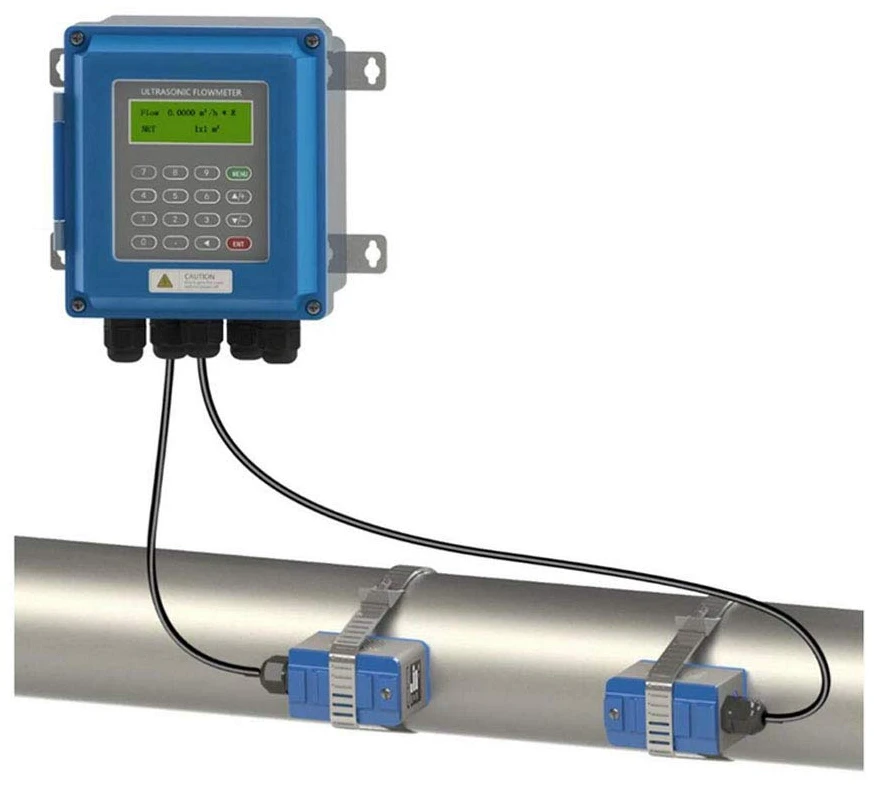
An aged meter suspected of under-registering can be checked in place against a clamp-on ultrasonic flow meter, or pulled and run on a test bench. Our flow meter calibration guide covers both routes.
Batteries and remote reading
A solid-state meter trades the wear problem for a battery. Residential ultrasonic meters run on 3.6 V lithium thionyl chloride cells with published lives of 10 to 20 years, 16 years being a common figure. Frequent radio transmission and high ambient temperatures shorten the real figure.
Reading is direct: the LCD shows cumulative m³ with no dial multipliers. For collection, AMR means one-way transmission gathered by walk-by or drive-by receivers. AMI means a fixed two-way network delivering interval data automatically, which is what enables leak alerts from continuous night flow.
Two practical points separate the technologies in the field. Magnets first: most mechanical meters couple the impeller to the register through a magnetic drive. Strong external magnets are a documented fraud vector against them. An ultrasonic meter has no magnetic coupling, so a magnet changes nothing.
Air second: vendor claims look contradictory here. One side says no moving parts means air is never billed; the other warns that ultrasonic readings suffer more from air than mechanical ones. Both are half-true: an empty-pipe detection function stops an ultrasonic meter from billing an air-filled line, but finely entrained bubbles in flowing water do bias transit-time measurement. In networks with intermittent supply, specify empty-pipe or dry detection explicitly.
Choosing a water meter
| Situation | Reasonable pick |
|---|---|
| Billing where low-flow revenue matters | Ultrasonic, R250 or higher |
| Tight budget, clean water, periodic replacement accepted | Multi-jet or positive displacement |
| Apartment submetering with remote reading | Ultrasonic with RS485, M-Bus or radio |
| District metered areas, night-flow leak monitoring | Ultrasonic with AMI interval data |
| Distribution mains and raw water, large bore | Electromagnetic |
| Verifying a meter already installed | Clamp-on comparison or bench test |
On the digital side, our ultrasonic water meter covers DN15 to DN40 threaded sizes at R200 to accuracy class 2. It carries a battery life of about 10 years, IP68 protection, and RS485 or M-Bus reading with NB-IoT and LoRa options. For large-bore utility lines, the electromagnetic flow meter line runs from DN6 to DN2000.
Application note
Submetering retrofit, general note. The typical retrofit case is a block of aging jet-type submeters that no longer register overnight flows, so tenant bills stop matching the master meter. The engineering decision is the R-ratio arithmetic above: if the tariff depends on capturing flows below about 30 L/h, a class 2 ultrasonic meter with R200 or better recovers what the worn impellers miss. The remote-reading interface is then chosen to match the billing system rather than the other way around.
FAQ
Are digital water meters more accurate?
At low flow, decisively: in peer-reviewed testing at about 14 L/h, solid-state meters read within about 0.5 percent while multi-jet meters missed most of the water. At intermediate and high flows a new mechanical meter matches them. The digital advantage compounds with age, because there is no wear drift.
What are the disadvantages of smart water meters?
Higher purchase price, a battery that limits service life to 10 to 20 years, and dependence on radio infrastructure for remote reading. Add sensitivity to entrained air unless empty-pipe detection is specified. Electronics also add failure modes, such as lightning surges, that a purely mechanical meter does not have.
Will a magnet stop a digital water meter?
Not an ultrasonic one: it has no magnetic coupling between sensing and register, so an external magnet has nothing to act on. Magnets are a known tampering method against mechanical meters with magnetic drive couplings, which is why utilities fit tamper alarms and shielding on those designs.
Can electronic water meters give false readings?
Yes, from specific causes: entrained air biasing the transit-time measurement, a partially empty pipe without empty-pipe detection, reversed installation, or electrical surges. What they do not do is drift steadily downward with mechanical wear. When a reading is suspect, verify against a clamp-on meter or a bench test.
Request a quote
Tell us the pipe size, the flow range, the billing scheme and how you plan to read the meter. We will recommend a mechanical or ultrasonic option with the dynamic range the application needs. Reach our application engineers or use the form below.
Written and technically reviewed by Wu Peng and the Instranova engineering team.