By Wu Peng, Senior Process Instrumentation Engineer · Last reviewed August 13, 2026
Dew point is the temperature a gas must be cooled to before its water vapor starts to condense. It is measured directly, with a chilled mirror or a capacitive dew point sensor in the gas stream. It can also be computed from temperature and relative humidity. In industrial service the number runs from ambient down to −80 °C, and a dew point meter, sensor, or transmitter is the instrument that reports it.
The number decides real outcomes: whether condensate forms in a compressed air line overnight, whether a desiccant dryer is actually delivering its class, whether powder stays free-flowing in a purged hopper. This guide covers the three ways to measure dew point and compares meter technologies with their ranges and accuracies. It then works the calculation from relative humidity, explains pressure dew point and the ISO 8573-1 classes, converts between units, and closes with the sampling rules that keep readings believable.
Contents
- What dew point means
- Three measurement routes
- Meter technologies compared
- Calculating from humidity
- Pressure dew point
- ISO 8573-1 classes
- Units and conversion
- Sampling rules
- Related guides
- FAQ
- Request a quote
What dew point means
Cool a parcel of gas at constant pressure and its relative humidity climbs, because colder gas sits closer to saturation for the same water content. The temperature where it reaches 100 percent relative humidity is the dew point. Cool further and water condenses on the nearest surface.
Two properties make dew point the preferred moisture number in process work. First, it maps directly to the failure mode: if the coldest surface in your system is warmer than the dew point of the gas touching it, nothing condenses. Second, unlike relative humidity, it does not swing with gas temperature alone. It does change with pressure, though, which is the single most misunderstood point in the subject and gets its own section below.
Below 0 °C the condensate is frost, and strictly the instrument reads a frost point, which sits slightly above the dew point of the same gas. Most industrial meters report the frost point below zero and label it dew point; that convention is fine as long as spec and instrument use the same basis.
Three measurement routes
Compute it from temperature and relative humidity. A thermohygrometer measures both, and the meter solves the dew point from them. This works well near ambient conditions, room monitoring, coating work, HVAC checks.
It fails for dry gases: at −40 °C dew point and room temperature the relative humidity is below 1 percent. That is around the total error of a good RH probe. Never spec an RH-based instrument for a dryer outlet.
Condense a sample on a chilled mirror. The instrument cools a small mirror until dew just forms, detects the film optically, and reports the mirror temperature. This is the fundamental method: the reading traces to a platinum thermometer, accuracy reaches a few tenths of a degree, and drift is close to zero. Chilled mirrors serve as laboratory references and calibration standards more often than as permanent plant instruments, mostly on cost and their dislike of dirty gas.
Put a moisture-sensitive sensor in the gas. Capacitive polymer and aluminum oxide sensors change capacitance or impedance as water molecules enter a hygroscopic layer. They are compact, handle line pressure, reach −80 °C dew point and lower, and cost a fraction of a mirror instrument. This is what sits inside almost every fixed dew point transmitter and portable dew point meter sold for compressed air and industrial gases.
Meter technologies compared
| Technology | Typical range | Typical accuracy | Where it fits |
|---|---|---|---|
| RH and temperature computation | Ambient to about −20 °C Td | ±0.5 to ±1 °C near ambient, degrades fast when dry | Rooms, coating work, HVAC; not dryer outlets |
| Chilled mirror | About −90 to +90 °C Td by model | ±0.1 to ±0.2 °C | Reference and calibration work, clean gases, audits |
| Capacitive polymer | About −60 to +60 °C Td | ±2 °C Td typical | Fixed transmitters and portables on compressed air |
| Aluminum oxide (metal oxide) | About −100 to +20 °C Td | ±2 to ±3 °C Td | Very dry gases, glove boxes, gas plants; needs periodic recalibration |
Ranges and accuracies are typical published figures; individual models vary, so read the datasheet of the unit you are buying.
The division of labor follows from the table. Continuous monitoring runs on capacitive or aluminum oxide sensors because they live at line pressure and cost little. The chilled mirror is the instrument you check them against. A typical plant setup is a fixed transmitter on the dryer outlet plus an annual comparison against a portable or a mirror-based reference.
Calculating from humidity
When you have temperature and relative humidity, the Magnus formula gets you the dew point with better than half a degree over normal ambient ranges:
Td = c × g / (b − g), where g = ln(RH/100) + b × T / (c + T)
With b = 17.62 and c = 243.12 °C: at T = 25 °C and RH = 60 percent, g = ln(0.60) + 17.62 × 25 / 268.12 = 1.1322, so Td = 243.12 × 1.1322 / 16.488 = 16.7 °C.
Published sources use several constant sets, 17.62/243.12, 17.625/243.04, 17.67/243.5 among them. They all trace to the same saturation vapor pressure curve and differ by hundredths of a degree over −40 to +50 °C. None of them is wrong; pick one set and use it consistently. The dew point calculator runs this conversion in both directions and between pressures.
The practical limit is not the constants but the RH input. A 2 percent RH error near ambient moves the computed dew point by roughly half a degree, and at low humidity the method collapses entirely. That is why dry-gas work uses a sensor, not arithmetic.
Pressure dew point
Compressing a gas packs the same water molecules into less volume, which raises the temperature at which they condense. So the dew point of air at line pressure, the pressure dew point (PDP), is always higher than the dew point of the same air expanded to atmosphere. One worked pair shows the size of the effect:
Air dried to −40 °C dew point at atmospheric pressure, then compressed to 7 barg, condenses at about −20 °C. Read the other way, a −40 °C reading taken at 7 barg line pressure corresponds to about −57 °C after expansion to atmosphere.
That 20-degree swing is why every dew point number needs its pressure stated next to it. A dryer specified at “−40 °C” without a pressure basis is ambiguous by a full ISO class. Compressed air specifications, and the ISO 8573-1 table below, are written in pressure dew point; measure at line pressure to compare against them directly. If the sensor must sit downstream of an expansion, convert the reading before judging the dryer.
The dryer types map onto PDP bands. A refrigerated dryer bottoms out around +3 °C PDP; that is the physics of its chilled heat exchanger. Desiccant dryers deliver −40 °C routinely and −70 °C when sized for it. If a refrigerated dryer feeds outdoor piping through a −10 °C winter, the line will rain inside; matching dryer PDP to the coldest downstream surface is the whole game.
Application note
Desiccant dryer monitoring. A common configuration on twin-tower desiccant dryers is a dew point transmitter at the outlet driving dew point dependent switching: the towers regenerate when the reading rises toward a setpoint instead of on a fixed timer. Purge air is a direct energy cost, so switching on measured dew point rather than on the clock cuts regeneration cycles whenever the load is below design. The same transmitter doubles as the alarm that catches desiccant aging before wet air reaches the plant.
ISO 8573-1 classes
ISO 8573-1:2010 grades compressed air purity for particles, water, and oil. The water axis uses pressure dew point for the vapor classes and grams per cubic meter of liquid water for the top classes. The humidity column in full:
| Class | Humidity limit |
|---|---|
| 0 | As specified by the user, more stringent than Class 1 |
| 1 | Pressure dew point ≤ −70 °C |
| 2 | Pressure dew point ≤ −40 °C |
| 3 | Pressure dew point ≤ −20 °C |
| 4 | Pressure dew point ≤ +3 °C |
| 5 | Pressure dew point ≤ +7 °C |
| 6 | Pressure dew point ≤ +10 °C |
| 7 to 9 | Liquid water present: ≤ 0.5, then 0.5 to 5, then 5 to 10 g/m³ |
The bands line up with the dryer map: Class 4 is what a refrigerated dryer delivers, Class 2 is a standard desiccant dryer, Class 1 is a well-run desiccant dryer with margin. Verifying a class takes a sensor that reads comfortably below the limit. Checking Class 2 with an instrument whose floor is −40 °C proves nothing, which is why compressed air transmitters are usually specified to −60 °C or lower.
Units and conversion
Dew point, parts per million by volume, and absolute water content describe the same moisture three ways, and specifications mix them freely: air classes quote °C, gas contracts quote ppmv or mg/m³. Anchor points at atmospheric pressure:
| Dew or frost point | Water vapor, ppmv | Water content, g/m³ |
|---|---|---|
| −70 °C | about 2.6 | 0.003 |
| −40 °C | about 127 | 0.12 |
| −20 °C | about 1,020 | 0.88 |
| +3 °C | about 7,480 | 5.9 |
Computed from the saturation vapor pressure curve at 1013 mbar; sub-zero rows use the frost point over ice, the convention most industrial meters follow. Values shift with pressure.
The table also shows why low dew point measurement is slow: at −70 °C there are under three water molecules per million. A sensor exposed to workshop air and then installed in that gas must shed its adsorbed water before the reading settles, which takes hours. A dry-down that long is normal, not a fault.
Sampling rules
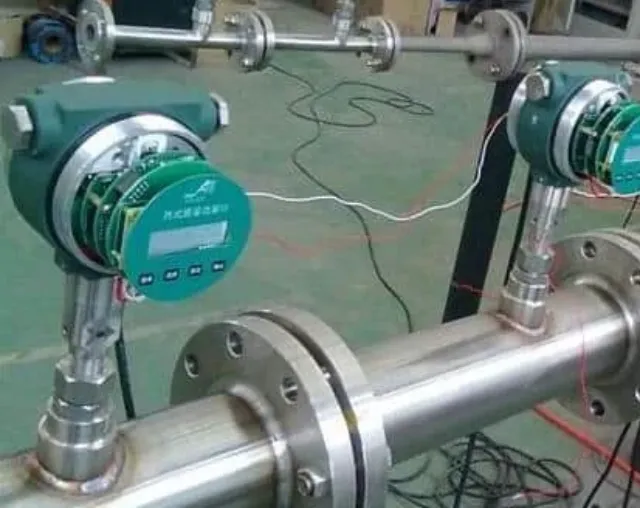
More dew point complaints trace to the sample point than to the sensor. Four rules cover most of them.
Never measure in a dead end. A sensor screwed into a stub with no flow past it reads the stub, not the process. Give it a continuously flowing sample, typically around 1 liter per minute through a sample cell. Much more flow creates a local pressure drop at the sensor and biases the reading.
Mind the pressure basis. To read pressure dew point, keep the sensor at line pressure and throttle downstream of it. To read atmospheric dew point, expand the gas through a valve upstream of the sensor. Same parts, opposite order, 20 degrees apart on the answer.
Use metal sample lines. Polymer tubing breathes water vapor through its wall and desorbs it for days. Short stainless steel lines reach equilibrium quickly. PTFE is the minimum acceptable plastic, and PVC or polyurethane lines will hold a dry-gas reading wet almost indefinitely.
Keep a calibration rhythm. Impedance and capacitive sensors drift, and a one to two year recalibration interval is the usual practice. An annual field comparison against a reference instrument catches drift between certificates. Log the as-found error each time, the same discipline used for pressure transmitter calibration.
Related guides
Dew point is one of the moisture-and-gas numbers that travel together on a utility line. A compressed air flow meter quantifies the air the dryer is treating, and the broader thermal mass flow meter line covers other dry gases. Both read in standard volume, the same pressure-referenced thinking explained in the pressure and temperature compensation guide. On fuel gas, water dew point sits beside the hydrocarbon dew point in pipeline specifications; the natural gas flow meter page maps that measurement chain.
FAQ
What is a dew point meter used for?
It verifies that a gas is dry enough for its job: confirming a compressed air dryer meets its ISO 8573-1 class, protecting paint and coating work from condensation, guarding medical and instrument air, and checking purge or blanket gas in hoppers, glove boxes, and switchgear. The reading warns before water condenses in the system.
How does a dew point meter work?
Most use a capacitive polymer or aluminum oxide sensor whose electrical properties change as water molecules adsorb into a hygroscopic layer; the electronics convert that change into a dew point temperature. Reference instruments instead chill a small mirror until dew forms and report the mirror temperature at which it happens.
How do you check the dew point?
Near ambient, measure temperature and relative humidity and compute it with the Magnus formula, or read it from a psychrometric chart. For compressed air or dry gases, connect a dew point meter to a flowing sample at a controlled pressure, let it dry down, and read directly. State the pressure with the result.
Is dew point 100% humidity?
They meet at saturation: when gas temperature falls to the dew point, relative humidity reaches 100 percent. But dew point describes the water content of the gas, while relative humidity describes how close the gas is to saturation at its current temperature. Cool the gas and RH rises; the dew point barely moves.
Request a quote
Send us the gas, the line pressure, the expected dew point range, and where the instrument will mount. We will return a dew point measurement proposal sized to the application, portable or fixed. Tell us the application and we configure one unit, not a shelf part. Reach our application engineers or use the form below.
Written and technically reviewed by Wu Peng and the Instranova engineering team.