Flow Meters › LNG Flow Meter
LNG Flow Meter
An LNG flow meter measures liquefied natural gas at about −162 °C (−260 °F), where the liquid sits within a few degrees of its boiling point and any pressure drop or heat leak turns part of it into vapor. That physics rules the whole selection: the meter must read a cryogenic liquid by mass, tolerate two-phase episodes during cool-down, and hold its accuracy while the pipe around it shrinks by millimeters.
This page covers dynamic metering of LNG as a liquid: truck and trailer loading skids, LNG bunkering of ships, and the boil-off gas lines that come with both. Regasified natural gas in the pipeline is a different measurement; see the natural gas flow meter page and the ultrasonic gas flow meter.
LPG is a different fluid again, stored near ambient temperature under pressure; its selection logic is in the LPG flow meter guide. For the general physics of metering cold liquids, the cryogenic flow meters guide covers liquid nitrogen and oxygen as well.
Most published pages on this subject list one product and stop. The selection work sits elsewhere: why LNG is metered by mass rather than volume, how to keep the liquid subcooled at the meter, and which custody transfer rules apply at a loading bay. This page puts numbers on each of those.
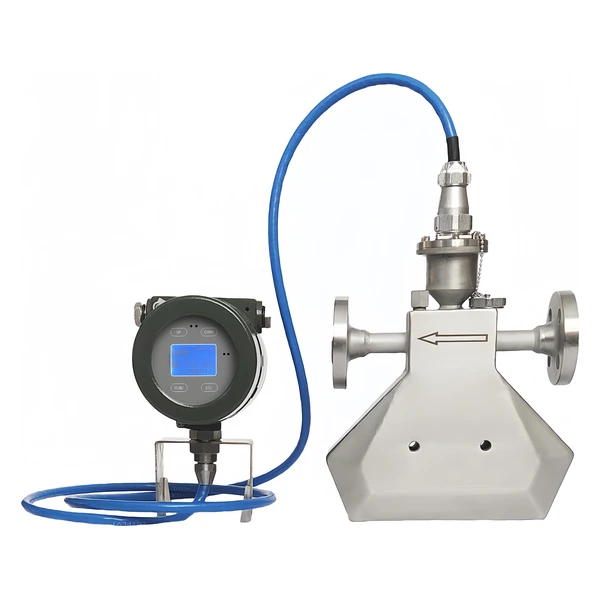 Coriolis Mass Flow Meter
Direct mass measurement with a low-temperature sensor build rated to −200 °C. The default choice for LNG loading skids because no density inference is needed.
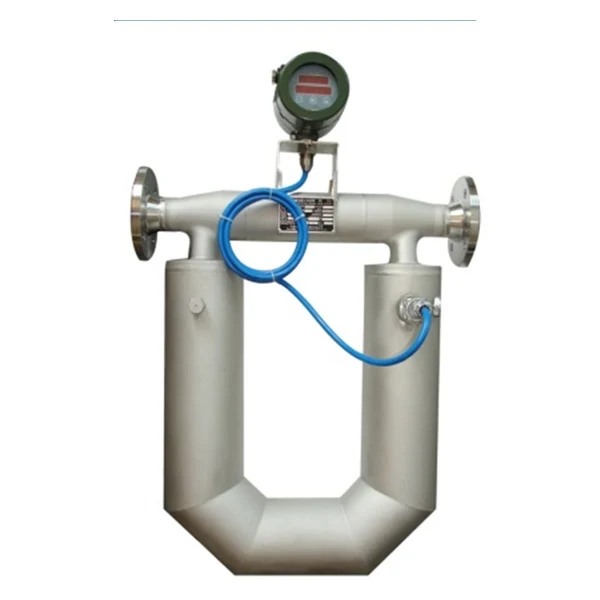 Large Diameter Coriolis Flow Meter
DN80 to DN200 sensors for high-capacity transfer service up to about 1,200 t/h, where a loading arm has to fill a trailer or barge quickly.
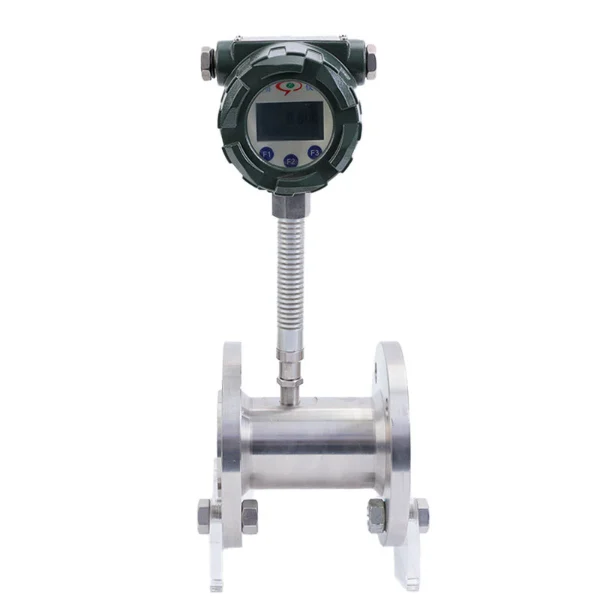 Cryogenic Turbine Flow Meter
A volume meter with a cold-rated rotor for service to −196 °C. Lower cost than Coriolis; pairs with a flow computer that infers density from temperature.
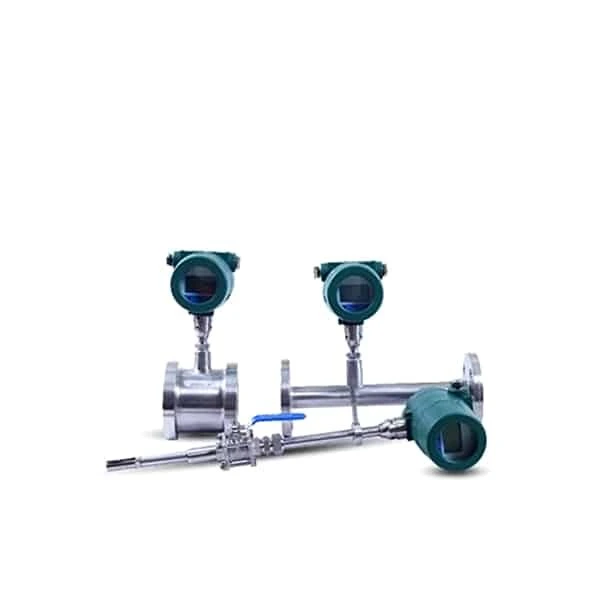 Thermal Mass Flow Meter
Gas-phase mass metering for boil-off and vapor return lines, read directly in mass or standard volume without separate compensation.
Choosing an LNG flow meter
Four measuring principles carry almost all LNG liquid and vapor metering. The table compares them on the points that decide a loading bay project.
| Technology | What it reads | Typical accuracy | Role in LNG service |
|---|---|---|---|
| Coriolis | Mass directly, plus live density | 0.1 to 0.5% of reading by class; low-temperature build to −200 °C | Truck loading and bunkering skids; the custody transfer default |
| Cryogenic turbine | Volume from rotor speed | About 0.5% of reading on liquid | Lower-cost skids; needs a flow computer and density tables for mass |
| Ultrasonic, multipath cryogenic | Volume from transit time | Custody classes to 0.3% in large certified spools | Terminal and ship loading headers beyond Coriolis sizes; project-engineered |
| Thermal mass | Gas mass from heat transfer | 1 to 2.5% of reading on gas | Boil-off and vapor return lines, within the sensor temperature rating |
A coriolis flow meter for LNG differs from the standard build in one essential way: the sensor is a low-temperature version whose tube alloy, brace bars, and pickoffs are rated and zeroed for cryogenic service. A standard sensor piped into LNG loses its zero as the tubes contract. State the operating temperature in the inquiry so the sensor is built for it.
Why mass, not volume
LNG density is not one number. It runs from roughly 420 to 470 kg/m3 depending on composition, and it moves with temperature: saturated liquid methane is 422 kg/m3 at −161.5 °C but 405 kg/m3 at −150 °C, about 1.5 kg/m3 for every degree.
Put numbers on a delivery. A 40 m3 trailer load assumed at 450 kg/m3 bills as 18,000 kg. If the actual density that day is 430 kg/m3, the same volume holds 17,200 kg.
The 800 kg gap is 4.4 percent of the invoice, an order of magnitude beyond the meter accuracy anyone paid for. A volume meter with an assumed density cannot close that gap; a mass meter never opens it.
This is why loading skids default to Coriolis. A turbine meter can still serve, but only as part of a system: the flow computer takes temperature (and pressure) signals and looks up the liquid density in property tables to convert volume to mass. That works when the composition is known and stable; the inferred density is only as good as the table it comes from. Large terminal contracts go one step further and settle in energy, multiplying mass by the calorific value from a gas analysis.
Keeping the liquid subcooled
In an atmospheric storage tank, LNG sits at its boiling point. Whether it stays liquid on the way to the meter is a race between pressure and temperature. Saturated methane at −160 °C has a vapor pressure of about 1.1 bar absolute; warm the liquid to −150 °C and the saturation pressure rises to about 2.4 bar. If the line pressure at any point falls below the saturation pressure of the liquid at its local temperature, part of the stream flashes to vapor on the spot.
The working rule follows directly: keep the pressure at the meter above the saturation pressure of the warmest LNG in the line, with margin. The transfer pump provides that head, which is why the meter belongs downstream of the pump, in the subcooled leg, rather than on a gravity line off the tank. Vacuum-jacketed or well-insulated pipe protects the temperature side of the same inequality.
Two-phase flow is the failure mode every principle shares. Vapor in a turbine meter over-speeds the rotor and cavitation erodes it. Vapor in a Coriolis sensor disturbs the tube vibration, and the meter flags the reading rather than certifying it. An unsteady or inflated reading on a loading bay is very often a subcooling problem, not a meter problem.
Cool-down before the count starts
A warm meter cannot measure LNG. Until the metal reaches liquid temperature, everything passing through it flashes, and the meter sees froth. Every transfer therefore begins with a cool-down: a small, throttled flow of LNG chills the line and the meter body gradually until liquid arrives at the far end.
The gradual part matters twice over. Thermal shock stresses sensor welds, and on turbine meters the violent slugs of vapor and liquid during an abrupt cool-down can over-speed and damage the rotor before the batch even starts. Modern Coriolis transmitters help close this phase out: their two-phase diagnostics show when the froth has cleared, which is the signal that the custody count may begin. Until that flag clears, the totalizer should not be adding to the ticket.
Frost on a vacuum-jacketed line is a diagnostic in itself. A jacketed section that suddenly frosts over has lost its vacuum, and the heat leaking in will shave the subcooling margin at the meter.
Truck loading and bunkering practice
A road tanker loading skid meters LNG at rates up to about 50,000 kg/h, which is roughly 111 m3/h at 450 kg/m3. The meter feeds a batch controller with a preset quantity; the controller ramps the flow down at the end of the batch and closes the loading valve, and the ticket prints in kilograms. LNG bunkering of ships follows the same architecture at higher rates, with the meter and computer sealed as a system.
The vapor side is its own line item. As liquid fills the receiving tank, the vapor it displaces returns through a vapor line, often back to the storage tank. Where the commercial terms account for that returned gas, the vapor return line carries its own meter, and the net delivery is liquid mass in minus vapor mass back.
Gas-phase meters such as thermal mass units serve here, subject to one hard check: the vapor temperature at the meter must sit within the instrument rating, which on cold sections close to the tank it may not. Deep-cold vapor lines need cryogenic-rated instruments or a warmer mounting point.
Custody transfer standards
The paperwork around LNG metering confuses more projects than the physics does, because several rulebooks overlap. In brief: OIML R 117 is the current international recommendation for dynamic liquid measuring systems and includes LNG in its scope, with accuracy classes such as 0.3 and 0.5 for the installed system. The older OIML R 81, written specifically for cryogenic liquid meters in 1998, still appears on legacy approvals and in some national programs.
In the EU, loading systems fall under the Measuring Instruments Directive as MI-005; in the US, dispensing into commerce runs through NIST Handbook 44 and NTEP.
Marine transfers add their own set. ISO 10976 governs measurement of cargo on board LNG carriers, and the GIIGNL Custody Transfer Handbook is the industry reference that ties tank gauging, composition, and energy together for ship cargoes. On the bunkering side, ISO 20519 specifies the LNG bunkering operation itself, while ISO 22192, written for Coriolis metering of conventional bunker fuels, is the practice major ports already mandate; LNG bunker metering is beginning to follow the same pattern.
The practical instruction is short. Custody transfer approval belongs to the metering system, not just the flow sensor, and it is jurisdiction-specific. Where the weights-and-measures authority requires a certified system, state that requirement first in the inquiry, before sizing starts. For proving and recalibration logic, the flow meter calibration guide covers method and interval.
Application example
Marine boil-off gas, South Africa. An inquiry covered flow measurement of boil-off gas on an LNG carrier: the vapor generated as the cargo warms, which the ship manages continuously. Proposed: a thermal gas mass flow meter on the boil-off line, reading the vapor directly in mass flow without separate pressure and temperature compensation.
FAQ
How is LNG gas measured?
Two ways, by context. Ship cargoes are measured statically: tank level gauging plus a composition analysis, converted to mass and energy under the GIIGNL custody transfer methodology. Dynamic transfers such as truck loading and bunkering are measured as they happen, by flow meters in the transfer line, normally Coriolis mass meters, with the ticket in kilograms and, where the contract requires it, an energy figure computed from the gas analysis.
What is the best cryogenic flow meter for LNG truck loading?
A Coriolis mass meter with a low-temperature sensor rated to −200 °C. It reads mass directly, so the billing quantity does not depend on an assumed density, and its two-phase diagnostics tell the operator when cool-down froth has cleared and the batch count can start. A cryogenic turbine meter with a temperature-compensating flow computer is the lower-cost alternative where the composition is stable and system accuracy requirements allow it.
How do you measure natural gas flow?
In the gas phase, after regasification or on boil-off lines, natural gas is measured with gas meters: ultrasonic, turbine, orifice, or thermal mass, with pressure and temperature correction to standard volume where the meter does not read mass directly. That is a different selection from liquid LNG metering; the natural gas flow meter page covers it technology by technology.
How much does an LPG flow meter cost?
LPG is not LNG: it is propane and butane, stored as a liquid near ambient temperature under its own vapor pressure, so it uses ordinary-temperature meters rather than cryogenic builds. Cost then depends on principle and size, from simple mechanical meters up to custody-grade Coriolis systems. The LPG flow meter guide walks through that selection and where each price band applies.
Request a quote
Tell us the transfer rate in kg/h or m3/h, the line size, the operating temperature and pressure, and whether the service is truck loading, bunkering, or a boil-off line. If a weights-and-measures authority requires a certified custody transfer system, state that first. We match the sensor build to the temperature, size the meter to the loading rate, and configure the outputs for the batch controller.