Home › Products › Flow Meters › Turbine Flow Meters › Cryogenic Turbine Flow Meter
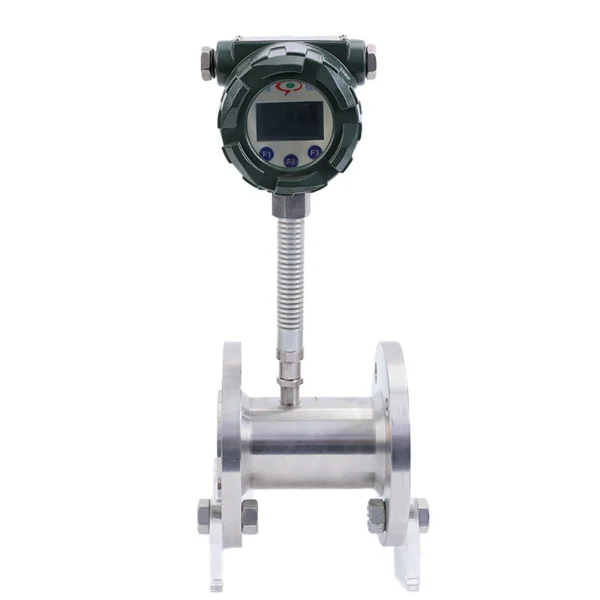
Cryogenic Turbine Flow Meter
A cryogenic turbine flow meter measures liquid nitrogen, liquid oxygen and LNG by volume, with a cold-rated rotor that stays linear down to −196 °C. It is the ultra-low-temperature build of our LWGY turbine series, with pulse or 4-20 mA output.
- Service: liquid nitrogen, liquid oxygen, LNG and other cryogenic liquids
- Medium temperature: ultra-low-temperature variant to −196 °C
- Size (inline): DN6 to DN100 (DN0.5 to DN300 available)
- Accuracy: plus or minus 0.5% of reading (0.2% option)
- Output: three-wire pulse or 4-20 mA; local LCD option
- Wetted parts: 304 / 316L stainless, carbide thrust bearing
Overview
A cryogenic turbine flow meter measures the volume flow of liquid nitrogen, liquid oxygen, LNG and similar cryogenic liquids by spinning a bladed rotor in the stream. It is the ultra-low-temperature variant of our LWGY turbine series: the rotor, bearings and housing are rated for service down to −196 °C, where a standard turbine meter would seize or drift.
Cryogenic liquids are tricky to meter because they sit close to their boiling point. A small pressure drop or a warm spot flashes part of the liquid to gas, and that two-phase mix makes a turbine read high. The fixes are mechanical and procedural: keep the line full and subcooled, size the meter to the real flow, fit a strainer upstream, and use cold-rated clearances and bearings. Built that way, the turbine gives a clean pulse proportional to flow, with accuracy of plus or minus 0.5% of reading.
Features
Built for cryogenic service from the bearing out, not a water meter with a cold label.
Rated to minus 196 CCold-rated carbide thrust bearing and matched clearances hold accuracy where an ambient-rated meter would seize.
Sealed, high-pressure bodyFully enclosed sensor suits pressurised cryogenic lines; nominal pressure to 6.3 MPa by size.
Wide turndownLow lower-limit flow and a broad measuring range cover transfer and filling on a single meter.
Selectable accuracyStandard 0.5% of reading, with 0.2% or 1% builds to match the application and budget.
Pulse or 4-20 mAThree-wire voltage pulse to a remote indicator, or a 4-20 mA transmitter; battery LCD for local reading.
Material choice304 or 316L stainless as standard; PTFE wetted parts for aggressive cryogenic chemistry.
Working principle
Cryogenic liquid enters the meter through a flow straightener and drives a bladed rotor mounted on a carbide thrust bearing. The rotor turns at a speed proportional to the average flow velocity. A pickup coil senses each blade passing and produces a voltage pulse train; the pulse frequency is proportional to volume flow, and the totalised pulse count gives accumulated volume.
Because the output is a frequency, the meter is linear over a wide range and easy to totalise. At cryogenic temperature the bearing material, rotor balance and internal clearances are what keep that linearity, which is why a low-temperature build is not the same part as a water turbine meter. Keep the liquid single-phase through the rotor and the reading stays accurate.
Technical specifications
| Parameter | Specification |
|---|---|
| Model series | LWGY cryogenic turbine flow meter (ultra-low-temperature variant) |
| Nominal size | DN6 to DN100 inline (DN0.5 to DN300 available; insertion DN80 to DN600) |
| Medium temperature | Ultra-low-temperature: −196 to 80 °C; ordinary −20 to 80 °C; high-temperature −20 to 120 °C |
| Ambient temperature | −20 to 55 °C |
| Accuracy | Plus or minus 0.5% of reading standard; 0.2% or 1% optional |
| Repeatability | Plus or minus 0.1% |
| Pulse output | Three-wire voltage pulse (three-core shielded cable); high level >= 8 V, low level <= 0.8 V |
| Pulse power supply | 12 V, current <= 10 mA; sensor to indicator up to 250 m |
| Analog output | 4-20 mA two-wire, 24 VDC, remote distance up to 500 m |
| Local display | LCD instantaneous and totalised flow; 3 V lithium battery, about 3-year life |
| Nominal pressure | PN 1.6 to 6.3 MPa by size; higher on request |
| Wetted material | 304 / 316L stainless; PTFE for corrosive media; carbide thrust bearing |
| Process connection | Thread (G) or flange |
| Protection / Ex | IP65; explosion-proof option (per nameplate) |
Flow ranges by size
Measuring ranges below are for the inline meter at the 0.5%-of-reading accuracy class, in cubic meters per hour. Liquid nitrogen is often dosed in liters per hour: 1 m³/h equals 1000 L/h. Tell us the real flow and we size the bore to keep the rotor in its linear band.
| Nominal size | Flow range (m³/h) |
|---|---|
| DN6 | 0.1 to 0.6 |
| DN10 | 0.2 to 1.2 |
| DN15 | 0.6 to 6 |
| DN20 | 0.8 to 8 |
| DN25 | 1 to 10 |
| DN32 | 1.5 to 15 |
| DN40 | 2 to 20 |
| DN50 | 4 to 40 |
| DN65 | 7 to 70 |
| DN80 | 10 to 100 |
| DN100 | 20 to 200 |
Installation
Mount the meter in a full, horizontal run with the valve downstream of the meter, and fit the supplied strainer upstream. Before first use, fill the sensor slowly with liquid; never let a dry rotor take the impact of high-speed flow, and flush new pipework before the meter goes in. Allow straight runs of about 10 diameters upstream and 5 downstream so the rotor sees a settled profile.
Keep the line subcooled and the run free of pockets where vapor can collect. Clean the strainer and the measuring chamber on a schedule, taking care not to disturb the rotor or the guide-to-rotor spacing on reassembly. When the meter is out of service, drain it, dry it and cap both ends to keep dirt out.
Output and wiring
Two signal paths cover most cryogenic jobs. For a remote indicator, the sensor sends a three-wire voltage pulse over three-core shielded cable, with a high level of at least 8 V and a low level under 0.8 V, on a 12 V supply drawing under 10 mA; the sensor can sit up to 250 m from the indicator. For a control system, the integral transmitter gives a 4-20 mA two-wire signal on 24 VDC over runs to 500 m.
Where an operator just needs to read transfer volume at the skid, the local LCD shows instantaneous and totalised flow and runs about three years on a 3 V lithium cell, so no field power is needed. Pulse, 4-20 mA and battery LCD are build options: pick the one that matches your readout.
Applications
- Liquid nitrogen transfer, filling and dosing on cryogenic skids and tankers
- Liquid oxygen and liquid argon supply lines in air-separation and medical gas plants
- LNG fuelling and small-scale distribution
- Cryogenic dosing in food freezing, cooling and inerting
- Laboratory and pilot cryogenic loops where totalised volume is billed or logged
Challenge: A US industrial-gas distributor needed to meter liquid nitrogen dispensed from a bulk tank into non-pressurised receiving containers, recording the fill delivered to each one. On the atmospheric line, boil-off and flashing were making a volume reading drift high.
Solution: An inline cryogenic turbine on the −196 °C build, sized to the real fill rate, with an upstream strainer and the line kept full and subcooled so the liquid stays single-phase through the rotor; pulse output to a totaliser for per-container counts.
Result: Repeatable per-container fill totals once the line was kept single-phase, with the local LCD giving the operator a direct read at the filling point.
Related products
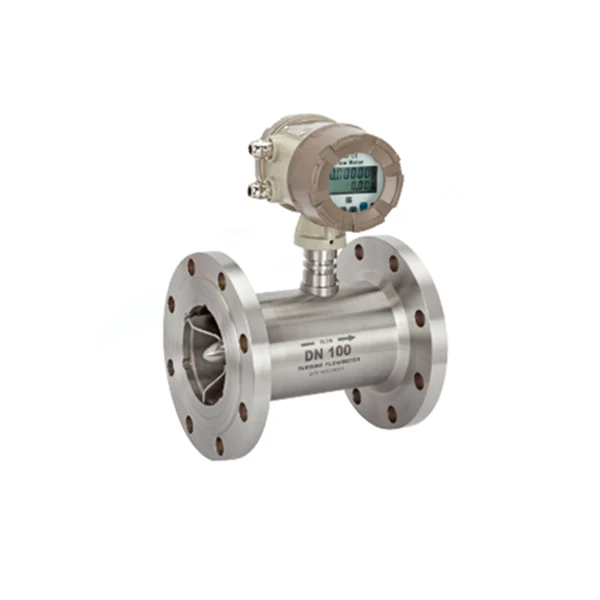 Turbine Flow Meter
LWGY turbine meter for clean low-viscosity liquids and gas, DN4 to DN200.
Liquid Nitrogen Flow MeterWhich technology to use for LN2: turbine, gear/PD or Coriolis mass.
Browse all turbine flow meters →
For bulk liquid argon supply and the warm-gas choices downstream of the vaporizer, see the argon flow meter guide.
For liquefied natural gas specifically, metering practice at loading bays is a subject of its own; the LNG flow meter page walks from cool-down through the applicable standards.
FAQ
How does a cryogenic turbine flow meter work?
Cryogenic liquid drives a bladed rotor whose speed is proportional to flow. A pickup coil turns each blade pass into a voltage pulse; pulse frequency gives flow rate and the pulse count gives totalised volume. A cold-rated bearing and matched clearances keep that relationship linear at cryogenic temperature.
What temperature can a cryogenic turbine flow meter measure?
The ultra-low-temperature build works down to −196 °C, the boiling point of liquid nitrogen, so it also suits liquid oxygen and liquid argon. Ordinary and high-temperature builds cover −20 to 80 °C and −20 to 120 °C for warmer service.
Are cryogenic turbine flow meters accurate?
Standard accuracy is plus or minus 0.5% of reading, with plus or minus 0.2% or 1% builds available, and repeatability of plus or minus 0.1%. Accuracy holds only while the liquid stays single-phase through the rotor, so keeping the line full and subcooled matters as much as the meter class.
Can a cryogenic turbine flow meter measure liquid oxygen and LNG?
Yes. The same cryogenic build meters liquid nitrogen, liquid oxygen, liquid argon and LNG. For oxygen service the meter is cleaned for oxygen use; tell us the medium so we specify the right wetted materials and cleaning.
Request a quote
Tell us the cryogenic medium, the real flow rate and line size, the pressure and the readout you need (pulse, 4-20 mA or local LCD), and we configure one unit for the application, not a shelf part.