By Wu Peng, Senior Process Instrumentation Engineer · Last reviewed July 23, 2026
Hydrostatic pressure is the pressure a still liquid exerts on anything below its surface, created by the weight of the liquid column above. It equals density times gravity times depth: P = rho × g × h. That one equation is why a pressure sensor at the bottom of a tank or well can read the liquid level, and why the reading depends on the liquid and the depth, not on the shape of the tank.
Deeper means more pressure, and a denser liquid means more pressure, but a wider tank does not. This guide gives the formula with a worked example, a density-to-pressure table in kPa and psi, the field errors that shift a level reading, and the transmitters that turn hydrostatic pressure into a 4-20 mA level signal.
Contents
- Hydrostatic pressure formula
- Depth not volume
- Density and units
- Where it applies
- Field reading errors
- Instruments that measure
- Pressure to height
- FAQ
Hydrostatic pressure formula
Hydrostatic pressure follows P = rho g h, where rho is the liquid density in kg/m³, g is gravitational acceleration (9.80665 m/s² at sea level), and h is the vertical depth below the free surface in meters. The result is in pascals, and it is gauge pressure: the pressure above the atmosphere already pressing on the surface.
P = rho × g × h
Take a storage tank with 3.0 m of clean water above a bottom port. Fresh water at 20 °C has a density of 998.2 kg/m³.
P = 998.2 kg/m³ × 9.80665 m/s² × 3.0 m = 29,367 Pa = 29.37 kPa = 4.26 psi
If you need absolute pressure, the value a sealed reference cell would read, add local atmospheric pressure (about 101.3 kPa at sea level) for the column of air sitting on the surface. The difference between the two is worth keeping straight; our guide on absolute versus gauge pressure walks through when each one matters for a level reading.
Depth not volume
Hydrostatic pressure depends only on vertical depth and liquid density. It does not depend on the tank diameter, the total volume, or whether the tank is round or square. This is Pascal’s principle, sometimes called the hydrostatic paradox.
Put two tanks side by side, both holding water 2.0 m deep: a 1 m diameter cylinder and a 5 m square pond. Both bottoms see the same 19.58 kPa, even though the pond holds far more water. Pressure at a point also acts equally in every direction, which is why a liquid pushes sideways out of a hole in a tank wall, not just downward.
For measurement, this is the useful part: a transmitter reads level from pressure no matter how odd the tank profile is. A buried or irregular tank still gives a clean depth reading, because the sensor only ever sees the height of liquid above it.
Density and units
Because pressure scales with density, the same depth reads a different pressure in every liquid. A level transmitter set up for water will read wrong if the real service is denser or lighter, so density (or specific gravity) has to be part of the calibration. The table below is the pressure produced by one meter of head in common process liquids.
| Liquid (density at 20 °C) | Pressure per 1 m of head (kPa) | Per 1 m (psi) |
|---|---|---|
| Fresh water (998.2) | 9.79 | 1.42 |
| Sea water (1025) | 10.05 | 1.46 |
| Diesel fuel (832) | 8.16 | 1.18 |
| Gasoline, light (720) | 7.06 | 1.02 |
| Sulfuric acid, 98% (1840) | 18.04 | 2.62 |
| Mercury (13546) | 132.84 | 19.27 |
Densities in kg/m³. Pressure is gauge, at g = 9.80665 m/s².
The spread is large. A transmitter calibrated for water reads about 28% low if it is actually in gasoline, and about 84% high in 98% sulfuric acid. Enter the true density, or specify the service medium when you order, and the error disappears. On the datasheet you will see head expressed in several units: 1 m of fresh water head is 9.79 kPa, 0.0979 bar, 1.42 psi, or 998 mmH2O. In US field units, 1 psi equals about 2.31 ft of fresh water, so every foot of water adds 0.433 psi (Engineering ToolBox). Our guide to pressure units has the full cross-table.
Where it applies
Hydrostatic pressure is the working principle behind several everyday measurement and process tasks. The four most common in our project files:
| Application | How hydrostatic pressure is used |
|---|---|
| Tank and well level | A transmitter reads pressure near the bottom; the reading converts to liquid height using density. |
| Pump suction head | Available NPSH is calculated from the hydrostatic pressure at the suction, minus the fluid vapor pressure. |
| Pipeline pressure test | A new line is filled with water and pressurized; a slow pressure decay reveals a leak. |
| Hydraulic pre-charge | Accumulator charge pressure is set against the static head of the working fluid above it. |
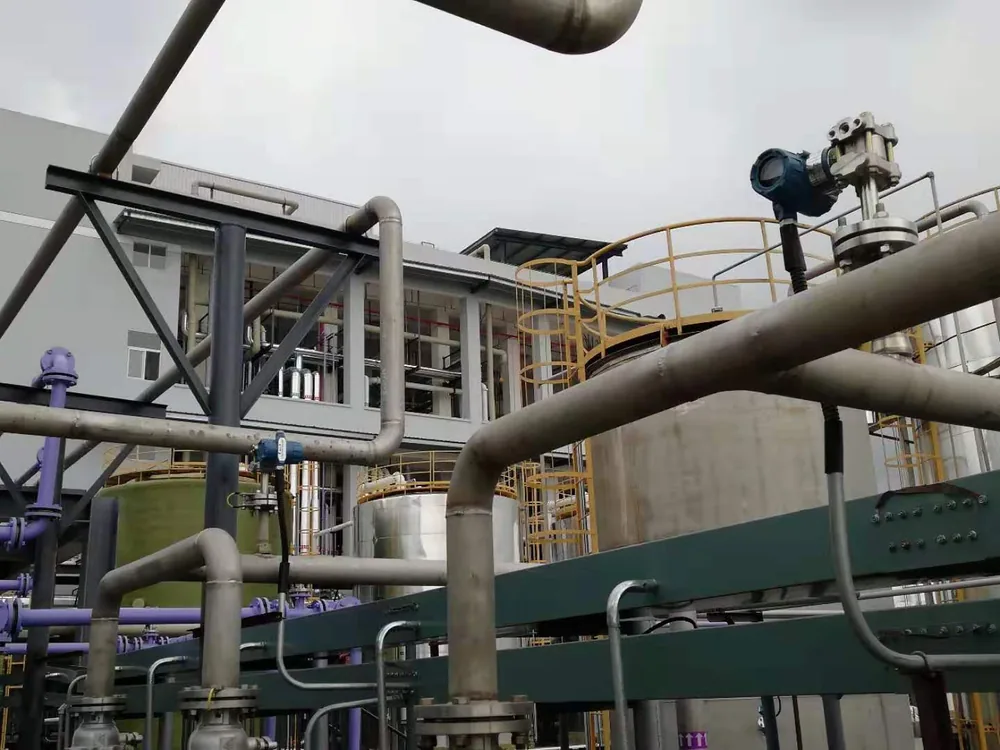
The physics is identical in each case. Only the way you read and use the number changes. Level measurement is the one most people meet first, and it is where the density and temperature corrections below start to matter.
Field reading errors
Three real effects pull a hydrostatic level reading away from the textbook P = rho g h value. Each one is easy to correct once you know it is there.
Temperature. Liquid density drops as it warms. Fresh water falls about 1.5% in density between 20 °C and 60 °C, which is roughly a 15 cm apparent level shift on a 10 m column if you ignore it. Most modern transmitters compensate internally, and custody applications add a separate temperature sensor for live density correction.
Sealed tank with a gas blanket. If the tank is closed and pressurized (a nitrogen blanket or vapor recovery), the gas pressure sits on top of the liquid and adds to the hydrostatic head. A plain gauge transmitter reads the total. Use a differential pressure transmitter with the low side piped to the vapor space, and the cell subtracts the blanket so the output is liquid head only.
Slurry and dissolved solids. Suspended solids raise the effective density, so water carrying 5% solids reads about 5% high. Calibrate against an actual process sample at working temperature, not clean laboratory water.
Instruments that measure
Three instrument families cover almost every field use of hydrostatic measurement. Pick by mounting access, service medium, and the accuracy you need.
| Instrument | Best fit |
|---|---|
| Submersible level transmitter | A sealed probe hung to the bottom of a tall open tank, well, or sump; cable length sets the range. |
| Bottom-port pressure transmitter | Threaded or flanged into a port at the tank bottom; a diaphragm seal handles hot, viscous, or slurry service. |
| Differential pressure transmitter | Sealed pressurized tanks; the low side subtracts the gas blanket, leaving liquid head only. |
For an open sump or a deep well, a submersible pressure transducer dropped on a vented cable is usually the simplest install. For a ported tank, a bottom-mounted hydrostatic level transmitter reads the same head through a fixed connection. Sealed vessels with a blanket gas call for a DP-style hydrostatic transmitter. If you are still weighing hydrostatic against radar or ultrasonic, the level transmitter types guide compares them side by side.
Application example
Energy storage, United States. A flow-battery maker needed continuous level in a 2.6 m electrolyte tank, and the electrolyte is corrosive. A submersible transmitter with PTFE wetted parts sits near the bottom and reads the hydrostatic head of the column above it, converting pressure to level and sending 4-20 mA to the controls. The corrosion-resistant wetted parts let the same hydrostatic method run in a chemistry that would attack a plain stainless probe.
Pressure to height
Running the formula the other way turns a pressure reading into a liquid height. Rearrange P = rho g h to h = P / (rho g).
h = P / (rho × g)
A transducer reads 27.5 kPa in a diesel storage tank, and diesel density is 832 kg/m³.
h = 27,500 Pa / (832 kg/m³ × 9.80665 m/s²) = 3.37 m of diesel above the transducer
In practice the recorder or control system does this once you tell it the density, and a wrong density entry is the single most common cause of level-error complaints. For a quick check on one value, the hydrostatic pressure calculator does P to h for any liquid in one step. Once you have depth, converting it to stored volume in a round horizontal vessel is a separate step; the horizontal tank volume calculator handles the tank geometry.
On fuel tanks the density term is the whole problem, and a water layer under the product biases the same calculation; the diesel tank level selection guide works those numbers.
FAQ
What is the hydrostatic pressure formula?
P = rho g h. Rho is the liquid density in kg/m³, g is gravitational acceleration (9.80665 m/s²), and h is the vertical depth below the surface in meters. The result is gauge pressure in pascals. Multiply pascals by 0.001 for kPa or by 0.000145 for psi.
Does the shape of the container affect hydrostatic pressure?
No. Hydrostatic pressure depends only on vertical depth and liquid density, not on tank width, volume, or shape. A narrow cylinder and a wide pond filled to the same depth show the same bottom pressure. This is Pascal’s principle, and it is why a pressure sensor can read level in any tank profile.
How do you convert hydrostatic pressure to liquid height?
Rearrange the formula to h = P / (rho g). A reading of 30 kPa in clean water (998 kg/m³) gives h = 30,000 / (998 × 9.80665) = 3.06 m of head. The recorder does this automatically once you enter the liquid density, so entering the wrong density is the usual source of level errors.
What instrument measures hydrostatic pressure?
Three families. A submersible level transmitter lowered to the bottom of a tank or well, a bottom-port pressure transmitter threaded into the tank, or a differential pressure transmitter for sealed pressurized tanks where a gas blanket has to be subtracted. All three output a standard 4-20 mA signal that reads as level once density is set.
Request a quote
Tell us the tank or well depth, the liquid and its density, and the accuracy you need, and we will size the right transmitter and provide a quote. Reach our application engineers or use the form below.
Written and technically reviewed by Wu Peng and the Instranova engineering team.