Products › Level instruments › Hydrostatic Level Transmitter
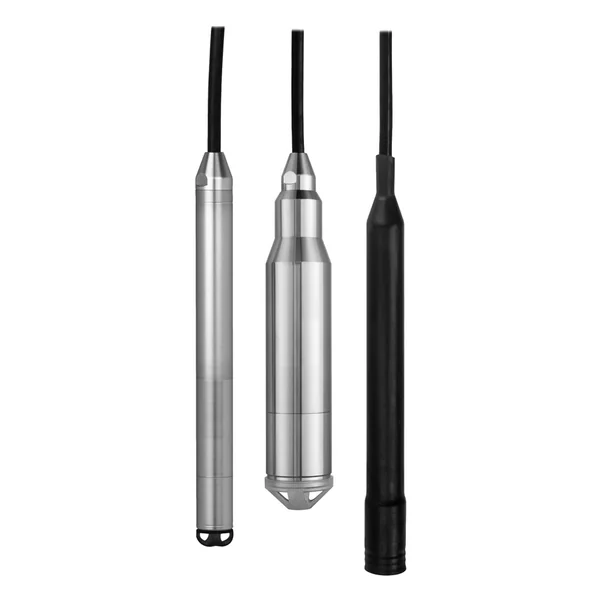
Hydrostatic Level Transmitter
A submersible level probe that reads liquid level from the weight of the column above it. Hang it near the bottom of a tank, sump or well; the head pressure it measures converts straight to level, and the shape of the vessel does not matter.
- Range: 0 to 200 m H2O
- Principle: hydrostatic head, P = ρgh
- Accuracy: 0.2% FS typical
- Output: 4-20 mA; voltage options
- Protection: IP68 probe; ceramic or 316L cell
Overview
A hydrostatic level transmitter does not look at the liquid surface at all. It sits near the bottom and measures the pressure of the column of liquid above it; that pressure is proportional to depth, so it reads as level. Because it measures from below, foam, vapor, tank baffles and odd vessel shapes do not affect it, which is why it is the default for water and wastewater tanks, sumps, wells and reservoirs.
It is the same physics as a submersible pressure transducer, seen from the level side: here the output is scaled to depth and the focus is the tank. For closed or pressurized vessels a differential pressure level transmitter or a diaphragm seal transmitter is the better route.
Working principle
The pressure at the bottom of a liquid column is P = ρgh: density times gravity times height. The probe carries a pressure cell with its outer face open to the liquid and its inner face vented to atmosphere through a tube in the cable, so it reads gauge pressure and cancels changes in barometric pressure automatically. With density and gravity known, the measured head converts directly to level. The cell is a flush ceramic capacitive diaphragm or a diffused-silicon element; both turn the head into a 4-20 mA signal after temperature compensation.
Density and gravity: pressure is not level until you convert
The probe measures pressure, not height. Level only follows once density and gravity are fixed, and density is the one that bites. Calibrate the transmitter in meters of water column, and if the liquid is not water, scale by its specific gravity: a tank of fuel oil at 0.85 SG reads about 15% low on a water-calibrated scale unless you correct it. Density that drifts with temperature or concentration drifts the level with it, so for tight accuracy the conversion is done in the PLC with the real specific gravity, and high-accuracy installs also compensate for media temperature.
Technical specifications
| Parameter | Specification |
|---|---|
| Measuring range | 0 to 200 m H2O (spans from about 1 m) |
| Overload | 2x full-scale pressure |
| Accuracy | 0.2% FS typical (0.5% FS max), incl. linearity, repeatability, hysteresis |
| Stability | 0.2% FS per year typical |
| Temperature drift | 0.01% FS (range ≥ 5 m H2O) |
| Output | 4-20 mA (2/3-wire); 0-5 V, 1-5 V, 0-10 V options |
| Power supply | 15 to 36 VDC (24 VDC calibration) |
| Sensing cell | Flush ceramic capacitive or diffused silicon; vented-gauge reference |
| Operating temperature | -20 to 80 C; compensated -10 to 70 C |
| Wetted diaphragm | 316L stainless steel; fluororubber O-ring |
| Cable | Vented waterproof cable; 10 m standard, extendable |
| Protection | IP68 (probe); IP65 (junction-box transmitter) |
| Standards | CE, FCC, RoHS |
Representative specifications, at room temperature and rated supply unless stated. Values typical; confirm the exact build per datasheet. Ranges beyond 200 m use a deep-well version.
Models and ordering
Quote checklist: send these five points and we configure one unit, not a shelf part.
- Level range in meters and the liquid (with its specific gravity)
- Cable length needed from the junction box to the probe depth
- Cell choice: ceramic for corrosive/abrasive media, silicon for clean water
- Output: 4-20 mA or a voltage; two- or three-wire
- Any corrosion, lightning or hazardous-area requirement
Ordering example: hydrostatic level transmitter, 0 to 5 m H2O, ceramic cell, 4-20 mA two-wire, 8 m vented cable, for a wastewater sump.
Applications
- Water and wastewater tanks, sumps and lift stations
- Storage and process tanks, header tanks
- Wells, boreholes, reservoirs, rivers
- Neutralization and plating tanks (ceramic cell)
- Pump inlet head and overflow protection
Application example
Liquid fertilizer, storage tank. A grower needed continuous level on outdoor liquid-fertilizer tanks, on a 12 VDC supply with a 4-20 mA output into the existing controller. A submerged hydrostatic probe suited it: nothing to mount inside the tank, the reading unaffected by the tank’s shape, and the only setup step was scaling the output to the fertilizer’s specific gravity rather than plain water.
Related products
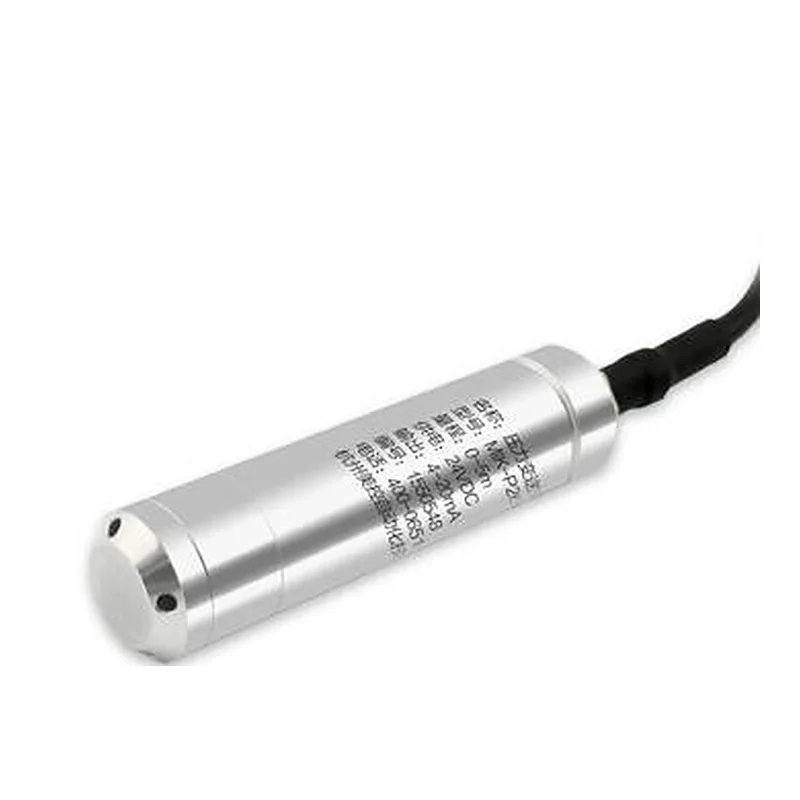 Submersible Pressure Transducer
The same probe seen from the pressure side, for wells and tanks.
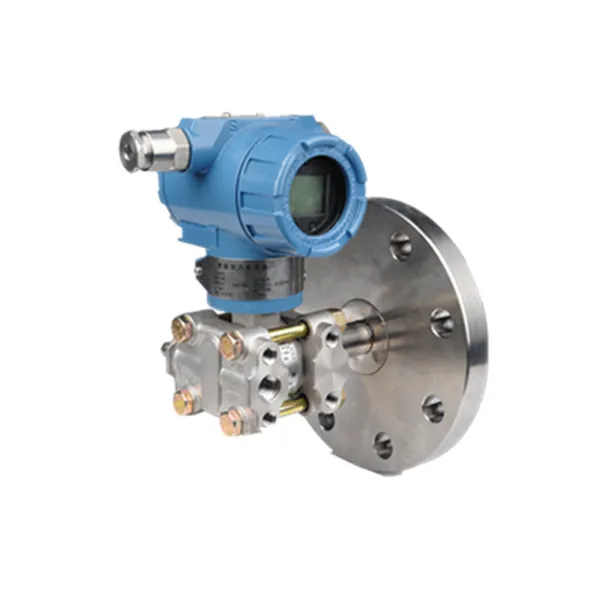 DP Level Transmitter
For closed and pressurized tanks where venting is not enough.
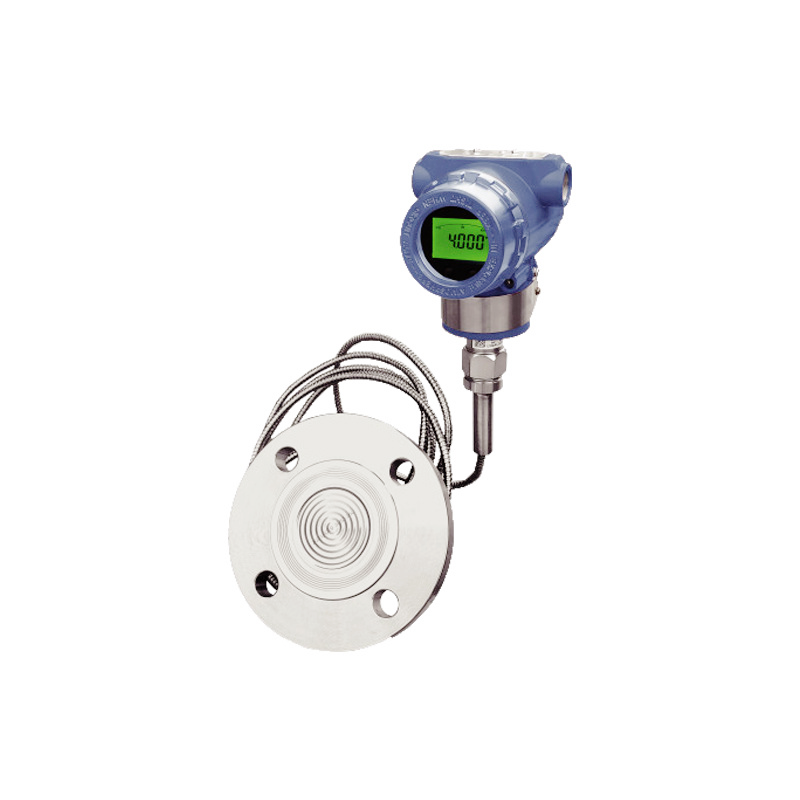 Diaphragm Seal Transmitter
Flush or remote seal for sticky or aggressive media.
Browse all level instruments →
FAQ
What is a hydrostatic level transmitter?
It measures liquid level from the pressure that the column of liquid exerts at the bottom of the tank: pressure equals density times gravity times height (P = ρgh). A submersible or bottom-mounted sensor reads that head pressure and converts it to level. The SI-151 outputs a 4–20 mA signal proportional to level.
What is a disadvantage of a hydrostatic level transmitter?
It depends on density. Because it infers level from pressure, a change in the liquid density (specific gravity) with temperature or composition shifts the reading unless you compensate. It also needs an atmospheric reference (a vented cable for open tanks), and the sensor sits in the medium, so an aggressive fluid calls for the right wetted material.
How much does a hydrostatic level transmitter cost?
It depends on the range, the wetted material, the cable length, and any certification, so we configure and price each unit to the application rather than sell a fixed shelf part. Tell us your range, medium, and connection and we quote it. Request a quote.
What is a hydrostatic-type level indicating transmitter?
It is a hydrostatic transmitter that both measures level from the head pressure and indicates or transmits it. The SI-151 reads the bottom pressure, converts it to level, and sends 4–20 mA, with the option of a local display for on-site reading.
Request a quote
Send the five points in the checklist above and our application engineers will configure a hydrostatic level transmitter for your range, liquid and cable length. Tell us the application and we configure one unit, not a shelf part. Reach our application engineers.