By Wu Peng, Senior Instrumentation Engineer · 20+ years in process instrumentation · Last reviewed July 10, 2026
Nine level transmitter types cover almost every tank in industrial service: radar, ultrasonic, guided wave radar, hydrostatic, differential pressure, capacitance, magnetostrictive, float and the magnetic level gauge. They split into two groups. Non-contact types read the surface from above and never touch the liquid. Contact types put a probe, float or pressure cell in the medium and usually cost less for the same accuracy.
Picking between them is not a catalog exercise. The medium decides: its temperature, its vapor and foam, whether its density or dielectric constant stays put, and whether you need one level or an oil-water interface. This guide compares all nine technologies with real numbers, then gives you a selection table by process condition. Every type links to the matching series in our level instruments range.
Contents
- What a level transmitter is
- Contact and non-contact technologies
- The nine types compared
- Non-contact types: radar and ultrasonic
- Contact types: GWR, hydrostatic, DP, capacitance, magnetostrictive, float
- Choosing by process conditions
- Common selection mistakes
- Featured level transmitters
- FAQ
- Request a quote
What a level transmitter is
A level transmitter measures the height of liquid or solids in a vessel continuously and converts it into a standard signal, usually 4-20 mA, often with HART or RS485 on top. The control system reads that signal in real time, so one instrument serves inventory, batching and alarm limits at once. On P&ID drawings it carries the tag LT.
A level switch is the simpler relative: it trips a relay at one preset point for a high alarm or a pump start, and reports nothing in between. Most tanks run both, a transmitter for the continuous reading and an independent switch as the overfill backstop. “Level sensor” is the umbrella word; in industrial buying it usually means the transmitter.
Contact and non-contact technologies
Non-contact transmitters (radar, ultrasonic) mount on a top nozzle and measure the time of flight of a pulse reflected off the surface. Nothing touches the medium, so corrosion, coating and hygiene problems mostly disappear, and there is nothing inside the tank to maintain.
Contact transmitters reach into the liquid: a guided wave radar probe, a magnetostrictive stem with a float, a submersible pressure probe on the tank floor, a capacitance rod, or pressure taps through the wall. They are cheaper per point, immune to foam in several cases, and the only route to some measurements, such as interface between two liquids. The trade is wetted materials: every contact instrument must survive the chemistry and temperature it sits in.
The nine level transmitter types compared
The table below is the short answer to the whole subject. Values are representative for standard industrial builds; confirm against the datasheet of the specific series you order.
| Type | Contact | Typical accuracy | Range | Strong on | Watch out for |
|---|---|---|---|---|---|
| Radar (26 / 80 GHz) | No | ±1 to ±3 mm | to 80 m | Vapor, dust, corrosives, solids | Heavy foam, agitator echoes |
| Ultrasonic | No | ~±0.3% FS | to 30 m | Low cost, water and wastewater | Vacuum or pressure, vapor, foam |
| Guided wave radar | Yes | ±2 to ±5 mm | to 30 m | Foam, small tanks, interface | Coating and crystallizing media |
| Hydrostatic (submersible) | Yes | ±0.2 to 1% FS | to 300 m (wells to 1000 m) | Water, deep wells, lowest cost | Density change reads as level change |
| Differential pressure | Yes | ±0.075 to 0.2% FS | set by span | Pressurized vessels, steam drums | Impulse lines, density, wet leg upkeep |
| Capacitance | Yes | class 0.2 to 1 | probe to ~10 m | Clean stable liquids, high pressure | Dielectric constant must stay stable |
| Magnetostrictive | Yes | ±0.5 to 1 mm | rod to 15 m, cable to 25 m | Highest precision, oil-water interface | Float jams in viscous or dirty media |
| Float (reed chain) | Yes | ~±10 mm | to 6 m | Simple, no power at the float | Specific gravity below float rating |
| Magnetic level gauge | Yes | visual, ~±10 mm | chamber length | Local reading with no power | Add a transmitter for a 4-20 mA signal |
Non-contact types: radar and ultrasonic
Radar level transmitters send a microwave pulse from a top-mounted antenna and time the reflection off the surface. Because microwaves ignore vapor, dust, temperature layers and vacuum, radar is the default for chemicals, solids and anything that fumes. A 26 GHz horn covers most tanks; 80 GHz gives a narrow beam that threads past ladders and agitators, and long-range parabolic builds reach 80 m in silos. Accuracy of ±1 to ±3 mm is routine. The weak spots are thick foam, which absorbs the signal, and low-dielectric liquids such as LPG; both are usually solved with a stilling well. Browse the frequency and antenna options in our radar level sensors range.
Ultrasonic level transmitters do the same time-of-flight trick with sound instead of microwaves, which cuts the price by a third or more. Sound needs a gas path at roughly atmospheric pressure, so ultrasonic is out for vacuum and pressurized vessels, and heavy vapor or foam scatters the echo. Mind the blind zone: the transducer cannot read the top 0.3 to 1.5 m below its face. For open water, wastewater sumps and atmospheric storage it is the economical choice; see our ultrasonic level sensors.
For the numbers behind that choice, from sound-speed error to steam error and beam spot, see our ultrasonic vs radar level sensor comparison.
Laser is a third non-contact option, suited to bulk solids and opaque liquids; our laser level sensor guide covers its limits.
Application example
Butane storage, United States. An operator with a 51 ft butane sphere wanted level measurement with nothing penetrating the vessel: carbon steel, 0.820 in plate at the top and 1.125 in at the bottom. That one requirement ruled out every nozzle-mounted and probe technology at once. We worked the selection around an external ultrasonic approach that reads through the tank wall, with the changing plate thickness as the main sizing question. When a vessel cannot be opened, the technology list shrinks fast; get the wall thickness on the table before quoting anything external.
Contact types: GWR, hydrostatic, DP, capacitance, magnetostrictive, float
Guided wave radar (GWR) runs the microwave pulse down a rod or cable probe instead of through open air. The probe concentrates the energy, so foam and vapor barely matter, and a second reflection off an oil-water boundary gives interface measurement. Coating and crystallizing media are the main limitation: buildup on the probe shifts the reading. Details on the guided wave radar level transmitter page.
Hydrostatic transmitters measure the pressure of the liquid column, P = rho × g × h, with a probe on the tank floor or a submersible probe lowered on a vented cable. They are the cheapest continuous technology and the only practical one for deep wells: standard probes cover 0.5 to 300 m of water column and deep-well builds reach 1000 m. One physical limit comes with the method: the cell reads pressure, not height, so a 5 percent density change reads as a 5 percent level error. Compare mounting styles under hydrostatic level sensors.
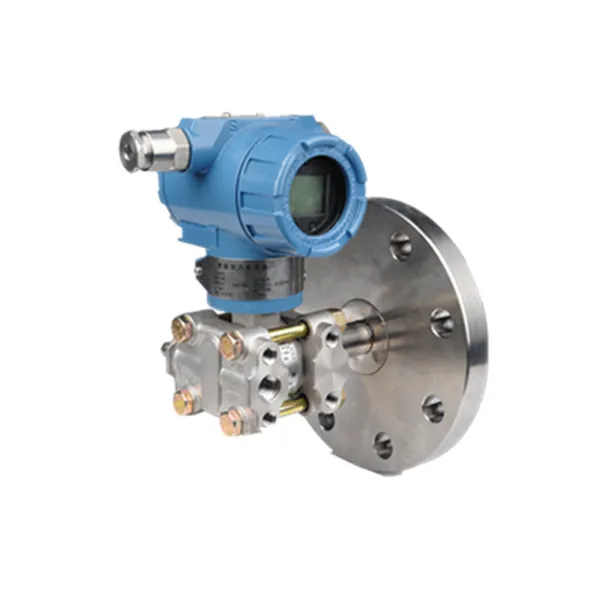
Differential pressure (DP) transmitters extend the hydrostatic idea to closed vessels: the high-pressure tap takes the column plus vessel pressure, the low-pressure tap takes vessel pressure alone, and the cell subtracts. This is the established answer for steam drums, reactors and anything pressurized, at ±0.075 to 0.2 percent of span. It brings impulse lines, wet legs and their winter maintenance with it. See DP level transmitters for flange and remote-seal builds.
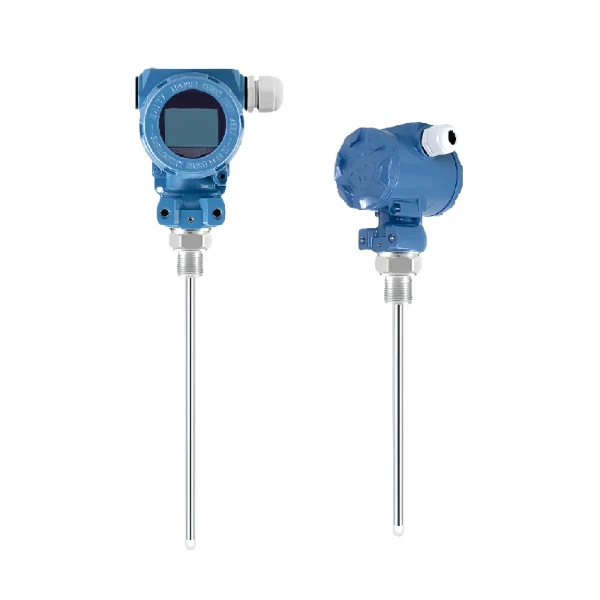
Capacitance transmitters use the probe and tank wall as a capacitor; rising liquid raises the capacitance in proportion to level. With a PTFE-insulated rod they handle corrosive and high-pressure service well. The reading depends on the dielectric constant of the medium staying constant, so composition swings are a real error source. Our capacitance level sensors page covers conductive versus non-conductive liquids.
Application example
Aviation fuel, Poland. A buyer needed level in Jet A1 at a fixed 360 mm probe length, flange mounted, with a 0-5 V output for an existing controller. Jet fuel is clean, non-conductive and stable in composition, which is exactly the service where a capacitance rod is the simple answer. We quoted the flanged capacitance sensor cut to length and asked for the operating pressure, temperature and flange standard before releasing the drawing; on short fixed-length probes those three details decide the build.
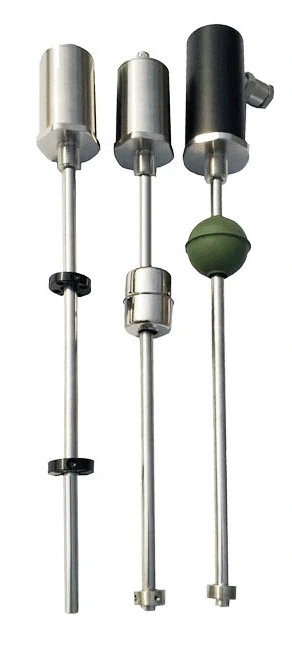
Magnetostrictive transmitters float a magnet on the surface around a rigid stem and locate it by timing a torsional pulse in an internal waveguide wire. At ±0.5 to 1 mm they are the precision option for tank gauging and custody-grade inventory, and a second float on the same stem tracks an oil-water interface. Rigid-rod builds cover tanks to about 15 m; the flexible cable version extends the same measurement to 25 m. Free float movement is the prerequisite: viscous, dirty or crystallizing media jam it. See the magnetostrictive level transmitter.
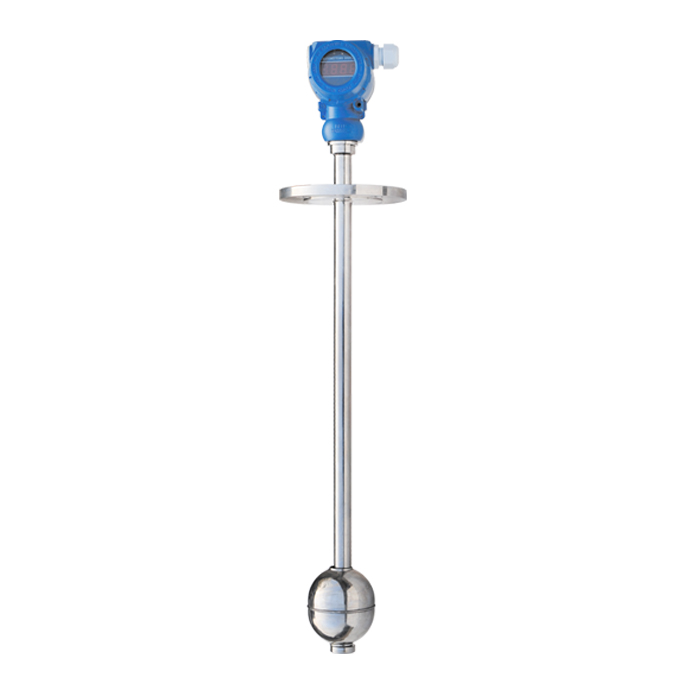
Float and magnetic gauge types round out the lineup. A reed-chain float level sensor gives a stepped 4-20 mA at around ±10 mm for a modest price, provided the liquid’s specific gravity exceeds the float rating. The magnetic level gauge is the visual cousin: a float in a side chamber flips indicator flags, needs no power at all, and takes a clamp-on transmitter later if the control room wants the signal.
Choosing by process conditions
Start from the condition that hurts most, not from the technology. The table gives the first choice we quote for each common condition, and the fallback when the first choice is ruled out.
| Process condition | First choice | Alternative |
|---|---|---|
| Corrosive chemicals (acids, caustics) | Non-contact radar, PTFE antenna | Capacitance with PTFE probe |
| Foam on the surface | Guided wave radar | DP or hydrostatic (reads below the foam) |
| Pressurized vessel or steam drum | DP transmitter | GWR rated for the pressure |
| Deep well or reservoir | Submersible hydrostatic probe | Radar over an open shaft |
| Powders and granular solids | Radar (frequency by particle size) | GWR cable probe in narrow silos |
| Oil-water interface | Magnetostrictive, two floats | GWR with interface firmware |
| Hygienic / CIP service | Sanitary radar, tri-clamp | Flush-mount hydrostatic |
| Tight budget, clean water, open tank | Hydrostatic probe | Ultrasonic |
Then sanity-check the winner against temperature and pressure ratings, hazardous-area certification, and the tank height against the range column above. If two technologies survive, take the one your maintenance crew already knows.
Common selection mistakes
- Trusting hydrostatic through a density change. The cell converts pressure to level with one fixed density. Brine that concentrates, or a tank that alternates products, shifts the reading by the same percentage the density shifted.
- Pointing radar at an agitated, foaming surface and hoping. Foam absorbs microwaves and a mixer paddle returns its own echo. Fit a stilling well, or switch to GWR or DP.
- Capacitance on a medium that changes composition. The calibration assumes one dielectric constant. Solvent blends and wet-dry solids break that assumption.
- A float lighter than the liquid can carry. Reed-chain floats need the specific gravity on the datasheet, typically 0.5 or better. Foaming or viscous media also hang up the float.
- Ultrasonic on a closed, hot or fuming vessel. Sound needs calm gas at near-atmospheric pressure and a known temperature for compensation. Vapor blankets and pressure kill the echo; that service belongs to radar or DP.
- Forgetting the vented cable on a submersible probe. The gauge reference must breathe to atmosphere through the cable. Seal it in a junction box without a vent and barometric swings walk the zero.
Application example
Palm oil processing, Indonesia. A processor asked for one instrument to track three layers in a storage tank: oil on top, water below it, and a sediment bed on the bottom. A magnetostrictive transmitter with two floats handles the total level and the oil-water interface cleanly; no float-based instrument reads a settled solids bed. We quoted the two-float magnetostrictive interface unit and said plainly that the sediment layer needs a separate approach rather than promising a three-layer reading from one probe. Match the technology to what it can physically measure instead of forcing one instrument to do everything.
Featured level transmitters
One series for each of the nine technologies. Every page carries the full specification table and an inquiry form.
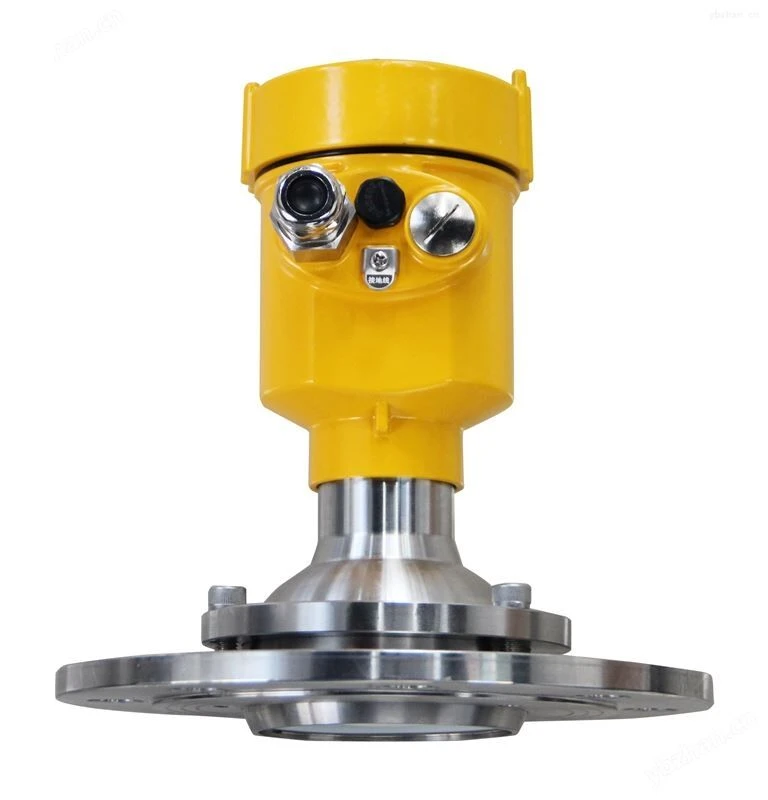 Radar Level Transmitter
26 GHz non-contact with 4-20 mA and HART output. The default for vapor, corrosives and agitated tanks.
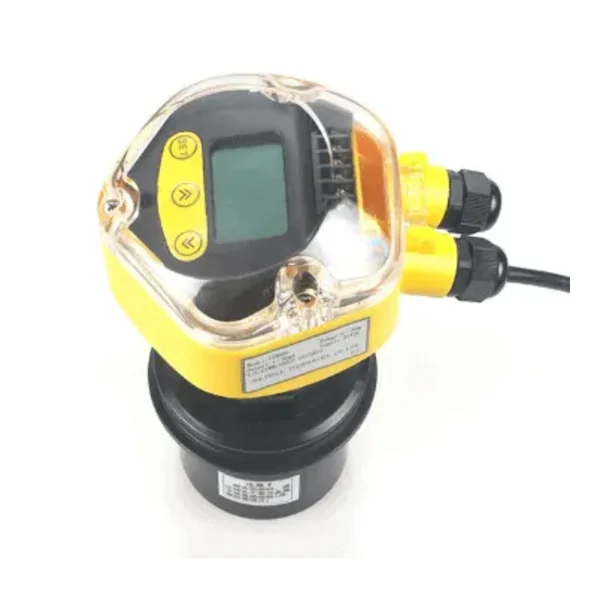 Ultrasonic Level Transmitter
Non-contact time-of-flight at the lowest non-contact price. Water, wastewater and atmospheric tanks.
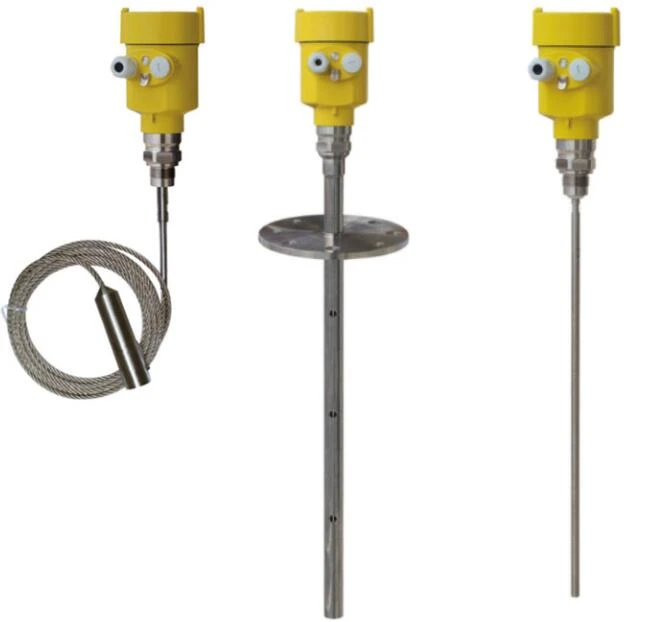 Guided Wave Radar
Probe-guided pulse for foam, small tanks and oil-water interface measurement, immune to surface noise.
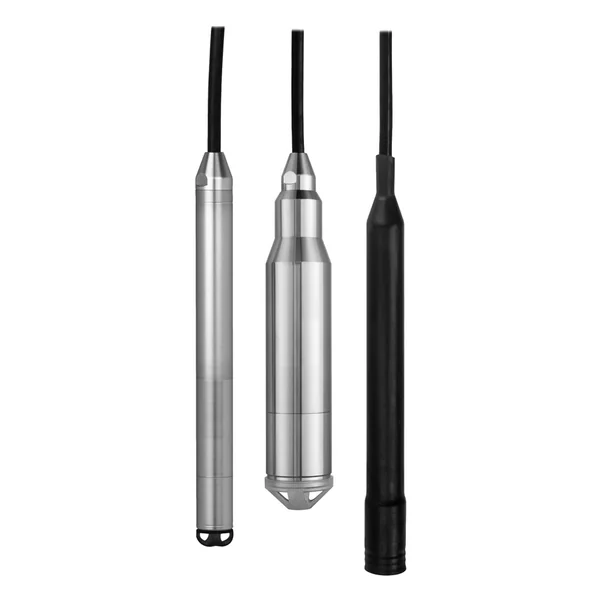 Hydrostatic Level Transmitter
SI-151 pressure-based probe, the lowest-cost continuous reading for water and open tanks.
 DP Level Transmitter
SMT3151LT flange-mounted DP cell for pressurized vessels, reactors and steam service.
 Capacitance Level Transmitter
Insulated-probe measurement for clean, stable liquids and high-pressure service.
 Magnetostrictive Level Transmitter
SI-100 millimeter-class precision for tank gauging and oil-water interface.
 Float Level Sensor
Reed-chain float for simple continuous level and point alarms at a modest price.
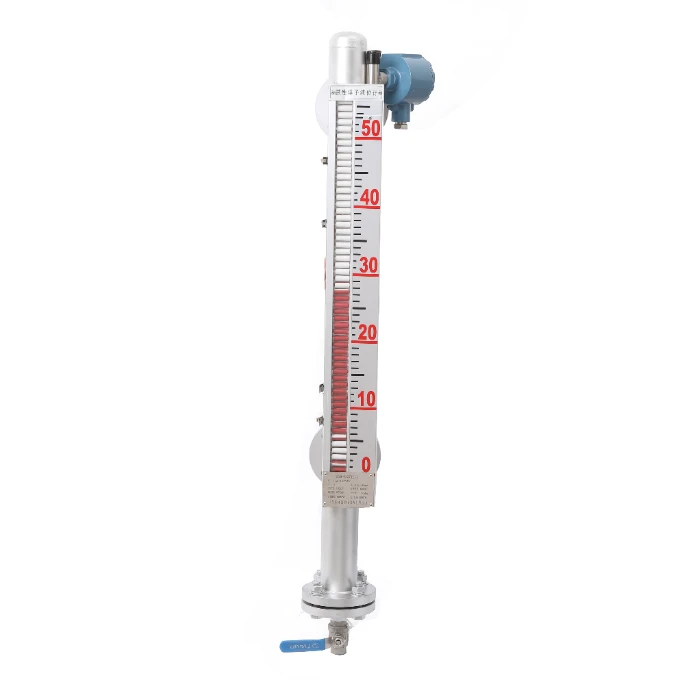 Magnetic Level Gauge
Side-chamber visual reading with no power at all; clamp-on transmitter option for a 4-20 mA signal.
Browse all level instruments →
Fuel service adds constraints the general comparison does not cover, including low permittivity surfaces and water under the product; see our diesel tank level gauge and sensor guide for that case.
On water storage specifically, the deciding factors are potable certification and pump control rather than sensing principle; see our water storage tank level sensor selection guide.
Once the instrument family is settled, the harder question on a bulk storage tank is how the reading becomes a booked quantity. The volume chain and the accuracy limits behind it are covered under tank gauging.
FAQ
How many types of level transmitters are there?
Nine technologies cover nearly all industrial continuous level measurement: radar, ultrasonic, guided wave radar, hydrostatic, differential pressure, capacitance, magnetostrictive, float and magnetic level gauge with a transmitter option. Vendors group and count them differently, but the physics behind every commercial product falls into this set.
What are the three types of transmitters?
In level work the three-way split is non-contact transmitters (radar, ultrasonic), contact transmitters (GWR, hydrostatic, DP, capacitance, magnetostrictive, float) and point-level switches. The first two give a continuous 4-20 mA reading; a switch only trips at a preset level.
How do you choose a level transmitter?
Work through five questions in order: what is the medium and its temperature and pressure; does its density or dielectric constant stay constant; is there foam, vapor or agitation; do you need plain level or an interface; and how tall is the tank. The answers usually leave one or two viable technologies, and the selection table above resolves the rest.
What is a LT transmitter?
LT is the ISA instrument tag for a level transmitter on P&ID drawings: L for the measured variable (level), T for the function (transmitter). LT-101 is simply level transmitter number 101 in that loop numbering. LSH and LSL on the same drawing are the high and low level switches.
Request a quote
Send five points: the medium and its temperature, the tank height and mounting options, the pressure, whether foam or agitation is present, and the output you need. We will come back with the technology, the series and a price, and we will say so when a cheaper type does the same job. You can also reach our application engineers directly. Tell us the application and we configure one unit, not a shelf part.