Home › Level Instruments › Radar Level Transmitter
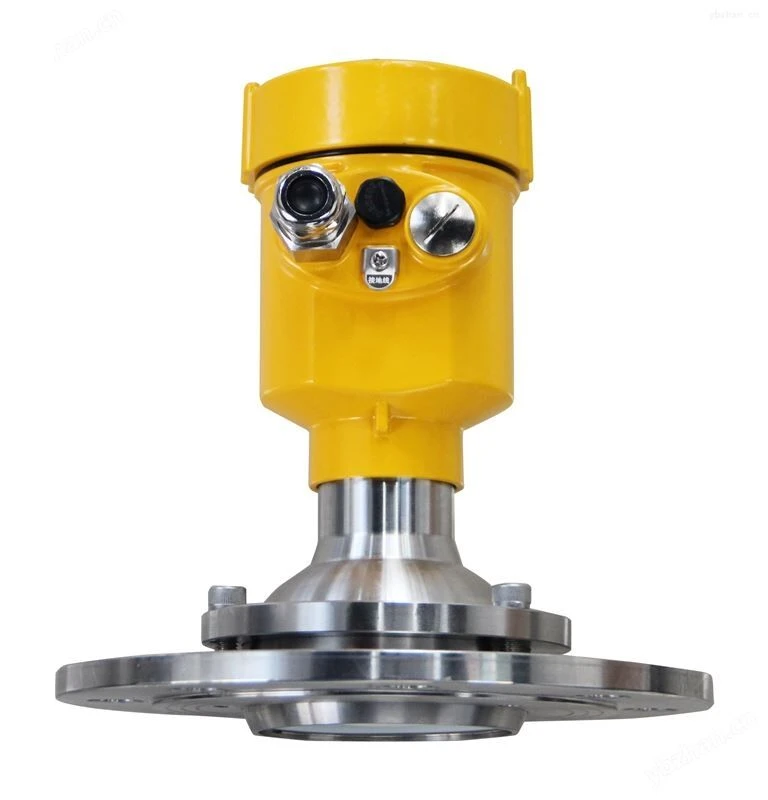
Radar Level Transmitter (Non-Contact, 120 GHz FMCW)
A non-contact radar level transmitter that measures by frequency-modulated continuous wave at the 120 GHz band. The reading comes from a frequency shift, not an echo strength, so it holds 2 mm accuracy and is not affected by density, temperature, vapor, or foam, with nothing touching the medium.
- Range: up to 150 m
- Accuracy: ±2 mm; blind zone 0.05 m
- Band: 120 GHz FMCW (123 GHz)
- Process: -40 to +200 °C, to 2.5 MPa
- Output: 4–20 mA + HART or Modbus-RS485
- Protection: IP67
Most level methods drift with the process: ultrasonic loses the echo on vapor, a float wears, and pressure-based methods move with density. A non-contact radar level transmitter sidesteps all of that. It sends a frequency-modulated microwave from the top of the tank and reads the frequency difference between the sent and returned signal, which is set only by the distance to the surface. Because that distance does not change with density, temperature, evaporation, or foam, the 120 GHz radar holds 2 mm accuracy on liquids and solids alike, with nothing touching the medium.
Overview
This is a 120 GHz FMCW radar level transmitter, the HBRD-FMF series, covering ranges up to 150 m with a blind zone of just 0.05 m and an accuracy of 2 mm. The millimetre-wave band allows a small antenna with a narrow beam, so energy is concentrated and the echo stays strong even in tall or cluttered vessels. PTFE lens antennas resist adhesion and condensation, and the wide dynamic range suits low-dielectric media that defeat lower-frequency radar. Output is 4–20 mA with HART, or Modbus-RS485, with a 1 mm resolution. For low-dielectric media in agitated or foaming tanks where a contact probe is better, see the guided wave radar level transmitter.
Features
What sets the 120 GHz FMCW series apart, and the real specification behind each point:
Reading independent of the processThe level comes from a frequency shift, not an echo amplitude, so it holds ±2 mm whatever the density, the temperature inside the vessel, the evaporation, or the dust. Boiling liquids and crystallising products read stably.
Sees low-reflectivity mediaA wide dynamic signal range picks up the small echoes from low-dielectric media, including light powders and plastic granules that weaker radar loses.
Works through coating and condensationStrong penetration plus a heated fluoroplastic (PTFE) lens antenna keep it measuring under adhesion and condensation.
Narrow, focused beamMillimetre-wave at 120 GHz with lens antennas gives emission angles as tight as 1.5 degrees, concentrating the energy on the surface and ignoring walls, agitators, and internal fittings.
Small antenna, long reachThe compact antenna fits more nozzles yet reaches up to 150 m, and the 0.05 m blind zone lets it measure close to the antenna.
Non-contact, fitted from outsideNothing touches the medium, so there is no corrosion and no wear; it suits corrosive, hygienic, ultra-high-temperature, and ultra-high-pressure service, and operates to -60 °C ambient.
Fast responseMultiple measurement modes; in fast mode the radar response time is under 1 second.
Working principle
The transmitter emits a frequency-modulated continuous wave from the top of the tank. The wave reflects off the medium and returns, and because the transmit frequency is sweeping, the returned signal differs in frequency from the signal being sent at that instant. That frequency difference is proportional to the distance to the surface: distance equals the speed of light times the frequency difference, divided by twice the modulation slope. The speed of light and the slope are known, so measuring the frequency difference gives the distance from the antenna to the surface. Subtracting that from the known empty height of the tank gives the level. Reading a frequency rather than an echo amplitude is why the result is stable across density, temperature, and surface conditions.
Technical specifications
Common to the series; per-model ranges and limits are in the model table below.
| Parameter | Specification |
|---|---|
| Frequency band | 120 GHz (123 GHz), FMCW |
| Accuracy | ±2 mm; resolution 1 mm |
| Blind zone | 0.05 m (0.1 / 0.2 / 0.3 m configurable) |
| Antenna material | PTFE lens (heated) |
| Wetted / connection | Thread or flange; SS304, 316L, PP, PTFE |
| Output | 4–20 mA + HART (2-wire); 4–20 mA / Modbus-RS485 (4-wire) |
| Power supply | 2-wire DC 24 V; 4-wire DC 12–24 V or AC 110/220 V |
| Housing | Cast aluminum, stainless steel, or ABS |
| Ambient temperature | to -60 °C |
| Protection | IP66 / IP67 |
Models and selection
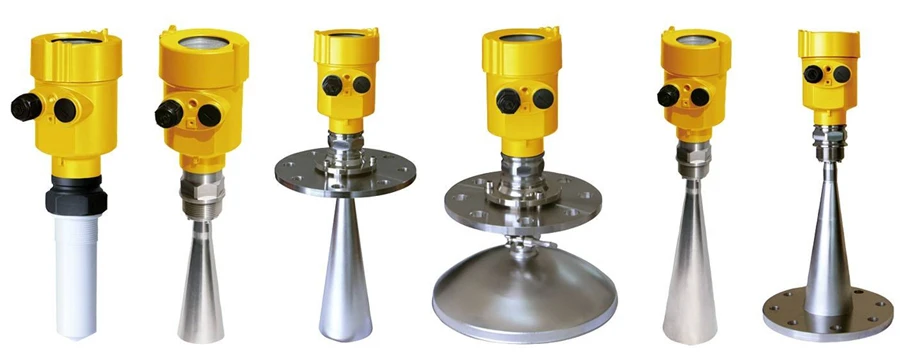
The HBRD-FMF series runs from short-range threaded liquid units to long-range flanged liquid and solid units. The antenna sets the beam angle, and a larger antenna gives a narrower beam that better ignores walls and internals. Pick the model by medium, range, process connection, and the temperature or pressure of the service:
| Image | Model | Medium | Range | Connection | Temp | Pressure | Antenna / beam | Accuracy |
|---|---|---|---|---|---|---|---|---|
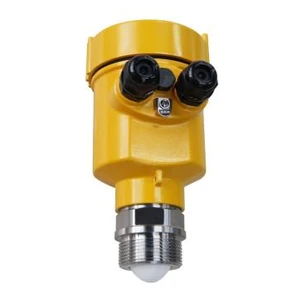 |
FMF-11 | Liquid | 0.05–30 m | G1½”A / 1½”NPT / flange ≥DN50 | -40 to 80 °C | -0.1–0.3 MPa | 32 mm lens, 7° | ±2 mm |
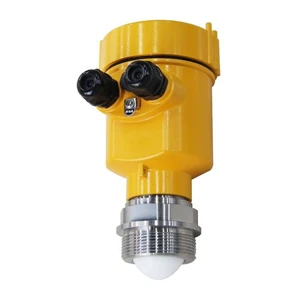 |
FMF-12 | Liquid | 0.05–35 m | G2″A / flange ≥DN65 | -40 to 110 °C | -0.1–1.6 MPa | 42 mm lens, 5° | ±2 mm |
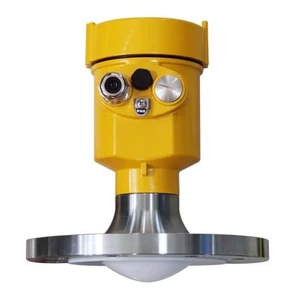 |
FMF-13 | Liquid | 0.1–100 m | Flange ≥DN80 | -40 to 110 °C | -0.1–0.3 MPa | 78 mm lens, 3° | ±2 mm (±5 mm >35 m) |
|
FMF-14 | Liquid | 0.1–150 m | Flange ≥DN125 | -40 to 110 °C | -0.1–0.3 MPa | 110 mm lens, 1.5° | ±2 mm (±5 mm >35 m) |
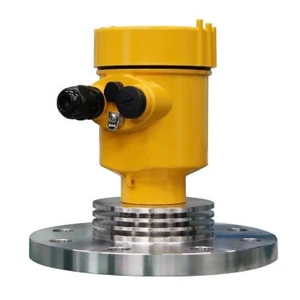 |
FMF-15 | Liquid, hot | 0.1–35 m | Flange ≥DN80 | -40 to 200 °C | -0.1–2.5 MPa | 78 mm lens, integral filling, 3° | ±2 mm |
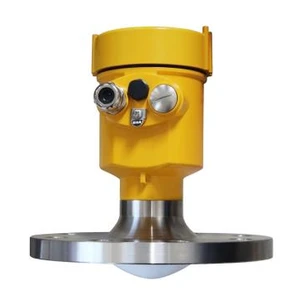 |
FMF-21 | Solid | 0.3–150 m | Flange ≥DN80 | -40 to 110 °C | -0.1–0.3 MPa | 78 mm lens, purge option, 3° | ±5 mm |
In short: FMF-11/12 are the threaded and compact liquid units for tanks to about 35 m; FMF-13/14 add the big 78 and 110 mm lenses for long-range liquid storage to 100 and 150 m with the narrowest beams; FMF-15 is the high-temperature, high-pressure liquid model to 200 °C and 2.5 MPa; and FMF-21 is the solids model for silos, with an optional air purge to keep the lens clean. All run at 123 GHz with the common electronics and outputs in the table above.
Applications
Because it reads through vapor, dust, and foam without contact, the series covers both solids and difficult liquids:
Solids (FMF-21):
- Powder, granule, and block materials in silos
- Low-dielectric plastic particles that weakly reflect
Liquids:
- Reactor and large steam (boiler) vessels
- Foaming and crystallising products
- Ultra-high-temperature and ultra-high-pressure product (FMF-15)
- Boiling and corrosive liquids, measured with no contact
- Hygienic product where a clean, non-contact fitting is required
FAQ
What is a radar level transmitter?
A radar level transmitter measures level without contact by sending a microwave signal from the top of the tank and reading the signal reflected from the surface. This 120 GHz unit uses FMCW (frequency-modulated continuous wave): it reads the frequency difference between the sent and returned signal, which is set by the distance to the surface, then subtracts that from the known tank height to give the level. Nothing touches the medium.
What is the difference between ultrasonic and radar level transmitter?
Both are non-contact and time a signal to the surface, but ultrasonic uses sound while radar uses microwave. Sound needs a medium to travel, so ultrasonic drifts with temperature, pressure, and vapor and cannot work in vacuum; radar is unaffected by density, temperature, pressure, vapor, or dust. That is why this radar holds 2 mm where an ultrasonic level transmitter is better kept to clean, vented, near-ambient tanks.
How accurate is a radar level transmitter?
This 120 GHz FMCW radar holds ±2 mm on liquids, with 1 mm resolution and a 0.05 m blind zone; long-range models give ±5 mm beyond 35 m, and the solids model ±5 mm. Accuracy comes from reading a frequency difference rather than an echo amplitude, so it does not drift with density or surface conditions.
What is the best radar level transmitter?
There is no single best one; the right radar depends on the medium, the range, and the process conditions. For clean liquids that reflect well, non-contact radar like this HBRD-FMF series is ideal, with a model for each range and a high-temperature, high-pressure variant. For low-dielectric, agitated, or foaming media, a contact guided wave radar level transmitter is more reliable. Use the model table above to match range, connection, temperature, and pressure to your tank.
Related products
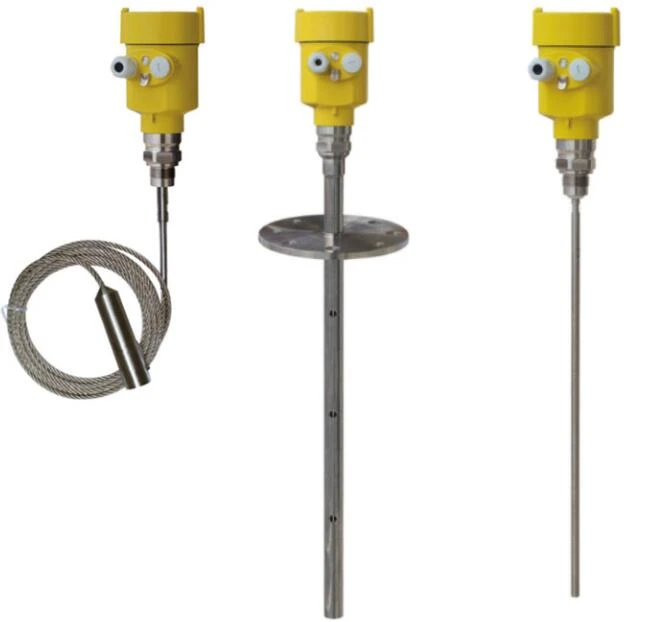 Guided Wave Radar
Contact probe for low-dielectric, agitated, or foaming media.
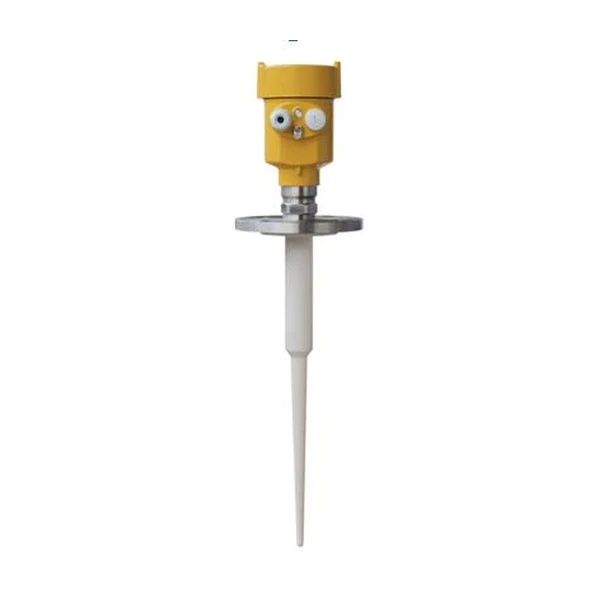 Radar Level Sensor for Corrosive Liquids
SIRD-802 PTFE rod antenna radar for acids, bases and corrosive liquids.
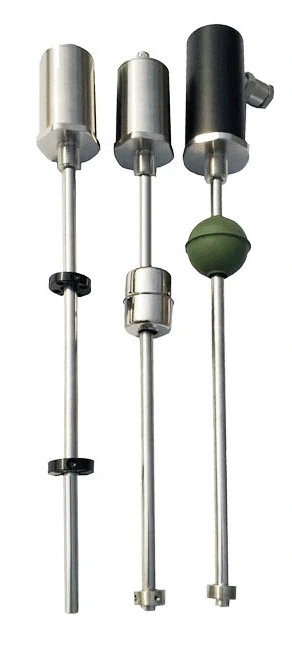 SI-100 Magnetostrictive
Sub-millimetre accuracy on clean liquids in smaller tanks.
 All Level Instruments
Compare radar, ultrasonic, magnetostrictive, and hydrostatic.
Browse all level instruments →
Request a quote
Tell us five things and we set the model and antenna for your vessel:
- Range and whether the medium is liquid or solid
- Process temperature and pressure at the connection
- Connection (thread or flange size) and nozzle height
- Output (4–20 mA / HART or Modbus-RS485) and supply
- Vessel internals that might sit in the beam
Ordering example: FMF-13, 0.1–40 m, liquid, DN80 flange, -40 to 110 °C, 4–20 mA + HART, aluminum housing.
Tell us the application and we configure one unit, not a shelf part. Have a tank or silo we have not covered? Reach our application engineers.