Home › Level instruments › Capacitance level transmitter
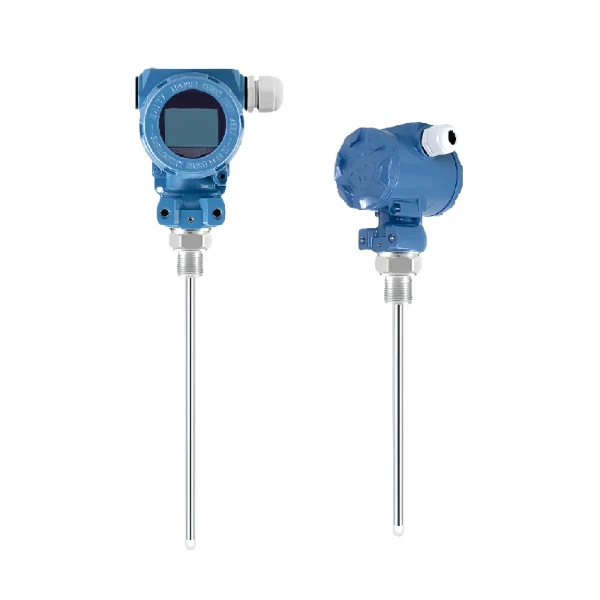
Capacitance Level Transmitter
A contacting, continuous level transmitter that reads the dielectric of the medium between a probe and the tank wall. No moving parts, a PTFE or stainless probe for corrosive and conductive liquids, and a two-wire 4-20 mA output. Best on liquids with a stable dielectric constant; for sticky or coating media, step up to RF admittance.
- Output: 4-20 mA two-wire; HART or RS485 optional
- Measuring range: 0.1 to 10 m
- Accuracy: class 0.2 / 0.5 / 1 (±0.2 / 0.5 / 1% FS)
- Medium temperature: -50 to +250 °C
- Pressure: -0.1 to 16 MPa (to 32 MPa custom)
- Wetted parts: 316 SS or PTFE
- Protection: IP66; Exib IIC T6; supply 15-36 VDC
Overview
A capacitance level transmitter turns a tank into a capacitor. The probe is one plate, the metal tank wall is the other, and the liquid or solid between them is the dielectric. As the level rises, more of the gap is filled with a higher-dielectric medium instead of air, the capacitance rises, and the electronics convert that change into a linear 4-20 mA signal. There are no floats, no diaphragms, and nothing that moves, which is why it holds up in corrosive and high-pressure service where mechanical sensors seize.
The technology is a fit when the medium has a stable dielectric constant and does not heavily coat the probe. It is a poor fit when the dielectric drifts batch to batch, or when sticky product builds a conductive film on the probe and fakes a high reading. That coating case is exactly what RF admittance is built to reject, so we route those applications there.
Features
No moving parts
No floats or springs to seize. High reliability with minimal maintenance.
Corrosion ready
PTFE-insulated or 316 SS probe for acids, alkalis, and aggressive conductive liquids.
High pressure and temperature
To 16 MPa (32 MPa custom) and 250 °C; the reading is unaffected by liquid temperature, density, or vessel shape.
Two-wire 4-20 mA
Loop-powered on 15-36 VDC; HART or RS485 available as an option.
Stable and protected
Long-term stability ≤ 0.1% FS/year; intrinsically safe Exib IIC T6 option.
Continuous or point
One probe family for continuous level or a single high or low setpoint.
Working principle
Two electrodes, the probe and the tank wall, form a capacitor. Dry tank space is mostly air, with a relative permittivity (dielectric constant) of 1. The process liquid has a much higher permittivity, so as it rises up the probe it replaces air and raises the measured capacitance, typically across a 10 to 5000 pF working range. The transmitter linearizes that capacitance against level and outputs 4-20 mA.
One detail decides the probe build. When the medium is electrically conductive, such as water, sewage, or acid and alkali solutions, a bare metal probe would short to the liquid, so the probe is sheathed in an insulating layer (usually PTFE) that becomes the working dielectric. When the medium is non-conductive, such as oil or fuel, the signal is weaker and the sensitivity adjustment is used to bring it into range.
Technical specifications
| Parameter | Specification |
|---|---|
| Measuring range | 0.1 to 10 m (set by probe length) |
| Capacitance range | 10 to 5000 pF |
| Accuracy | Class 0.2 / 0.5 / 1 (±0.2 / 0.5 / 1% FS) |
| Output | 4-20 mA two-wire; HART or RS485 optional |
| Supply voltage | 15-36 VDC |
| Process pressure | -0.1 to 16 MPa (to 32 MPa on custom high-pressure build) |
| Probe temperature | -50 to +250 °C |
| Ambient temperature | -40 to +85 °C |
| Long-term stability | ≤ 0.1% FS per year |
| Temperature drift | ≤ 0.01% FS / °C (0 to 70 °C) |
| Wetted material | 316 stainless steel, 1Cr18Ni9Ti, or PTFE |
| Protection / Ex | IP66; intrinsically safe Exib IIC T6 |
Representative specifications. Values typical; confirm the accuracy class and probe length for your range on the datasheet.
Dielectric constant and media: the one check that matters
A capacitance probe only works if the medium has a usable, stable dielectric constant (relative permittivity, Dk). High-Dk liquids give a strong signal; as Dk drops toward air at 1.0, the signal shrinks and low-density powders or large granules become hard to read. Just as important, the Dk must stay constant: if it swings with concentration or temperature, the reading swings with it unless the transmitter compensates.
| Medium | Typical Dk | Signal / probe |
|---|---|---|
| Water, sewage (conductive) | ~80 | Very strong; use PTFE-insulated probe |
| Glycol, alcohols | ~24-37 | Strong |
| Acids, alkalis (conductive) | high | Strong; PTFE-insulated probe |
| Oils, diesel, fuel (non-conductive) | ~2.0-2.5 | Weak; raise sensitivity, use a longer probe |
| Dry grain, plastic granules | ~1.5-5 | Weak to moderate; low-Dk powders are hard |
| Air (empty tank) | 1.0 | Reference |
Dk values are typical and vary with temperature and composition. Send us the medium and we confirm whether capacitance is the right method or whether radar or RF admittance suits better.
Configuration and ordering
The transmitter is configured by probe style, range, accuracy class, and wetted material. The range band is set by an internal DIP switch (factory set), and zero, span, and sensitivity are field-adjustable.
| Option | Choices |
|---|---|
| Probe style | Rod (rigid) for shorter spans; cable for deep tanks |
| Range band (DIP) | 0.1-0.5 m / 0.5-1 m / 1-3 m / 3-10 m |
| Accuracy class | 0.2 / 0.5 / 1 |
| Wetted material | 316 SS / 1Cr18Ni9Ti / PTFE (PTFE for corrosive or conductive media) |
| Output | 4-20 mA two-wire standard; HART or RS485 optional |
| Process connection | Thread or flange to suit the vessel |
Quote checklist, send these five points: range (probe length); installation (thread or flange); medium (and whether conductive); temperature; pressure.
Ordering example: PTFE rod probe, 3 m, range band 1-3 m, class 0.5, 4-20 mA, Exib IIC T6, for a corrosive conductive vessel to 16 MPa.
Calibration and common faults
Calibration is a two-point field job plus a sensitivity trim. With the tank empty, set the zero so the loop reads 4 mA; with the tank at your defined full level, set the span so it reads 20 mA. If the medium has a low dielectric, raise the sensitivity until the signal is stable. The range band DIP switch is normally set at the factory to match the probe length.
- Zero (4 mA): empty probe, adjust the zero control until the loop reads 4 mA.
- Span (20 mA): fill to full scale, adjust the span control until the loop reads 20 mA.
- Sensitivity: for a low-dielectric medium, increase the sensitivity control so the reading tracks cleanly.
| Symptom | Likely cause | Fix |
|---|---|---|
| Output stuck at 4 mA | Power reversed, probe open, or tank truly empty | Check polarity and voltage; check probe and cable |
| Output stuck at 20 mA | Probe shorted by coating or touching the wall, or tank truly full | Clean the probe; check the mounting clearance |
| Output unstable or jumping | Turbulent media, EMI, or probe buildup | Add damping, ground the shield, clean or pick a self-cleaning build |
| Reading inaccurate | Range not calibrated or dielectric changed | Re-run empty and full calibration; confirm the medium |
Applications
Capacitance level transmitters cover continuous and point level on conductive and corrosive liquids, and on many bulk solids, in open or pressurized vessels. Common applications:
- Chemical and fertilizer: acid, alkali, and solvent storage, plus ammonia synthesis level (a classic capacitance application)
- Power and boilers: water level in pressure vessels
- Wastewater and water utilities: reservoir, sump, and sewage level
- Oil and lubrication: product oil, lubricating oil, and fuel tanks
- Bulk solids: cement, coal powder, plastic pellets, grain, and feed silos
Application example
Chemical plant, sulfuric acid storage tank. A float-based high-level alarm kept seizing in the aggressive liquid, leaving the operators unsure of the real level near the top of the tank. The site moved to a PTFE-insulated capacitance probe: nothing mechanical to corrode or stick, and the acid is conductive, so the insulated probe reads it cleanly. The value here is reliability rather than a headline accuracy number, a high-level reading that holds up in service where a moving sensor did not.
Related products
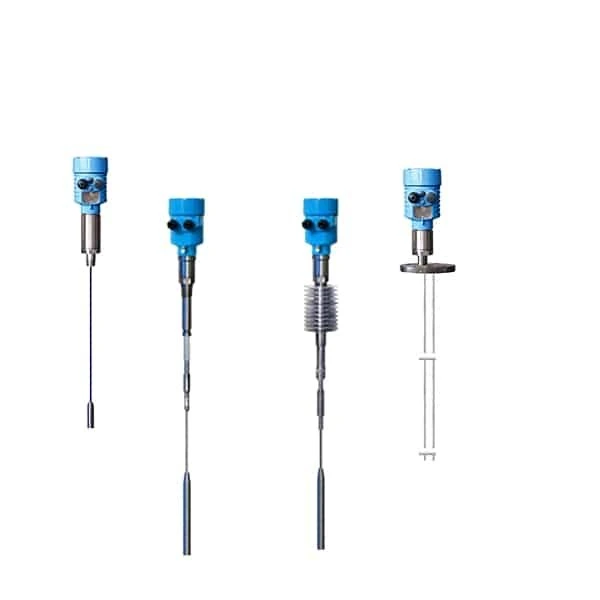 RF Admittance Level Sensor
Capacitance with coating rejection for sticky, dirty, conductive media.
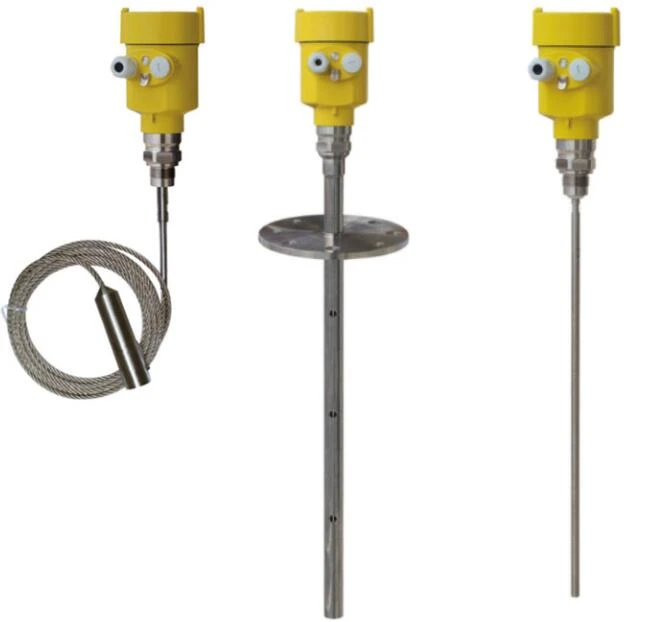 Guided Wave Radar
Contacting radar for varying dielectric and interface, unaffected by Dk drift.
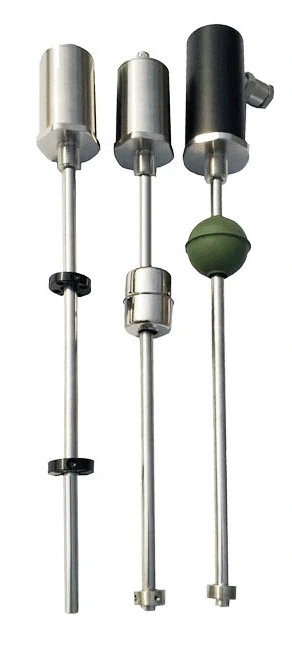 SI-100 Magnetostrictive
Millimeter-class accuracy for clean tanks and custody-grade level.
Browse all level instruments →
Background reading: our guide to capacitive fuel level sensors explains output conventions and why a change of liquid shifts a two-point calibration.
FAQ
How does a capacitance level transmitter work?
The probe and the tank wall form a capacitor, and the medium between them is the dielectric. As the level rises, higher-dielectric liquid replaces air along the probe, capacitance increases, and the transmitter converts that change into a linear 4-20 mA output proportional to level.
What are the disadvantages of a capacitive level sensor?
It depends on a stable dielectric constant, so a medium whose Dk drifts with concentration or temperature can shift the reading. Heavy conductive coating on the probe can fake a high level (use RF admittance there), very low-density powders and large granules read weakly, and the probe needs the right insulation for conductive liquids.
How do you calibrate a capacitance level transmitter?
Calibrate two points in the field. With the tank empty, set the zero so the loop reads 4 mA; with the tank at full scale, set the span so it reads 20 mA. For a low-dielectric medium, raise the sensitivity until the reading is stable. Recheck whenever the medium or its dielectric changes.
Can a capacitance level sensor measure non-conductive liquids?
Yes, with care. Non-conductive liquids such as oils and fuels have a low dielectric and give a weaker signal, so the sensitivity is raised and a suitable probe length is chosen so the reading tracks cleanly across the range.
Request a quote
Tell us the tank, the medium (and whether it is conductive), the range, temperature, and pressure, and our application engineers will confirm whether a capacitance probe fits or whether RF admittance, guided wave radar, or another method is the better call, then configure one model for the application.