Flow Meters › Variable Area Flow Meters › Metal Tube Rotameter
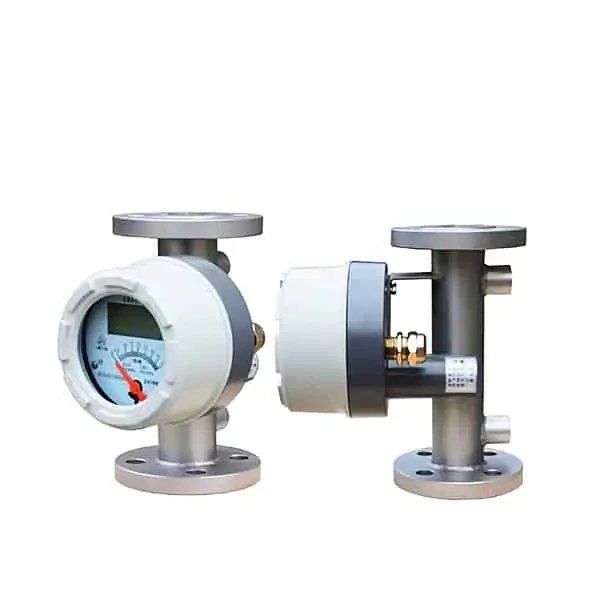
Metal Tube Rotameter
A variable area flow meter in a stainless body. A float rides in a tapered tube and a magnet drives a dial pointer, so it reads flow on the spot with no power and no glass. It suits liquid and gas, opaque and corrosive media, and higher pressure and temperature than a glass tube.
- Principle: Variable area, float in a tapered tube
- Size: DN15 to DN150
- Accuracy: 1.5 or 2.5 grade
- Range: medium to 200 C, to 4.0 MPa
- Output: local dial; optional 4-20 mA; IP65
Overview
A metal tube rotameter is a variable area flow meter. Flow enters the bottom of a tapered tube and lifts a float; as the float rises the gap around it widens, the drag falls, and the float settles where lift balances its weight. That height is proportional to flow. The tube is stainless steel, not glass, so a magnet in the float couples to a follower outside the tube that drives a dial pointer. The reading is mechanical and needs no power, and the meter handles opaque and corrosive media at higher pressure and temperature than a glass tube can.
It is the simple, self-contained choice for local flow indication on a liquid or gas line: low cost, easy to read, and easy to fit. Where you need a signal as well, an optional 4-20 mA transmitter and an alarm contact mount on the same head. For a powered meter with no moving parts on steam, gas, or large lines, see the vortex flow meter; this meter is for straightforward variable area metering and a dial you can read at the pipe.
Features
Everything here follows from one idea: a float in a metal tube, read by a magnet on a dial.
Metal tube, not glass
A stainless tube takes higher pressure and temperature than glass and handles opaque media.
Magnetic dial, no power
A magnet in the float drives a pointer on a dial, so the flow reads locally with no power.
Optional 4-20 mA and alarm
A two-wire 4-20 mA transmitter and an alarm contact add a signal to the same head.
PTFE lining for corrosives
A PTFE or F46 lining lets the meter read acids and other corrosive liquid and gas.
Liquid and gas
One meter reads liquid or gas, from small lab lines up to a DN150 process pipe.
Compact, vertical install
A short flanged body fits a vertical run with flow upward, and reads with no straight-run fuss.
Working principle
Flow enters the bottom of a tapered tube and pushes up on a float. Three forces act on the float: its weight down, and buoyancy and flow drag up. As the float rises in the tapering bore, the open area around it grows, so the flow speed and the drag fall, until the up forces balance the weight and the float holds steady. That equilibrium height moves up and down with the flow rate, so the float position is a direct reading of flow. Because the tube is metal, the position is sensed by a magnet in the float and a follower magnet outside the tube, which turns a pointer on a dial. A transmitter can read the same position and send 4-20 mA.
Technical specifications
| Parameter | Specification |
|---|---|
| Measurement principle | Variable area; float in a tapered metal tube, magnetic dial |
| Medium | Liquid and gas, including opaque and corrosive media |
| Measuring range | Water 2.5 to 150000 L/h; air 0.07 to 2000 m3/h (at 0.101 MPa, 20 C) |
| Size | DN15 to DN150 |
| Accuracy | 1.5 or 2.5 grade (PTFE-lined) |
| Turndown | 10:1 or 20:1 |
| Nominal pressure | DN15 to DN50 to 4.0 MPa; DN65 to DN150 to 1.6 MPa |
| Medium temperature | -30 to 120 C standard; high-temp build to 350 C; PTFE-lined 0 to 80 C |
| Liquid viscosity | DN15 below 5 mPa s; DN25 to DN150 to 250 mPa s |
| Output | Local dial; optional 4-20 mA two-wire with HART (load below 680 ohm); alarm contact |
| Linearity | Below 0.5% |
| Ambient temperature | -25 to 55 C |
| Protection | IP65 |
Representative specifications; confirm per datasheet for the medium, size, and range you need.
Ordering example. Metal tube rotameter for a DN25 water line, 0 to 6 m3/h, dial plus 4-20 mA, 316L body, flange connection.
Metal tube or glass
A rotameter comes in a glass tube or a metal tube, and the choice follows the medium and the line:
- Metal tube (this page). A stainless tube for higher pressure and temperature, opaque and corrosive media, and a magnetic dial that needs no power. It adds an optional 4-20 mA output and a PTFE lining for acids.
- Glass tube. A clear tube for a low-cost visual read on clean, low-pressure liquid or gas, where you can see the float. It is limited in pressure, temperature, and to transparent fluids.
- Powered meters. For higher accuracy, a signal, or steam and large lines, a vortex flow meter or another powered meter fits better than a variable area meter.
Versions and options
The metal tube rotameter is built to order, and a few choices set the version:
- Indicator. A local dial reads with no power (type M1); a remote indicator adds a two-wire 4-20 mA output (M2); and HART versions with display and intrinsically safe or flameproof protection are available (M5, M6, M8, M9).
- Mounting. The standard form mounts vertical with flow upward. Where a line cannot run vertical, a horizontal version with a spring-loaded float reads in a horizontal pipe, and the inlet and outlet can be set bottom-to-top or with side ports to suit the piping.
- Connection. Flange to GB/T 9119 is standard, with a threaded connection for smaller lines.
- Wetted material. 304 (R1), 316 (R0), 316L (RL), titanium (Ti), or a PTFE lining (RP), chosen for the fluid.
- Specialized builds. For a corrosive fluid see the PTFE lined rotameter; for high pressure the high pressure rotameter; for viscous or crystallizing media the jacketed rotameter; and for a hygienic line the sanitary rotameter.
Applications
Metal tube rotameters suit local flow indication on liquid and gas lines:
- Cooling, dosing, and process water on small and medium lines
- Industrial gas: nitrogen, argon, compressed air, and CO2
- Corrosive chemical feed with a PTFE lining
- Boiler feed, additive, and lube oil lines
- Local flow checks where a powered meter is not warranted
Application example
Industrial gas lines. A gas user metered a nitrogen line at about 1000 L/min and an argon line at about 200 L/min with metal tube rotameters on DN15 and DN25, reading flow on the dial at the pipe and showing a running total on the head. A simple, powerless dial at each line suited a job where the crew needed a quick local check rather than a signal back to the control room.
Related products
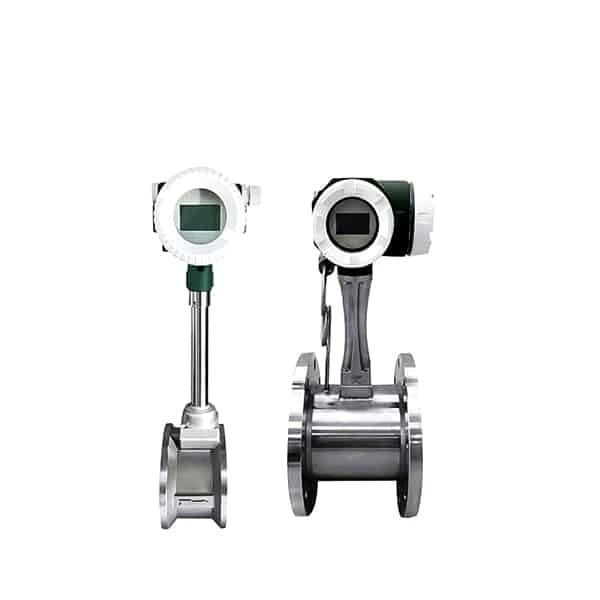 Vortex Flow Meter
Powered, no moving parts, for steam, gas, and liquid.
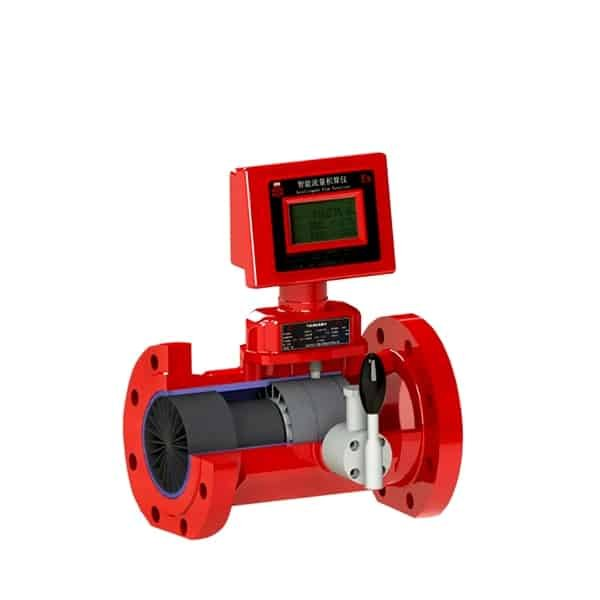 Gas Turbine Flow Meter
Clean dry gas with a tight repeatability and a signal output.
Browse all variable area flow meters →
Why must this meter stand vertical while others merely prefer it? The orientation rules across all meter types are compared in our vertical installation guide.
On gland water headers feeding several pumps, the range follows the seal flush rate for each seal rather than the header size. That sizing step is worked through on the seal water flow meter page.
FAQ
How does a metal tube rotameter work?
Flow lifts a float in a tapered tube to the height where buoyancy and drag balance the float’s weight; that height is proportional to flow. Because the tube is metal, a magnet in the float drives a follower and a dial pointer outside the tube, so the flow reads locally with no power and no glass.
Why must a rotameter be mounted vertically?
The float balances on gravity, so the meter has to stand vertical with flow upward for the reading to hold. A tilt changes the float’s balance and the calibration. Mount it plumb in a vertical run, flow from the bottom up.
What is the difference between a metal tube and a glass tube rotameter?
A metal tube takes higher pressure and temperature, reads opaque and corrosive media, and uses a magnetic dial that needs no power, with an optional 4-20 mA output. A glass tube is a lower-cost visual meter for clean, low-pressure, transparent fluids where you can see the float.
How accurate is a metal tube rotameter?
To 1.5 or 2.5 grade, over a 10:1 turndown. It is a robust local meter rather than a custody instrument; where you need higher accuracy or a precise signal, a powered meter is the better choice.
Request a quote
Send us the medium, the size, the flow range, and the pressure and temperature, and we set the float, the lining, and the output.