By Wu Peng, Senior Process Instrumentation Engineer · Last reviewed October 15, 2026
An ultrasonic level sensor and a radar level sensor both measure from the top of the tank by timing an echo off the surface; what differs is the signal. Ultrasonic uses a sound pulse, so its reading depends on the gas it travels through. Radar uses microwaves, which are far less affected by the gas but need a surface that reflects them.
On a clean, vented water tank, ultrasonic does the job at a lower price. With vapor, pressure, vacuum or wide temperature swings, radar usually holds its reading where ultrasonic drifts, although steam and some vapors set limits of their own. The sections below put numbers on each effect from manufacturer datasheets. For the short answer, go to Choosing by application.
Contents
- Side-by-side comparison
- How each one measures
- Temperature and gas
- Pressure and vacuum
- Foam, dust, condensation
- Beam and blind zone
- Low-dielectric liquids
- Choosing by application
- Our level sensors
- FAQ
Side-by-side comparison
Figures in brackets come from named datasheets and are examples, not limits for every model.
| Point | Ultrasonic | Radar |
|---|---|---|
| Signal | Sound pulse in the kHz range (FMU30: about 50 to 70 kHz) | Microwave, bands from 6 to 120 GHz |
| Gas temp. | Speed of sound shifts about 0.17% per °C; corrected at the sensor only | Negligible at normal pressure |
| Gas mix | CO2, solvent vapor or methane change the speed of sound | Polar vapors such as ammonia or acetone can absorb the signal |
| Pressure | Low pressure only (FMU30: 0.7 to 3 bar abs) | Vacuum to high pressure (FMR62B: −1 to +160 bar) |
| Beam angle | Wide (FMU30: 11°) | Narrow at 80 GHz (3° with an 80 mm antenna) |
| Blind zone | 0.25 m (FMU30) to 1.5 m (ULT-200A, long range) | From 0.05 m (FMW, 80 GHz) |
| Weak point | Vapor, gradients, foam, pressure | Very low dielectric liquids, heavy foam |
| Cost | Lower | Higher, depends on band and antenna |
Sources: Endress+Hauser Prosonic FMU30 and Micropilot FMR62B technical information, VEGAPULS 64 product data, Instranova FMW and ULT-200A datasheets. Confirm values for the exact model.
How each one measures
Both are time-of-flight instruments. The sensor sends a signal down, the surface reflects it, and the transmitter converts the round trip into distance. Level is the tank height minus that distance:
Distance = v × t / 2 Level = H − Distance
For ultrasonic, v is the speed of sound in the gas above the liquid, about 343 m/s in air at 20 °C. For radar, v is the speed of light, and modern 80 GHz units use FMCW: they sweep the frequency and read distance from the frequency difference between the sent and returned wave.
The two differ in v. The speed of light in a gas barely changes, so radar distance is stable. The speed of sound depends on the temperature and the composition of the gas, so an ultrasonic sensor must assume or measure it, and any gap between the assumed and the real value shows up as level error.
Same mounting, different signals. The ultrasonic beam is wider and its speed depends on the vapor layer; the 80 GHz beam is narrow and its speed barely changes.
Temperature and gas
The speed of sound in air rises with temperature: c = 331.3 × √(1 + T/273.15) m/s, which gives 343.22 m/s at 20 °C and 354.94 m/s at 40 °C. That is about 0.17% per °C near room temperature. Industrial ultrasonic transmitters measure temperature and correct for it (the FMU30 uses an NTC thermistor), but that sensor sits in the transducer head. It knows the temperature at the top of the tank, not the average along the path.
Take a 5.000 m (16.4 ft) distance from the transducer to a warm liquid. The head is in the shade and reads 20 °C, while the air column between it and the liquid averages 40 °C:
Indicated distance = 5.000 × 343.22 / 354.94 = 4.835 m
The transmitter reports the surface 165 mm (6.5 in) closer than it is, so level reads 165 mm high, an error of 3.3% of the distance. Sun on the tank roof, a hot liquid, or a heated headspace all create this kind of gradient. Radar has no equivalent error at atmospheric pressure, because the speed of light in air barely changes with temperature.
Gas composition has a larger effect. The speed of sound in carbon dioxide is about 258 m/s at 0 °C, against 331 m/s for air at the same temperature. An ultrasonic sensor set up for air and looking through a pure CO2 headspace would read the distance 28% long. Real headspaces are mixtures, so the error is smaller but shifts as the mixture changes.
| Gas | Speed of sound | At |
|---|---|---|
| Air | 331 m/s | 0 °C |
| Carbon dioxide | 258 m/s | 0 °C |
| Ammonia | 440 m/s | 30 °C |
| Methane | 450 m/s | 27 °C |
| Steam | 477.5 m/s | 100 °C |
| Hydrogen | 1320 m/s | 27 °C |
Atmospheric pressure; values from Engineering ToolBox. Air formula from sengpielaudio.
Endress+Hauser gives a practical screen in the FMU30 documentation: ultrasonic measurement is possible if the vapor pressure at 20 °C is below 50 mbar, and high vapor pressures or outgassing media such as ethanol, acetone and ammonia can influence the accuracy. Treat that as a first check on any solvent or fuel tank.
Pressure and vacuum
Ultrasonic sensors need a gas near atmospheric pressure to carry the sound. The FMU30 is rated 0.7 to 3 bar absolute, and the VEGASON 61 −0.2 to 2 bar. A deep-vacuum vessel or a high-pressure reactor is outside what an ultrasonic sensor is designed for.
Radar covers that range but is not free of pressure effects. Endress+Hauser states that high pressure reduces the speed of the signal in the gas or vapor above the medium, which gives a systematic error that grows with distance. Its FMR62B table lists:
| Gas phase | Pressure | Error |
|---|---|---|
| Air or nitrogen, 20 °C | 10 bar | +0.22% |
| Air or nitrogen, 20 °C | 25 bar | +0.58% |
| Saturated steam, 180 °C | 10 bar | +2.10% |
| Saturated steam, 263 °C | 25 bar | +4.15% |
Endress+Hauser Micropilot FMR62B technical information. A positive value means the measured distance is too large.
In air at 10 bar the effect is small: 0.22% of a 6 m (19.7 ft) distance is about 13 mm (0.5 in). In saturated steam at 180 °C it is 2.10%, about 126 mm (5.0 in) over the same 6 m, so level reads low.
Endress+Hauser’s FMR60 documentation adds that with a known, constant pressure the error can be compensated, for example with a linearization. On a boiler drum or a steam-heated vessel where the pressure moves, consider guided wave radar or a differential pressure (DP) transmitter instead.
Foam, dust, condensation
Foam is hard for both technologies. A soft foam layer absorbs sound, and Endress+Hauser asks users to contact the company about foaming ultrasonic applications. Rosemount lists foam, heavy turbulence and condensation as conditions that can reduce the usable radar range, so a thin foam layer may shorten the usable range without stopping the measurement. A deep, stable foam layer is a case for guided wave radar or a pressure-based measurement, since neither reads the surface from above.
Vapor affects the two signals in different ways. For ultrasonic, the problem is the speed change described above. For radar, Rosemount states that vapor from media with polar molecules may attenuate the reflected signal, especially at elevated pressures, and names ammonia, acetone and vinyl chloride monomer (VCM). Endress+Hauser lists the same kind of absorbing gases for its 80 GHz unit and recommends guided radar for them.
Heavy dust attenuates an ultrasonic pulse. Radar is far less affected: at 80 GHz the radar wavelength is about 3.75 mm, thousands of times larger than the 0.5 to 1.0 micrometer dust particles VEGA cites, so the signal passes a dust cloud with little loss and buildup on the antenna becomes the bigger risk.
Condensation and buildup on the face matter for both. Our FMW radar uses a PTFE lens to resist adhesion and condensation, VEGA states that its software filters out interference from buildup on the antenna, and some ultrasonic sensors offer a self-cleaning option. Endress+Hauser also notes that ice can attenuate radar signals, and it offers ultrasonic sensors with an integral heater for outdoor use in freezing weather.
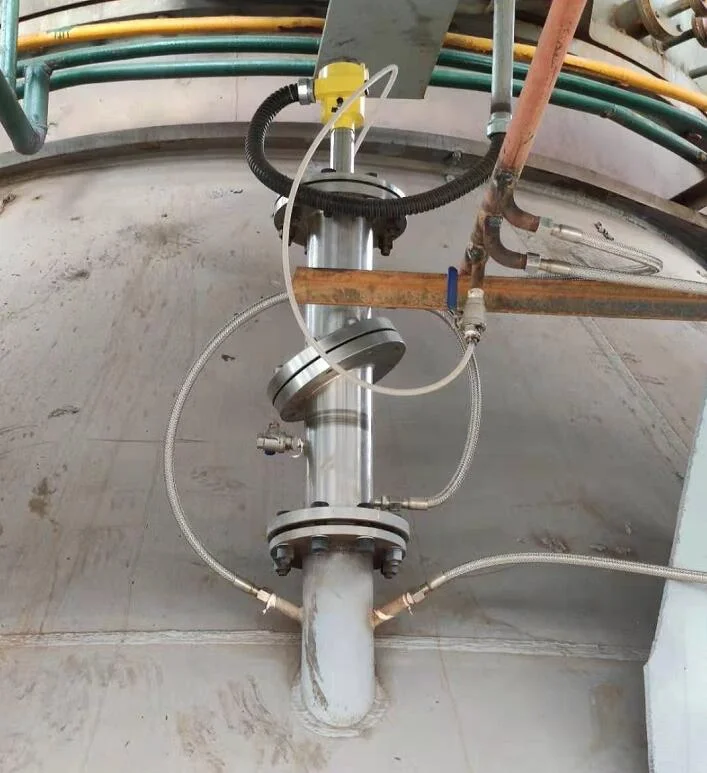
Beam and blind zone
The beam angle sets how much of the tank the sensor sees. The spot diameter at distance d is about 2 × d × tan(θ/2). At 5 m, the 11° beam of the FMU30 ultrasonic sensor covers about 0.96 m (38 in), while the 3° beam of an 80 mm, 80 GHz radar antenna covers about 0.26 m (10 in). In a 2 m vessel with a ladder or agitator, the wide beam can pick up their echoes; the narrow one can pass between them.
Siemens lists 10° for a 3 in horn on its 25 GHz SITRANS LR250, against 3° for an 80 mm antenna at 80 GHz, so within radar the higher band gives a much narrower beam from a similar nozzle.
Radar beam angle is quoted at half power, as Endress+Hauser defines it, so some energy still falls outside it. Keep the sensor away from the wall and out of the fill stream whatever the technology. Where the internals leave no clear path, a stilling well gives the sensor a calm surface inside a pipe, but check that the model is approved for pipe mounting first.
A laser goes narrower still, with a beam under 0.3 degrees, but light has its own limits on clear liquids, dust and foam. Our laser level sensor guide covers where it fits.
The blind zone is the distance under the sensor where it cannot measure. For ultrasonic it comes from the transducer, which keeps vibrating for a moment after each pulse; APG explains that the sensor must ignore signals until that vibration stops.
The FMU30 lists 0.25 m for its 5 m sensor and 0.35 m for its 8 m sensor; our split ultrasonic transmitter runs from 0.3 m to 1.5 m depending on range. An 80 GHz radar can measure from about 0.05 m. On a full tank, that difference sets how high the maximum level can be.
Low-dielectric liquids
Radar needs a surface that reflects microwaves, and the reflection depends on the dielectric constant (εr) of the liquid. Water at about 80 reflects strongly. Fuels such as diesel and gasoline sit around 1.8 to 2.3, and LPG (liquefied petroleum gas) around 1.4 to 1.8, so they return a much weaker echo. Ultrasonic does not depend on εr, so it remains an option for low-dielectric liquids in vented tanks, provided the vapor check above passes.
The limit is model-specific, and the often-quoted value of 1.8 is only a general number. Endress+Hauser rates the 80 GHz FMR62B to εr 1.2 for liquids, with lower values on request. Agitation and foam raise the practical minimum. Our guide to dielectric constant in radar level measurement gives values for common liquids and the fallback options.
Choosing by application
Start with the gas above the liquid, then pressure, then the surface.
| Service | First pick | Why |
|---|---|---|
| Water tank, sump, wet well | Ultrasonic | Air headspace, vented, lower cost |
| Open channel or weir | Ultrasonic | Short range, open air |
| Chemical tank with vapor | 80 GHz radar | Vapor changes the speed of sound |
| Pressure or vacuum vessel | Radar | Outside ultrasonic pressure rating |
| Tall tank or silo | 80 GHz radar | Narrow beam, long range, short blind zone |
| Steam drum, ammonia, acetone | Guided wave radar or DP | Steam error and vapor absorption |
| Deep, stable foam | Guided wave radar or DP | Both top-down signals lose the surface |
| Low-εr oil, vented tank | Ultrasonic or 80 GHz radar | Check vapor pressure and the radar εr rating |
Ultrasonic makers argue for a wider role: Pulsar Measurement states that nearly 95% of applications can be solved with ultrasonic, and keeps radar for cases such as long-range open channel flow, high temperature, acoustic noise, foam and digesters. For the other technologies in these rows, see our overview of level transmitter types or the guided wave radar level transmitter and DP level transmitters.
Our level sensors
We build both. The two units below cover the ultrasonic and radar rows of the table above; the specifications come from our own product datasheets.
| Parameter | Split ultrasonic ULT-200A | 80 GHz radar FMW |
|---|---|---|
| Range | 3 to 30 m by sensor | 0.1 to 150 m by model |
| Blind zone | 0.3 to 1.5 m by range | From 0.05 m |
| Accuracy | ±0.3% of full scale, 1 mm resolution | ±1 mm typical, 1 mm resolution |
| Beam angle | Confirm per sensor | About 3° (76 mm lens) to 8° (32 mm lens) |
| Process | Normal temperature and pressure | −40 to +260 °C, −0.1 to 2.5 MPa by model |
| Output | 4-20 mA, HART, RS485, four relays | 4-20 mA / HART or RS485 / Modbus |
| Enclosure | IP53 controller | IP67 |
Values typical; confirm per datasheet for the selected sensor or antenna.
See the split ultrasonic level transmitter and the 80 GHz radar level transmitter for full data. For a compact one-piece unit there is the ultrasonic level transmitter, and for classified areas the explosion-proof ultrasonic level transmitter. The full lines are in our ultrasonic level sensors and radar level sensors ranges.
Application example
Semiconductor, pure water and chemical applications, India. A long-standing customer with repeat orders asked us to cover water and industrial liquid tanks across several range bands. The selection splits by range: 80 GHz radar transmitters for the 20 to 30 m tanks and ultrasonic transmitters for the 5 to 20 m tanks.
FAQ
What is the difference between an ultrasonic and a radar level sensor?
Ultrasonic times a sound pulse; radar times a microwave signal. The speed of sound changes with gas temperature and composition, and ultrasonic needs a gas near atmospheric pressure, so it suits clean, vented tanks. Radar is far less affected by the gas, works under pressure and vacuum, and has a narrower beam, but costs more and needs a liquid that reflects microwaves.
Do radars use ultrasonic?
No. Radar uses electromagnetic waves in the microwave range, such as 26 or 80 GHz, which travel at the speed of light. Ultrasonic sensors use sound waves above human hearing, in the kHz range for level measurement (about 50 to 70 kHz on the Endress+Hauser FMU30). The two are separate technologies that share only the time-of-flight method.
Request a quote
Send the tank height and the lowest and highest level you must read, the liquid and its vapor, the operating pressure and temperature, the nozzle size, and any agitator or internals. Tell us the application and we configure one unit, not a shelf part. Reach our application engineers or use the form below.
Written and technically reviewed by Wu Peng and the Instranova engineering team.