Home › Products › Level Instruments › Ultrasonic Level Sensors › Split Ultrasonic Level Transmitter
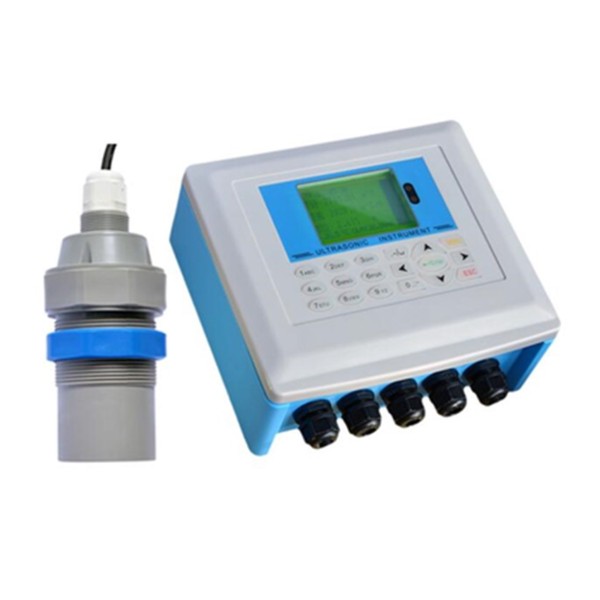
Split Ultrasonic Level Transmitter (ULT-200A)
A split ultrasonic level transmitter puts the sensor on the tank and the LCD controller where you can read it, joined by a cable. It measures level without touching the liquid, covers ranges to 30 m, and drives 4-20 mA, HART, RS485 and up to four relays, so it suits fuel, water, wastewater and chemical tanks.
- Type: split (remote sensor plus controller)
- Range: 3 to 30 m (by sensor); blind zone 0.3 to 1.5 m
- Accuracy: plus or minus 0.3% of full scale; 1 mm resolution
- Output: 4-20 mA, HART, RS485 and four relays
- Measurement: non-contact, no wetted parts
Overview
A split ultrasonic level transmitter measures liquid level by timing an ultrasonic pulse from the sensor down to the surface and back. Nothing touches the liquid, so there are no wetted parts to corrode or foul. The split design separates the sensor, which mounts on the tank top, from the controller, which carries the LCD, 16-key keypad and outputs and can be placed up to 10 m away where an operator can see it.
It covers ranges from 3 m up to 30 m by sensor choice, reads to 1 mm and holds plus or minus 0.3% of full scale. With 4-20 mA, HART, RS485 and four built-in relays it both reports level and switches pumps or alarms, which makes it a practical choice for fuel and diesel tanks, water and wastewater, and open or chemical tanks where a non-contact reading is wanted.
Features
Why engineers pick a split ultrasonic level transmitter:
Non-contact
No wetted parts; the sensor never touches the liquid, so corrosion and fouling are not an issue.
Remote readout
The controller mounts where you can see it, up to 10 m from the sensor on the tank.
Range to 30 m
Sensor options cover 3 m to 30 m, so one family suits small day tanks and tall silos.
Outputs and relays
4-20 mA, HART and RS485 plus four relays report level and switch pumps or alarms.
Clear local display
An LCD and 16-key keypad set the range, units and relays without a laptop.
1 mm resolution
Plus or minus 0.3% of full scale with 1 mm resolution for steady, repeatable readings.
Working principle
The sensor sends an ultrasonic pulse downward and listens for the echo off the liquid surface. The controller measures the round-trip time and, knowing the speed of sound, works out the distance to the surface; level is the tank height minus that distance. Because the speed of sound changes with air temperature, a temperature element compensates the reading.
Close to the sensor there is a blind zone, between 0.3 m and 1.5 m depending on the range, where an echo cannot be resolved, so the sensor is mounted above the highest level by at least the blind distance. Foam, heavy vapor or a turbulent surface can scatter the echo, so the sensor is sited over a calm part of the tank.
Technical specifications
| Parameter | Specification |
|---|---|
| Type | Split-type ultrasonic level transmitter (ULT-200A) |
| Measuring range | 3, 5, 8, 10, 12, 15, 20, 25 or 30 m by sensor |
| Blind zone | 0.3 to 1.5 m (by range) |
| Accuracy / resolution | Plus or minus 0.3% of full scale; 1 mm |
| Display | LCD with 16-key keypad |
| Output | 4-20 mA (standard); 0-20 mA, 1-5 V, 0-5/10 V, RS485, HART; four relays (AC 5 A/250 V, DC 10 A/120 V) |
| Power consumption | Less than 8 W |
| Controller | ABS housing, 240 x 184 x 110 mm; sensor cable to 10 m |
| Sensor thread | G1.5 (3 m), M60 x 2 (5-15 m), M30 x 1.5 (20-30 m) |
| Protection / conditions | IP53; normal temperature and pressure |
Range and sensor selection
Pick the sensor for the tallest level you need to reach plus the blind zone above the highest surface. Short-range sensors (3 m) use a G1.5 thread; mid-range sensors (5 to 15 m) use M60; long-range sensors (20 to 30 m) use M30. The controller is set in the field to the tank height, the units and the relay points, so the same controller works with any sensor in the family.
Output and wiring
The standard signal is 4-20 mA, with 0-20 mA, voltage outputs, RS485 and HART available for a control system. Four relays switch pumps, fill valves or high and low alarms directly from the controller, each rated AC 5 A at 250 V or DC 10 A at 120 V. The controller draws under 8 W and connects to the sensor with a cable up to 10 m long, so it can sit at a walkway or panel rather than at the top of the tank.
Applications
- Diesel, fuel and oil storage tanks with non-contact level
- Water and wastewater tanks, wells and pump stations
- Open channels and sumps where contact sensors clog
- Chemical and effluent tanks needing no wetted parts
- Tall tanks and silos where the readout must sit away from the top
Challenge: An oil-and-gas transfer site needed non-contact level on its storage tanks, with the reading totalized in volume and the display away from the tank top.
Solution: A split ultrasonic transmitter with the sensor on each tank and the controller at a walkway, set to the tank height and scaled to read volume, with relays for high and low alarms.
Result: Non-contact, repeatable level and volume readout with no wetted parts in the fuel and the display where operators could see it.
Related products
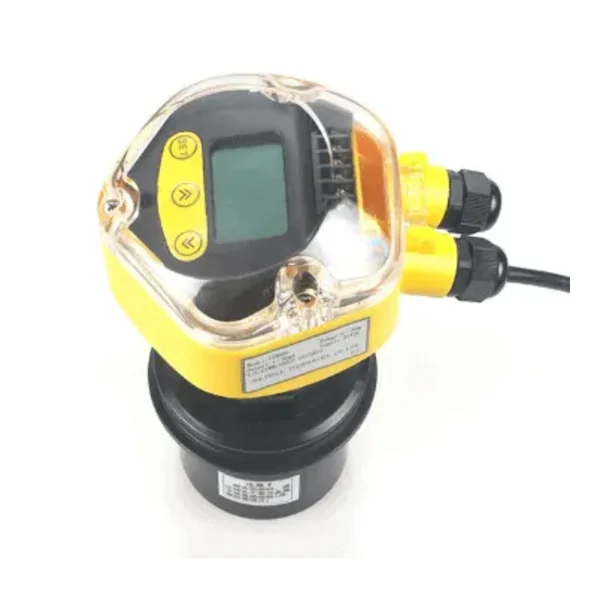 Ultrasonic Level Transmitter
Compact integral ultrasonic transmitter (ULT-100A) for clean liquids and water.
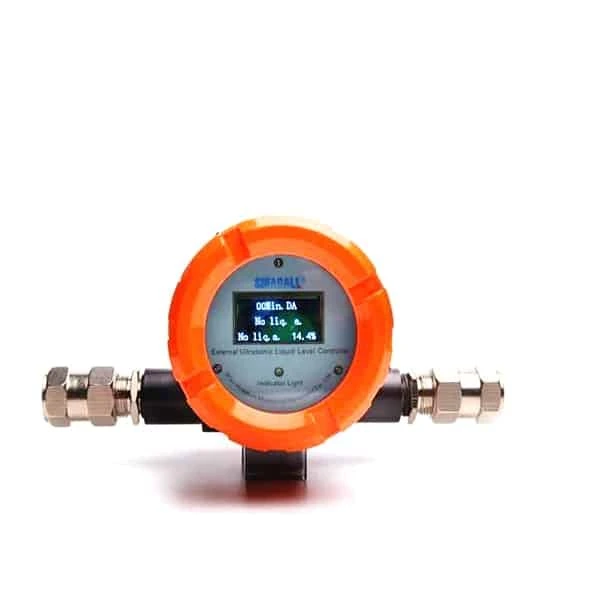 Ultrasonic Level Switch
External, non-contact ultrasonic point switch for high and low alarms.
Browse all ultrasonic level sensors →
FAQ
How does an ultrasonic level detector operate?
The sensor emits a pulse and the controller measures the round-trip time to the surface and back. Level equals the tank height minus the measured distance. A temperature element corrects for the change in the speed of sound with air temperature.
What is an ultrasonic sensor used for?
It is used for non-contact level on fuel, water, wastewater and chemical tanks, in open channels and at pump stations. With four relays it also switches pumps and high or low alarms, and with 4-20 mA, HART or RS485 it feeds a control system.
What are the disadvantages of ultrasonic sensors?
Heavy foam, dense vapor, a turbulent surface or a tank close below the blind zone can weaken or block the echo. Mount the sensor above the highest level by at least the blind distance, over a calm surface; where foam or vapor is heavy a radar sensor is the better choice.
Request a quote
Tell us the tank height, the medium, the readout units and the outputs or relays you need, and we configure one sensor and controller for the application, not a shelf part.