Home › Pressure Switches › Adjustable Pressure Switch PC-400
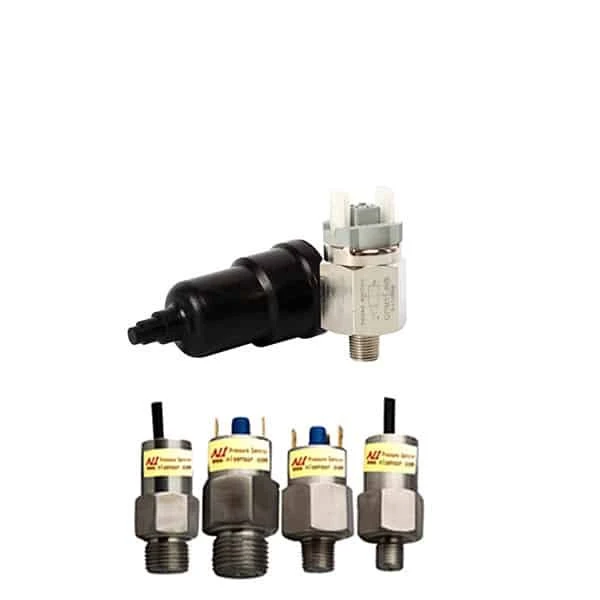
Adjustable Pressure Switch PC-400
A compact mechanical pressure switch with a field-adjustable set point, for low-pressure control. Turn the screw to set the trip point anywhere in its range, so one switch covers a band of jobs instead of a fixed point.
- Adjustment range: -1 to 145 psi
- Action point: -0.5 to 80 psi
- Deadband: ± 3 to 30 psi
- Set point: field-adjustable by screw
- Contact: micro-switch, 220 VAC 6 A
- Life: over 100,000 cycles
A fixed switch is simple, but it ties you to one trip point. The PC-400 lets you set the point in the field with a screw, anywhere across its low-pressure range. That is the difference between stocking five fixed switches and stocking one adjustable one, and it lets an installer dial in the exact cut-in for a pump, fan, or air line on site.
Overview
The PC-400 is the adjustable, low-pressure member of the compact PC switch series. An adjustment screw moves the spring that opposes the pressure, so you set where the contact trips, anywhere in the range up to 145 psi. It keeps the snap-action micro-switch and the over-100,000-cycle life of the family, and is built for control jobs where the set point is decided on site rather than at the order.
For a fixed compact switch the PC-100 is simpler; for higher pressure the stainless PC-300 reaches 2200 psi.
Working principle
Pressure acts on a sensing element against an adjustable range spring. The set point is the pressure at which the element overcomes the spring and trips a snap-action micro-switch. Turning the adjustment screw changes the spring force, which moves the set point up or down. When pressure falls back below the reset point, the switch returns; the gap between the two is the deadband, set between about 3 and 30 psi to stop chatter. No power is needed for the switch itself.
Technical specifications
Representative specifications; confirm the exact build per datasheet.
| Parameter | Specification |
|---|---|
| Output | Switch signal (dry contact) |
| Pressure adjustment range | -1 to 145 psi (about -0.07 to 10 bar) |
| Action point | -0.5 to 80 psi |
| Deadband | ± 3 to 30 psi |
| Set point | Field-adjustable by screw |
| Contact rating | 220 VAC, 50/60 Hz, 6 A |
| Ambient temperature | -40 to +85 °C |
| Medium temperature | -40 to +125 °C |
| Working life | Over 100,000 cycles |
Output and contacts
The PC-400 gives a dry switch contact rated 220 VAC at 6 A, the highest in the compact series, so it switches larger contactor coils and motor loads directly. Order it normally open (A), normally closed (B), or as a changeover (C). After mounting, set the trip point with the adjustment screw and confirm it against a gauge.
Applications
The adjustable low-pressure design suits jobs where the set point is dialed in on site:
- Pump cut-in and cut-out on water and booster systems
- Fan and blower low-pressure control in HVAC
- Low-pressure air and gas lines
- OEM equipment that ships to many different set points
FAQ
What psi should my pressure switch be set at?
Set it for your process rather than a fixed value, which is exactly what the adjustable PC-400 is built for. Pick a trip point below the safe limit of the equipment, leave margin so normal swings do not nuisance-trip it, and set the reset point so the output recovers cleanly. Because the PC-400 is field-adjustable, you can dial the set point in on site and change it later if the process changes, instead of ordering a new fixed switch.
How do you tell if a pressure switch is normally open or closed?
Read it from the wiring and the trip logic: normally open (NO) contacts stay open until pressure reaches the set point, normally closed (NC) stay closed until then. On the PC-400 you choose the action that suits the circuit and set the trip and reset points to match, so the contact changes to the safe state at the pressure you want. Confirm the contact form with a meter while you raise pressure through the set point.
What is a pressure switch used for?
A pressure switch turns a contact on or off when pressure crosses a set point, to start or stop a pump, raise an alarm, or interlock a machine without a separate controller. The adjustable PC-400 suits jobs where the right trip point is not known until the system is running, or where it may need to move: one switch covers a range of set points, so you commission and tune it in place.
Request a quote
Tell us five things and we configure one unit, not a shelf part:
- Set-point band you need to cover and the deadband
- Pressure range and the medium (liquid or gas)
- Contact action (A, B, or C) and what it switches
- Connection (thread or air tube)
- Where the adjustment needs to be accessible
Ordering example: PC-400, adjustable, normally open (A), set around 40 psi cut-in, 220 VAC 6 A contact.
Tell us the application and we configure one unit, not a shelf part. Need a set-point band we have not listed? Reach our application engineers.