Home › Pressure Switches › Miniature Pressure Switch PC-100
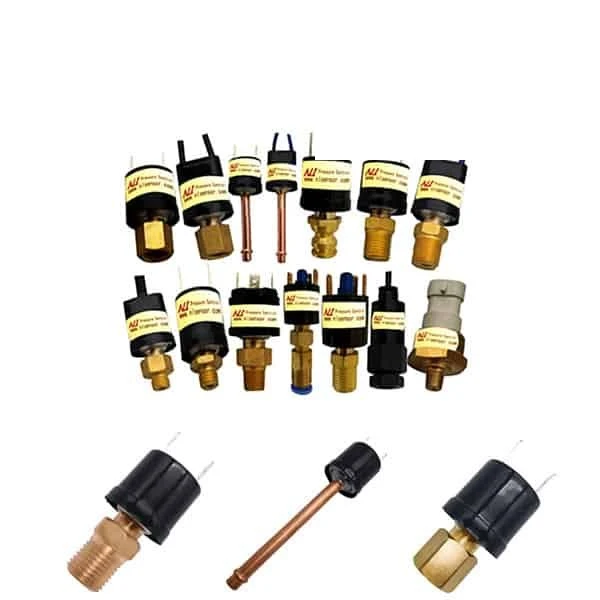
Miniature Pressure Switch PC-100
A compact mechanical pressure switch for OEM equipment. A stainless bellows acts on a snap-action micro-switch, so the contact flips at a set pressure with no power needed. It is small, takes a range of threads, and is rated for over 100,000 cycles.
- Working range: -14.5 to 800 psi
- Reset range: -12 to 780 psi
- Deadband: ± 3 to 30 psi
- Contact: SPST micro-switch, 220 VAC 6 A
- Life: over 100,000 cycles
- Body: stainless bellows, about 22 mm diameter
An OEM pressure switch has to do two things: fit in a tight space and keep switching for the life of the machine. The PC-100 is built for that. The stainless bellows and snap-action micro-switch give a clean make-or-break at the set point, the body is about 22 mm across, and a single design can be ordered with the thread, the electrical exit, and the contact action your build needs.
Overview
The PC-100 is a compact mechanical pressure switch for building into equipment that monitors liquid or gas pressure. It uses an internationally sourced stainless steel bellows with a laser-welded assembly, so the pressure element is sealed and durable. The high and low set points are integrated in one body, which lets a single switch watch both ends of a system. With contacts rated for over 100,000 cycles, it suits compressors, pumps, and machinery that cycle constantly.
It is the smallest of our pressure switch range. Where you need a manual-reset lockout, a stainless body for higher pressure, or an electronic switch with a display, the wider range covers those.
Working principle
Pressure enters the port and acts on a stainless bellows. As pressure rises past the set point, the bellows moves enough to trip a snap-action micro-switch, which changes the state of the contact. When pressure falls back below the reset point, the switch returns. The gap between the trip and reset points is the deadband, set between about 3 and 30 psi, which stops the contact chattering when pressure sits near the set point. No supply is needed for the switch itself; the contact simply makes or breaks the load circuit.
Technical specifications
Representative specifications; confirm the exact build per datasheet.
| Parameter | Specification |
|---|---|
| Output | Switch signal (dry contact) |
| Working pressure range (high set) | -14.5 to 800 psi |
| Reset pressure range (low set) | -12 to 780 psi |
| Working pressure deviation (deadband) | ± 3 to 30 psi |
| Contact rating | 220 VAC, 50/60 Hz, 6 A |
| Ambient temperature | -40 to +85 °C |
| Medium temperature | -40 to +125 °C |
| Working life | Over 100,000 cycles |
| Pressure element | Stainless steel bellows, laser-welded |
| Body size | About 22 mm diameter |
Models and ordering
The PC-100 is ordered by thread or connection, by the electrical exit, and by the contact action: normally closed (A), normally open (B), or a changeover with both (C). Common configurations:
| Model | Connection | Electrical exit | Contact |
|---|---|---|---|
| PC 101 | 7/16-20 UNF internal thread | Terminal | SPST, A or B |
| PC 102 | 7/16-20 UNF internal thread | Direct lead-out | SPST, A or B |
| PC 103 | Phi 6 air tube | Terminal | SPST, A or B |
| PC 104 | Phi 6 air tube | Direct lead-out | SPST, A or B |
| PC 105 | Phi 6 air tube | Terminal | SPST, A or B |
Other threads and connections are available; tell us your port and we match it.
Applications
The PC-100 suits compact OEM pressure control:
- Air compressors and pneumatic equipment
- Water pumps and booster sets
- HVAC and refrigeration equipment
- Hydraulic power packs and small machinery
- Any build that needs a small, long-life trip point on liquid or gas
FAQ
What is a pressure switch used for?
A pressure switch turns a contact on or off when pressure crosses a set point, so it can start a pump, stop a compressor, raise an alarm, or interlock a machine without a separate controller. The PC-100 is a digital version: it shows the live pressure on an LED display and lets you key in the trip points, so one compact unit both monitors and switches.
Does a pressure switch require power?
A mechanical switch needs no power, but the PC-100 is electronic and needs a DC supply to run its display and its switching output. That supply is what gives you the digital readout, push-button set points, and a repeatable, drift-free trip that a spring-and-contact switch cannot hold over time.
What psi should my pressure switch be set at?
Set it for your process, not a fixed number. Pick a trip point below the safe limit of the equipment, with margin so normal fluctuations do not nuisance-trip it, and set the reset (hysteresis) point so the output recovers cleanly. On the PC-100 you enter both values directly on the display, which makes them easy to dial in and to change later if the process changes.
Request a quote
Tell us five things and we configure one unit, not a shelf part:
- Set point (or high and low set points) and the deadband
- Pressure range and the medium (liquid or gas)
- Connection (thread or air tube)
- Electrical exit (terminal or lead-out) and contact action (A, B, or C)
- Load the contact will switch
Ordering example: PC-101, 7/16-20 UNF thread, terminal exit, normally open (B), high set 120 psi, low set 90 psi.
Tell us the application and we configure one unit, not a shelf part. Building something we have not listed? Reach our application engineers.