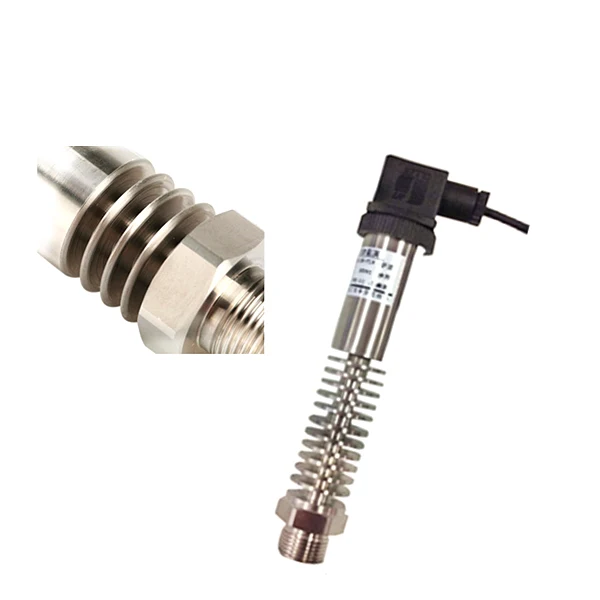
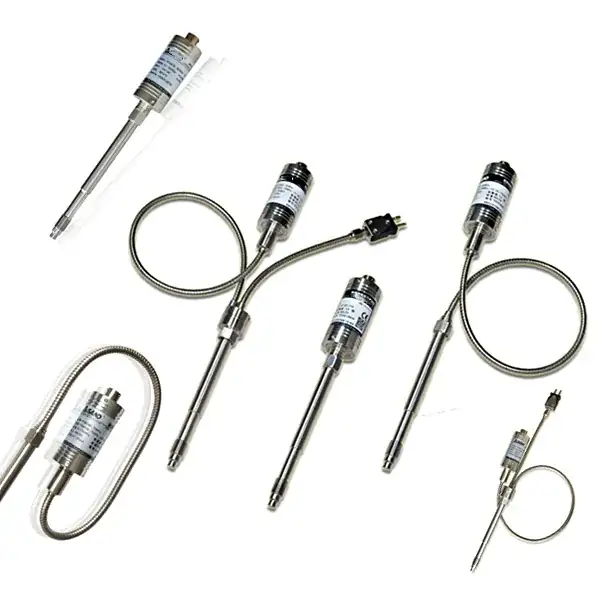
High-temperature pressure transmitter custom-built for the media temperature of your process – 200 °C and 300 °C builds are common, 800 °C media is the maximum – on furnace, exhaust and high-temperature steam lines. The 800 °C top end is reached with a cooled stainless-steel isolation standoff rather than a bare cell. Heat-sink and capillary diaphragm-seal variants cover the steps below it.
- Max process temp: −30 to 350 °C standard; custom builds to 800 °C max
- Range: 1 kPa to 60 MPa selectable (incl. vacuum to −0.1 MPa)
- Output: 4–20 mA
- Diaphragm: 304 stainless steel (weakly corrosive liquids and gases)
- Hazardous area: IP65; intrinsically safe / Ex options on request
Overview
A standard pressure transmitter cooks if you bolt it straight onto a 300 °C line: its electronics top out near 85–150 °C, so hot service needs a way to move the heat away from the sensing cell. High-temperature service does not use a tougher chip; it uses distance and cooling to drop the process heat before it reaches the cell. The SI-512H is built to order for each application – 200 °C and 300 °C versions are common – and accepts media up to 800 °C maximum with a cooled standoff; heat-sink standoffs and condenser tubes handle the lower steps. For the cold end of the scale the same isolation idea runs in reverse on our cryogenic pressure transducers; the full range sits on the pressure instruments page.
Technical specifications
| Parameter | Specification |
|---|---|
| Model | SI-512H high-temperature pressure transmitter |
| Max process temperature | −30 to 350 °C standard; custom builds to 800 °C max |
| Range | 1 kPa to 60 MPa selectable (incl. vacuum to −0.1 MPa) |
| Output | 4–20 mA (2-wire); 0–5 / 1–5 / 0–10 V (3-wire) |
| Accuracy | ±0.25% or ±0.5% FS composite error, including non-linearity, hysteresis and repeatability |
| Diaphragm material | 304 stainless steel (weakly corrosive liquids and gases) |
| Mounting / isolation | Stainless temperature-isolation standoff; heat-sink; condenser tube |
| Process connection | M20×1.5 standard; other threads to order |
| Hazardous area | IP65; intrinsically safe / Ex options on request |
| Ambient temperature | −20 to 85 °C |
| Load resistance | ≤800 Ω (current output); >50 kΩ (voltage output) |
| Insulation | >2,000 MΩ at 100 VDC |
| Long-term stability | 0.1% FS per year |
| Vibration effect | <0.1% FS over 20–1,000 Hz |
| Dimensions | M20 × Ø26.5 × 156 mm |
| Compensated temperature range | 0 to 80 °C (operating range wider; see media temperature) |
| Certification | CE |
Features
Working principle
You match the mounting to the temperature, climbing a ladder of isolation. A direct seal handles about 150 °C; a heat-sink standoff lifts that to roughly 260 °C; a capillary diaphragm seal carries it to about 400 °C, because the fill fluid carries the pressure while the long thin line sheds the heat so the cell sees close to ambient. For the hottest applications the SI-512H reaches up to 800 °C process media with a cooled standoff. The diagram above shows the rung each method covers.
Models and options
| Ordering option | Choices |
|---|---|
| Media temperature | −30 to 350 °C standard; custom builds up to 800 °C max |
| Range | 0–1 / 10 / 400 kPa; −0.1 to 0–1 … 60 MPa, selectable |
| Accuracy | ±0.25% or ±0.5% FS composite error, including non-linearity, hysteresis and repeatability |
| Output | 4–20 mA (2-wire); 0–5 / 1–5 / 0–10 V (3-wire) |
| Power supply | 24 VDC (9–36 VDC) |
| Process connection | M20×1.5 standard; other threads to order |
| Electrical / sealing | Hessmann connector; IP65 |
| Cooling accessories | Heat-sink standoff; condenser (buffer) tube for steam lines |
Applications
- Furnace, exhaust and high-temperature steam pressure measurement.
- Refinery, vapor and tar lines using capillary diaphragm seals.
- Combustion and engine-cylinder pressure on hot gas.
- Hot lines in classified areas needing certified intrinsically safe or explosion-proof builds.
Related products
Quote checklist – send these five points
1) Media temperature at the tapping point 2) Pressure range 3) Output signal 4) Thread or flange 5) Mounting space for the standoff. Our engineers reply with a configured build, datasheet and price.
Ordering example: 0–10 MPa, 300 °C media with heat-sink standoff, 4–20 mA, M20×1.5, Hessmann connector.
Browse all pressure instruments →
FAQ
What does a pressure transmitter do?
A pressure transmitter converts the pressure of a liquid, gas, or vapor into a standard electrical signal, usually 4-20 mA or a digital output, that a PLC or DCS can read. A high-temperature unit does the same job but adds a heat path: a capillary diaphragm seal or a cooling extension keeps the hot process away from the sensing cell, so the SI-512H reports pressure from hot media without the electronics overheating.
What is the difference between a pressure sensor and a pressure transmitter?
A pressure sensor is the raw sensing element and puts out a small, unconditioned signal in millivolts that still needs processing. A pressure transmitter packages that sensor with the electronics that amplify, linearize, and temperature-compensate the signal, then deliver a calibrated 4-20 mA or HART output ready for the control room. On a hot line the on-board temperature compensation matters even more, because it corrects the drift that heat would otherwise add to the reading.
What is the difference between a pressure regulator and a pressure transmitter?
They do opposite jobs. A pressure regulator is a mechanical device that controls pressure and holds it at a set value. A pressure transmitter only measures pressure and reports it; it changes nothing in the process itself. The SI-512H is a measuring instrument: it tells the control system the pressure on a hot line, and a separate valve or regulator acts on that reading.
Request a quote
Tell us the process temperature, medium, pressure range, process connection and area classification. Our engineers reply with a configured high-temperature model, datasheet and price.