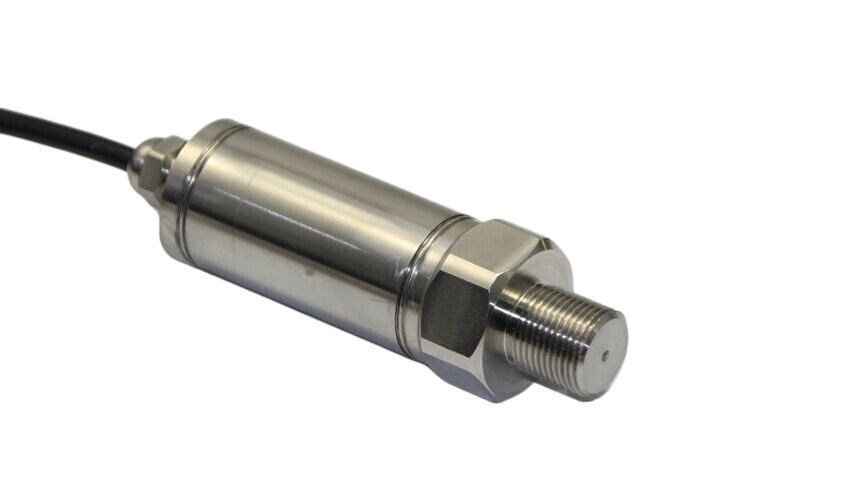
Stainless cryogenic pressure transducer for liquid oxygen, nitrogen, hydrogen and helium, with stable output from −196 °C down to −252 °C. Pressure range, temperature, thread and output are configured per application.
- Temperature: −196 °C / −252 °C (−260 °C special)
- Range: 0–0.2 MPa up to 0–200 MPa
- Output: 0–5 V, 0–10 V, 4–20 mA
- Accuracy: ±0.25 % / ±0.5 % FS
- Body: Stainless steel, IP65 / IP67
- Cert: CE; pressure & temperature customizable
Overview
A cryogenic pressure transducer measures pressure in ultra-low-temperature service where a standard sensor would drift or fail. The stainless body and a specially designed pressure-sensitive diaphragm keep the device stable in liquid oxygen, liquid nitrogen and liquid hydrogen, with a special extended-low-temperature variant for liquid-helium service. Pressure range, operating temperature, mounting thread and output are configured to the line. For the warmer and hotter ends of the range, see the wider pressure instruments page.
Technical specifications
| Parameter | Specification |
|---|---|
| Range | 0–0.2 MPa … 15 MPa … 60 MPa … 200 MPa |
| Pressure type | Absolute, gauge |
| Operating temperature | −196 °C / −252 °C (−420 °F); −260 °C special |
| Signal output | 0–5 V, 0–10 V, 4–20 mA |
| Operating voltage | 5–15 VDC (10 VDC) / 9–36 VDC |
| Accuracy | ±0.25 % FS, ±0.5 % FS |
| Low-temp zero drift | 1–4 % FS (full-temperature zone) |
| Response frequency | >1 kHz or >5 kHz optional |
| Overload | Safe 150 % FS; limit 300 % FS |
| Thread | M3–M12×1 or specified |
| Wetted material | Stainless steel construction |
| Protection | IP65 or IP67 |
| Linearity | 0.1% or 0.2% FS |
| Repeatability | 0.05% FS |
| Zero output | ±5% FS typical |
| Full-scale output (mV builds) | 10, 20 or 100 mV options |
| Accuracy vs temperature | 0.1–0.5% FS at room temperature; 0.5–3% FS across the cryogenic zone |
| Vibration effect | <0.1% FS at 5–1,000 Hz, 2 mm amplitude |
| Humidity | To 95% RH |
| Certification | CE |
Features
Working principle
Process pressure acts on the stainless diaphragm; the sensing element converts the deflection to a stable electrical signal, conditioned to a 4–20 mA or voltage output. The wide-temperature design holds accuracy across the large gradient between the cold wetted surface and the warmer electronics. For tank-pressure service the unit can read the gas (ullage) phase rather than contacting the liquid directly.
Configurable options
The CPT-20SD1 is built to order. Temperature rating (−196 / −252 / −260 °C), pressure range (0–0.2 MPa to 0–200 MPa), pressure type (absolute or gauge), output (0–5 V, 0–10 V or 4–20 mA) and mounting thread (M3–M12 or specified) are all selected for the line. Tell us the application and we configure one unit, not a shelf part.
Applications
- Liquid oxygen, liquid nitrogen and liquid hydrogen pressure measurement; liquid-helium service on the special extended-low-temperature variant.
- Cooling tanks, cryogenic storage tanks and propellant pressure monitoring.
- Cryogenic storage for aerospace, aviation and naval vessels.
- Cryogenic scientific experiments and military cryogenic equipment.
Related products
Quote checklist – send these five points
1) Cryogen (LN2, LOX, LH2, LNG) 2) Lowest temperature at the sensor 3) Pressure range and type 4) Output signal 5) Thread size. Our engineers reply with a configured model, datasheet and price.
Ordering example: LN₂ line at −196 °C, 0–0.2 MPa gauge, 4–20 mA, M12×1 thread.
FAQ
What pressure transmitter for liquid nitrogen?
Liquid nitrogen sits near -196 C, so you need a transmitter built for cryogenic service, not a standard one. The trick is keeping the sensing electronics away from the cold: a cryogenic pressure transducer uses an extended or capillary standoff, so the cell runs near ambient while the diaphragm sees the cold process, which holds the zero stable. For liquid oxygen the same unit must also be oxygen-cleaned, and for liquid hydrogen it must suit the wider temperature swing. A general-purpose transmitter clamped straight onto an LN2 line will drift or freeze.
What is the purpose of a pressure transducer?
A pressure transducer turns pressure into an electrical signal a control system can read. On a cryogenic tank that signal tracks the vapour pressure and the fill pressure, so operators can watch boil-off, control venting, and confirm a safe ullage. The transducer is what makes a cold, sealed vessel observable from the control room without anyone opening it.
What are the three types of pressure transducers?
By reference the three common types are gauge (measured against atmosphere), absolute (against a vacuum), and differential (between two ports). Cryogenic tanks usually use gauge or absolute units, depending on whether you care about the reading relative to local air pressure or to a fixed zero. By sensing technology you will also see strain-gauge, capacitive, and piezoresistive cells; the cryogenic versions add the thermal standoff that keeps any of those working at low temperature.
Request a quote
Tell us the medium, pressure range, temperature, mounting thread and output. Our engineers reply with a configured cryogenic pressure transducer, datasheet and price.